Four Astronauts Return to Earth With Pictures and Stories to Share
Artemis II's four astronauts are one day from splashdown, carrying 50+ gigabytes of lunar imagery and science data gathered during the first crewed moon flyby in more than 50 years.

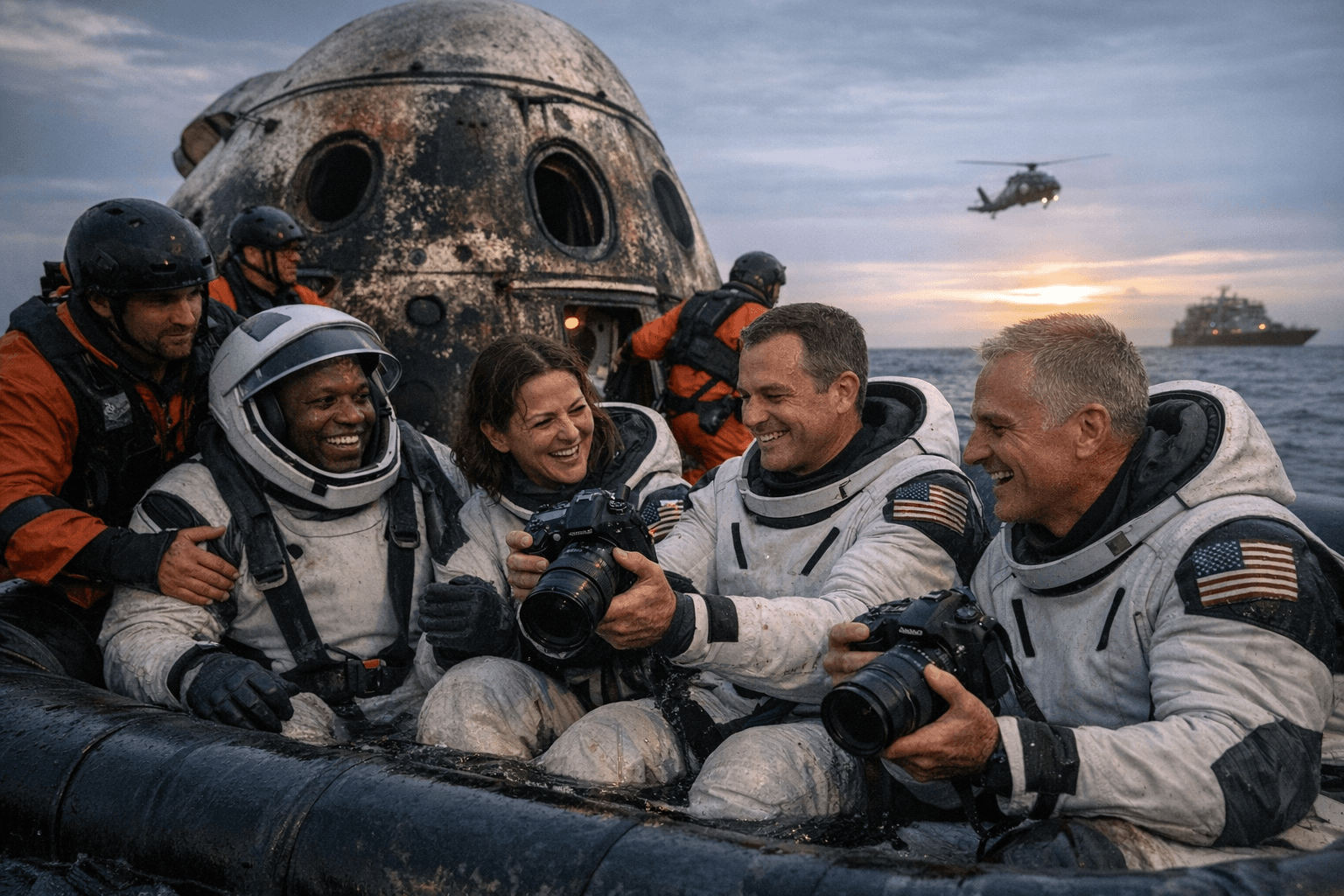
Pilot Victor Glover had one message for the scientists waiting at Johnson Space Center: the crew is coming back with "so many more pictures, so many more stories." With splashdown off San Diego scheduled for April 10 at approximately 8:07 p.m. EDT, commander Reid Wiseman, Glover, mission specialist Christina Koch, and Canadian Space Agency mission specialist Jeremy Hansen spent April 9 closing the final miles of a 10-day round trip that became the farthest human journey in history.
The numbers alone frame the scope of what the Orion capsule is carrying home. After the April 6 lunar flyby, the crew had already beamed back more than 50 gigabytes of imagery and instrument data from a seven-hour observation period above the moon's surface. That archive includes Earthset photographs reminiscent of Apollo 8's 1968 Earthrise shot, detailed imagery of the South Pole-Aitken basin's terminator, and far-side observations captured during a 40-minute communications blackout behind the moon, among the longest such blackouts in human spaceflight history.
For NASA's science teams, the pictures are a starting point, not a conclusion. "While they are inspirational," said Kelsey Young, Mission Control's lead lunar scientist, "there's also a lot of science hidden inside of those images. The conversations and the science lessons learned are just beginning." Geologists will parse surface texture and lighting geometry from the terminator images to sharpen landing-site assessments for future Artemis missions. The radiation instrument readings gathered at 248,655 miles from Earth, the new record distance that eclipsed Apollo 13's 1970 mark, will feed directly into the shielding specifications that engineers must certify before any crew attempts a lunar surface stay.
Glover described the far-side blackout as unexpectedly productive. "I was actually recording scientific observations of the far side of the moon," he said. "That is actually the time when we were the farthest and the closest to the moon, and so we were really able to make some of our most detailed observations." He was less clinical about what the view meant on a human level: "It doesn't change it, it absolutely reaffirms that we live on a fragile planet in the vacuum of space. It's almost like seeing living proof."
The mission was also, by any measure, emotionally charged. As the crew passed closest to the lunar surface at roughly 4,067 miles, Wiseman wept as Hansen radioed Mission Control to propose naming two newly observed craters "Integrity," for the capsule, and "Carroll," for Wiseman's wife, who died of cancer in 2020. The crew then shared maple cookies Hansen had brought from Canada. "That was probably the most critical lunar observations for our geology team," Wiseman said afterward. "But the four of us took a moment."
Recovery crews aboard the USS John P. Murtha departed Naval Base San Diego in advance of the splashdown, with forecasters projecting light winds and moderate seas at the landing site. Orion will enter the atmosphere at around 25,000 mph, survive a fireball reentry, and be slowed to 20 mph by parachute before hitting the water. The engineering data from that descent, including heat shield performance after design changes made following Artemis I's erosion problems, will be as scrutinized as any photograph the crew is bringing back. Artemis II launched April 1 from Kennedy Space Center's pad 39B. It was the first crewed lunar mission since Apollo 17 in 1972.
This article was produced by Prism’s automated news system from verified source data, official records, and press releases, then run through automated quality and moderation checks before publishing. The system is built and supervised by the people who set the standards it runs under. Read our full AI policy.
Did this article answer your question?