Four Corners Will See Total Lunar Eclipse March 3, 2026
Skywatchers in the Four Corners region can see a total lunar eclipse March 3, 2026; it’s the only total lunar eclipse of 2026 and the last until 2028.
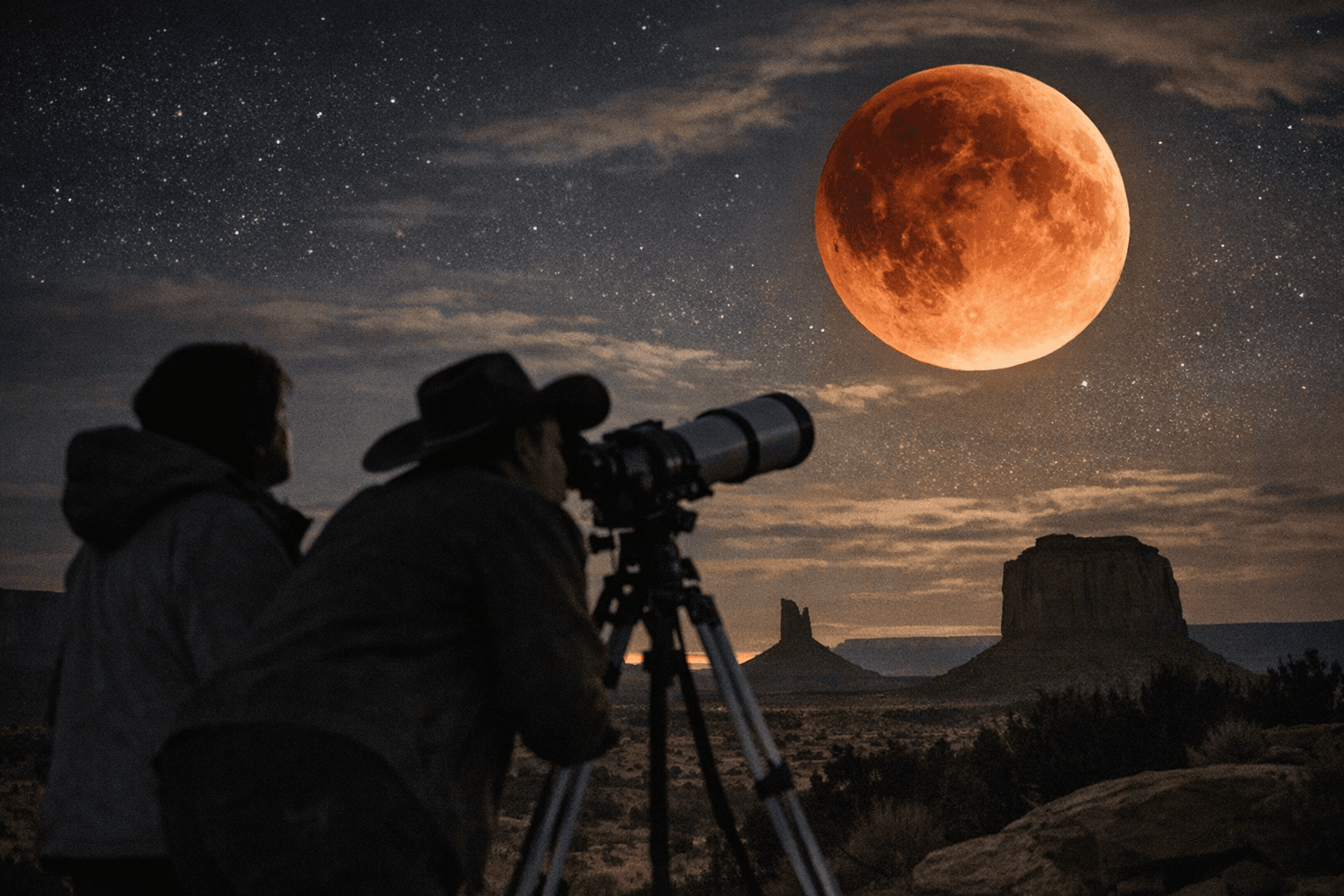
Skywatchers across the Four Corners region will have a front-row seat to a total lunar eclipse on March 3, 2026, KSJD’s Outdoor Report advises, with the event visible locally and favored by western North America and Pacific viewing geometry. Starwalk calls this the only total lunar eclipse of 2026 and notes it will be the last total until 2028, giving the region a rare early-march spectacle to plan for.
Visibility for this eclipse spans broad swaths of the globe: easternmost Asia, eastern Australia, New Zealand, the Pacific and parts of western North America will see the full sequence of penumbral, partial and total phases, while central Asia and much of South America will see only partial phases and Africa and Europe will see none. NASA Goddard’s Scientific Visualization Studio produced an animated map centered on the sublunar longitude 170°37'W that shows the visibility region and contours marking the edge of visibility at eclipse contact times; those contours are labeled in UTC and identify where moonrise or moonset will cut the view short.
Observers near the visibility edges should plan accordingly, because the GSFC map cautions that “Observers near the edge of the visibility region may see only part of the eclipse because for them, the Moon sets (on the eastern or right-hand edge) or rises (on the western or left-hand edge) while the eclipse is happening.” Starwalk notes viewers in eastern Asia and western or central Australia may see the Moon rise already in eclipse, allowing dramatic red-Moon totality over the horizon, while Space and Science NASA characterize the Pacific as the epicentre where the eclipse occurs overhead around midnight (local to that region).
New Zealand provides a concrete timing example: Space lists Wairarapa Dark Sky Reserve with a time of totality from 00:04 to 01:02 NZDT on March 4, 2026, and gives a historical average cloud chance of 64 percent for that site, while noting outdoor lighting is regulated in the valley and most of the reserve is accessible for night-sky viewing. For North America, SLSC points out that the March 3 total eclipse favors the western half of the continent and that North America will also see a deep partial eclipse on August 28, 2026; places like St. Louis are expected to see only roughly half of the March event.
For practical observing, Science NASA lays out the basics: “You can observe a lunar eclipse without any special equipment. All you need is a line of sight to the Moon! For a more dramatic observing experience, seek a dark environment away from bright lights. Binoculars or a telescope can also enhance your view.” Local watchers in the Four Corners should consult NASA SVS’s animated visibility map, the GSFC shadow diagram and Dial-a-Moon outputs to pull UTC contact times and convert them to MST or MDT for chosen viewing sites, and use location tools such as the Sky Tonight app to check exact local visibility.
This March totality also carries calendar weight: it is the first total lunar eclipse visible in the Americas since March 2025 and, according to Starwalk, the only total lunar eclipse of 2026 and the last until 2028. Plan viewing around local contact times, pick a dark site with an open horizon and use the NASA and Starwalk tools to lock down exact local timings for Four Corners communities.
Know something we missed? Have a correction or additional information?
Submit a Tip