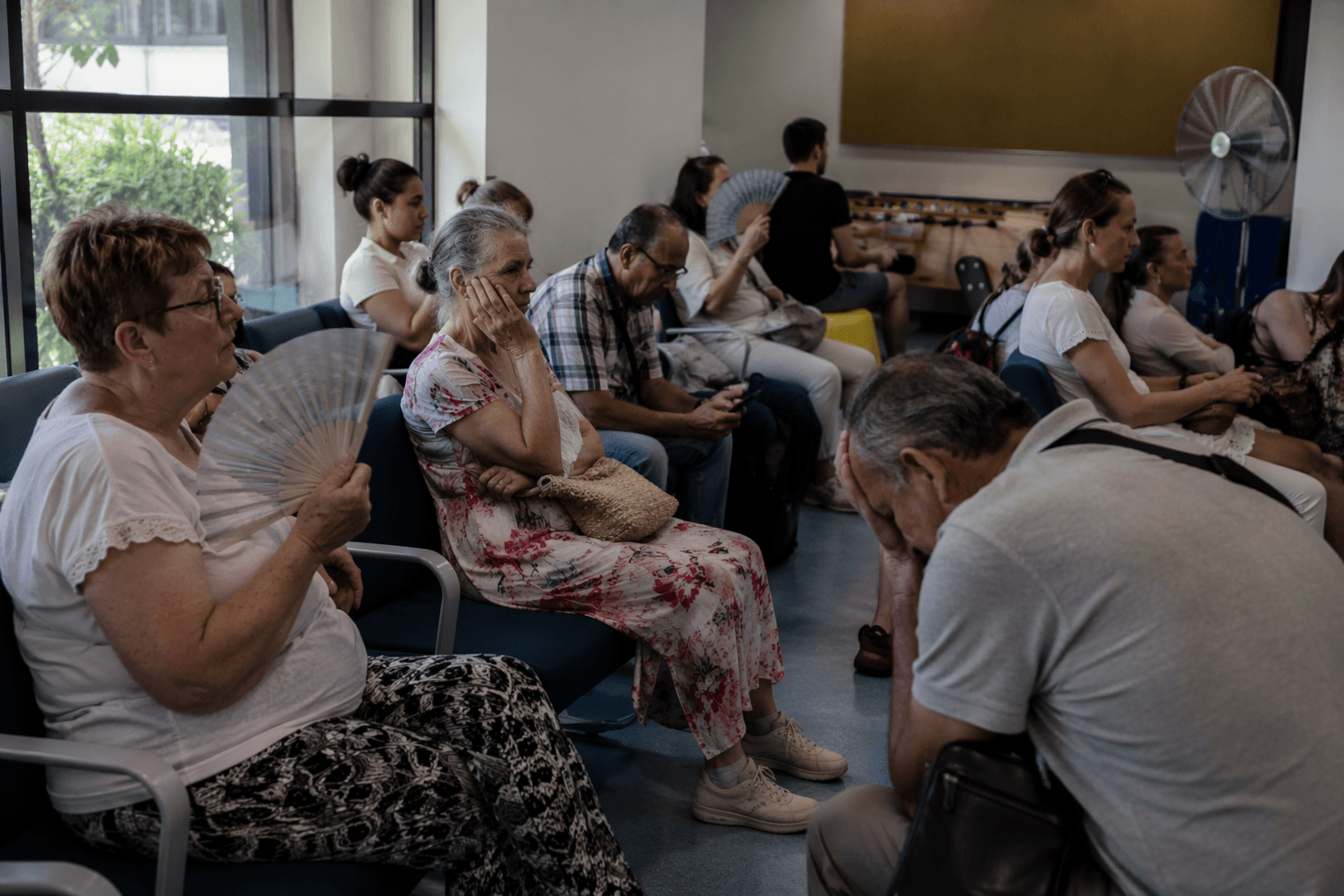
France heatwave turns hospital waiting room into cooling refuge
At a hospital south of Paris, a waiting room with books and table football became prized for one thing: air conditioning during France’s record heat.

A waiting room at Manhes Private Hospital in Fleury-Merogis, just south of Paris, became the most popular room in the building as a punishing heatwave drove temperatures to record levels across France. The space had books, table football and a television, but patients and staff were there for the air conditioning, a small comfort that had turned into a frontline necessity.
That scene landed as France’s heat emergency showed up in the health system. Santé publique France said that on June 22, heat-related emergency care rose sharply, with more than 650 emergency-room visits and 390 consultations with SOS Médecins for heat indicators. The agency said those figures approached or exceeded historic peaks recorded in the summers of 2019 and 2025. President Emmanuel Macron urged the public to “look out for each other,” especially elderly people, children and others who were vulnerable or isolated.
The heatwave has also strained daily life far beyond hospital walls. France 24 said the spell, which swept the country from June 17, led to more than 800 school closures and the cancellation of 10 percent of trains serving the Paris region. RFI said hundreds of schools were still closed on Monday and nearly 2,000 were preparing to send pupils home early, a measure that underscored how quickly extreme temperatures were disrupting public services from classrooms to commuter lines.
Météo-France described the heat as exceptional and comparable to the August 2003 heatwave, the benchmark event that remains one of France’s deadliest. That comparison has sharpened a national debate over how to cool buildings that were designed for a milder climate. Hospitals, schools, factories and homes across France were largely built without the kind of cooling capacity now becoming essential during repeated heat episodes.
The hospital waiting room in Fleury-Merogis captures the policy dilemma in one place. Air conditioning brings immediate relief to patients, older people and staff working long shifts indoors, but it also raises questions about electricity use, emissions and the cost of retrofitting a country’s built environment. With heatwaves becoming more routine, the pressure is no longer abstract. It is showing up in emergency wards, school calendars, railway timetables and in the one room in the hospital where everyone wants to sit.
This article was produced by Prism’s automated news system from verified source data, official records, and press releases, then run through automated quality and moderation checks before publishing. The system is built and supervised by the people who set the standards it runs under. Read our full AI policy.
Know something we missed? Have a correction or additional information?
Submit a Tip