France's heat wave reignites fierce debate over air conditioning
France's scorcher has turned air conditioning into a political fault line, exposing a clash over climate policy, grid strain and who should bear the cost of cooling.

France's heat wave has turned air conditioning into a political fault line. Marine Le Pen called for a "major air conditioning equipment plan" last year, and the latest surge in temperatures has pushed cooling to the center of a fight over climate policy, public health, and who should be protected when cities overheat.
Cooling becomes a political test
What looks like a household appliance has become a proxy for much larger arguments about adaptation. On one side are politicians and commentators who frame air conditioning as a basic necessity in a hotter Europe, especially for older people, workers, and residents in overcrowded housing. On the other are climate and energy voices who warn that making AC the default answer can lock in higher emissions, stronger grid demand, and more waste heat dumped into already hot streets.
That divide is especially sharp in France, where resistance to widespread cooling has long been tied to energy use, environmental concern, and the difficulty of retrofitting older buildings. The current debate is not simply about comfort. It is about whether the state should invest in cooling access as part of public infrastructure, or keep arguing over the causes of extreme heat while families and institutions improvise their own solutions.
The numbers show how far Europe lags
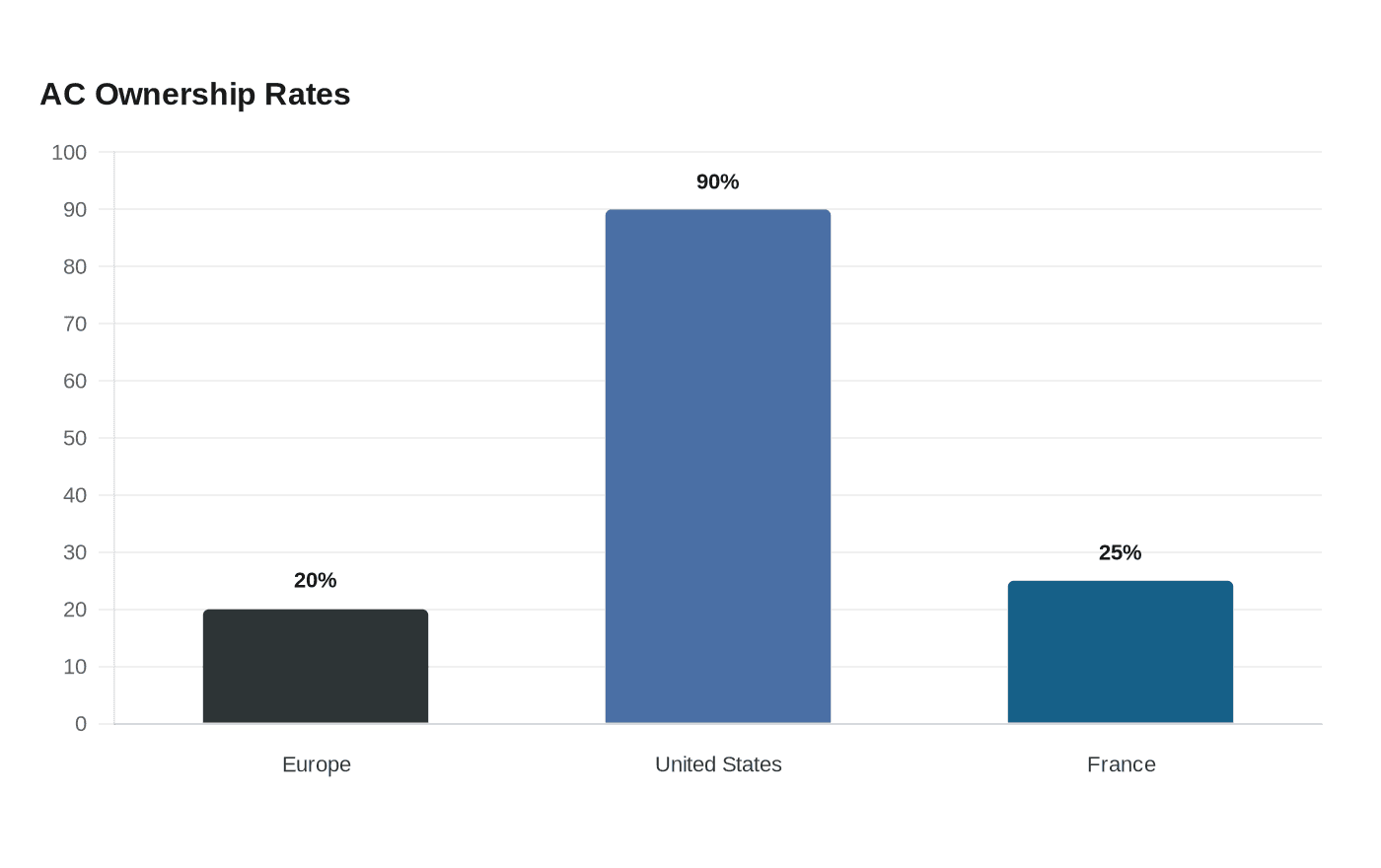
The International Energy Agency says only about 20% of European households have air conditioning, compared with roughly 90% in the United States. In France, reporting this week put the share of homes with an air-con unit at about 25%, underscoring how much of the country still relies on shutters, fans, insulation, and old building habits rather than mechanical cooling.
The long trend is unmistakable. A European Commission BUILD UP summary says AC use in Europe has more than doubled since 1990, rising alongside hotter summers linked to climate change. The IEA says demand for space cooling is increasing globally as temperatures climb, and that using air conditioners and electric fans already accounts for nearly 20% of the total electricity used in buildings worldwide.
That is why the argument has become so charged. For supporters, AC is not a symbol of excess but of adaptation, a tool that protects health and makes homes, offices, hospitals, and transit systems usable during extreme heat. For critics, rapid expansion would deepen dependence on electricity at the very moment governments are trying to cut emissions and stabilize power systems.
Heat has made the cost of delay visible
The latest European heat wave has stripped away any abstraction. France reported around 1,000 additional deaths during last week's record-breaking heat, a toll that shows how quickly extreme temperatures can become a public-health emergency. Across the continent, the same heat has disrupted rail systems, offices, and in some places schools, turning an energy debate into a live test of state capacity.
Those disruptions matter because they expose where adaptation is already failing. Rail networks need workers and equipment that can function at high temperatures, schools need spaces that do not become unsafe by midday, and offices need ventilation systems that can protect employees without driving up power demand. The debate over AC is really a debate over whether governments are preparing those systems for a hotter climate, or leaving each sector to absorb the shock on its own.
What the fight in France reveals about adaptation
Le Pen's push fits a broader pattern among right-wing populists who are willing to champion cooling as a common-sense answer to summer heat. That framing resonates because it speaks directly to daily experience: a sweltering apartment, a sleepless night, a train platform that feels unbearable, a workplace that no longer functions normally. It also forces climate politics into a more immediate register, where abstract emissions goals compete with very concrete demands for relief.
The counterargument is equally concrete. More AC can raise electricity demand, strain grids during heat spikes, and push hot air into streets and courtyards already trapped by urban heat islands. In older buildings, where insulation and ventilation are often poor, cooling can become a stopgap rather than a durable fix, especially if governments do not pair it with building upgrades, shade, better design, and cleaner power.
That is why France's argument matters beyond France. The country is being pulled toward a larger European choice: whether adaptation will mean expanding access to cooling, upgrading the buildings and grids that support it, and treating heat as an infrastructure problem, or whether political leaders will keep postponing that decision until the next record-breaking summer makes it unavoidable again.
This article was produced by Prism’s automated news system from verified source data, official records, and press releases, then run through automated quality and moderation checks before publishing. The system is built and supervised by the people who set the standards it runs under. Read our full AI policy.
Did this article answer your question?