Frank Furness, Civil War hero who reshaped Philadelphia architecture
A Civil War captain who won the Medal of Honor at Trevilian Station, Furness turned battlefield daring into more than 1,000 buildings that still shape Philadelphia.

Frank Furness brought the same aggression to architecture that he had shown in combat. The Philadelphia-born Army captain of the 6th Pennsylvania Cavalry won the Medal of Honor for extraordinary heroism at Trevilian Station, Virginia, on June 12, 1864, and then translated that fearless energy into buildings defined by oversized arches, asymmetrical facades and eccentric ornament.
Born in Philadelphia on November 12, 1839, and dead by June 27, 1912, in Media, Pennsylvania, Furness became one of the city’s most important late-19th-century architects. He is commonly credited with designing more than 600 buildings, while CBS has described his output as about 1,000, a scale that helps explain why his work still dominates conversations about Philadelphia’s architectural identity. By 1889, he had designed more than 300 buildings in Philadelphia alone.
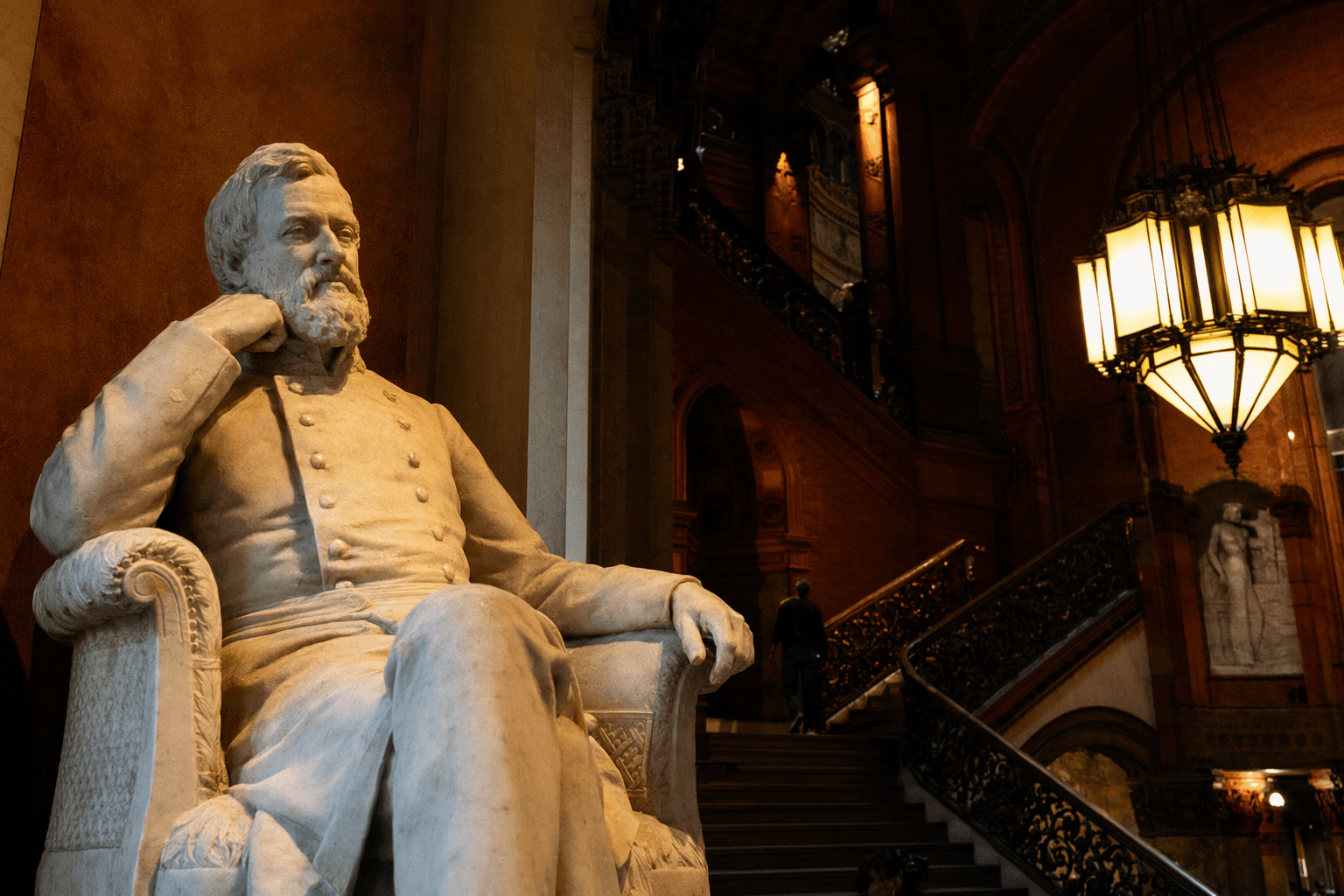
Furness did not simply decorate the city; he challenged the polite Victorian vocabulary that prevailed around him. From 1875 onward, he moved away from European revival styles and toward ideas drawn from the American West and the industrial age, a shift that fit the energy of industrial Philadelphia. His commissions ranged widely: railroad stations for the Pennsylvania Railroad and Baltimore & Ohio Railroad, banks, residences, office buildings, churches, schools, hospitals, factories and warehouses.
That breadth made Furness more than a stylistic outlier. He was a cofounder of the Pennsylvania Institute of Architects in 1869, and his influence reached beyond his own buildings. Louis H. Sullivan worked as a draftsman in 1873 for Furness and Hewitt, later Furness, Evans, & Company, and Furness’s radical approach helped shape Sullivan’s own architectural imagination. Later architects, including Robert Venturi, also looked back to Furness as a source for bolder American design.
The modern reassessment of Furness has been driven in part by Michael J. Lewis, whose book Frank Furness: Architecture and the Violent Mind recast him as a visionary who fused abolitionist, Civil War and industrial-era energies into a new architectural language. That reappraisal matters now because Furness’s work sits at the center of broader arguments about preservation, civic memory and which figures get honored in the built environment.
That debate will be visible again at the Pennsylvania Academy of the Fine Arts on May 21, 2026, where an architecture talk is tied to the reopening and 150th birthday of one of Furness’s landmark buildings. More than a century after his death, Furness remains a test case for how America remembers the people who gave its cities their shape.
This article was produced by Prism’s automated news system from verified source data, official records, and press releases, then run through automated quality and moderation checks before publishing. The system is built and supervised by the people who set the standards it runs under. Read our full AI policy.
Did this article answer your question?