Gaza Ceasefire Plan Advances as UN, Hamas, and Israel Weigh Disarmament Terms
Mediators handed Hamas a written disarmament proposal in Cairo last week, demanding tunnel maps and heavy weapons within 90 days; Hamas called it a "take it or leave it" offer.
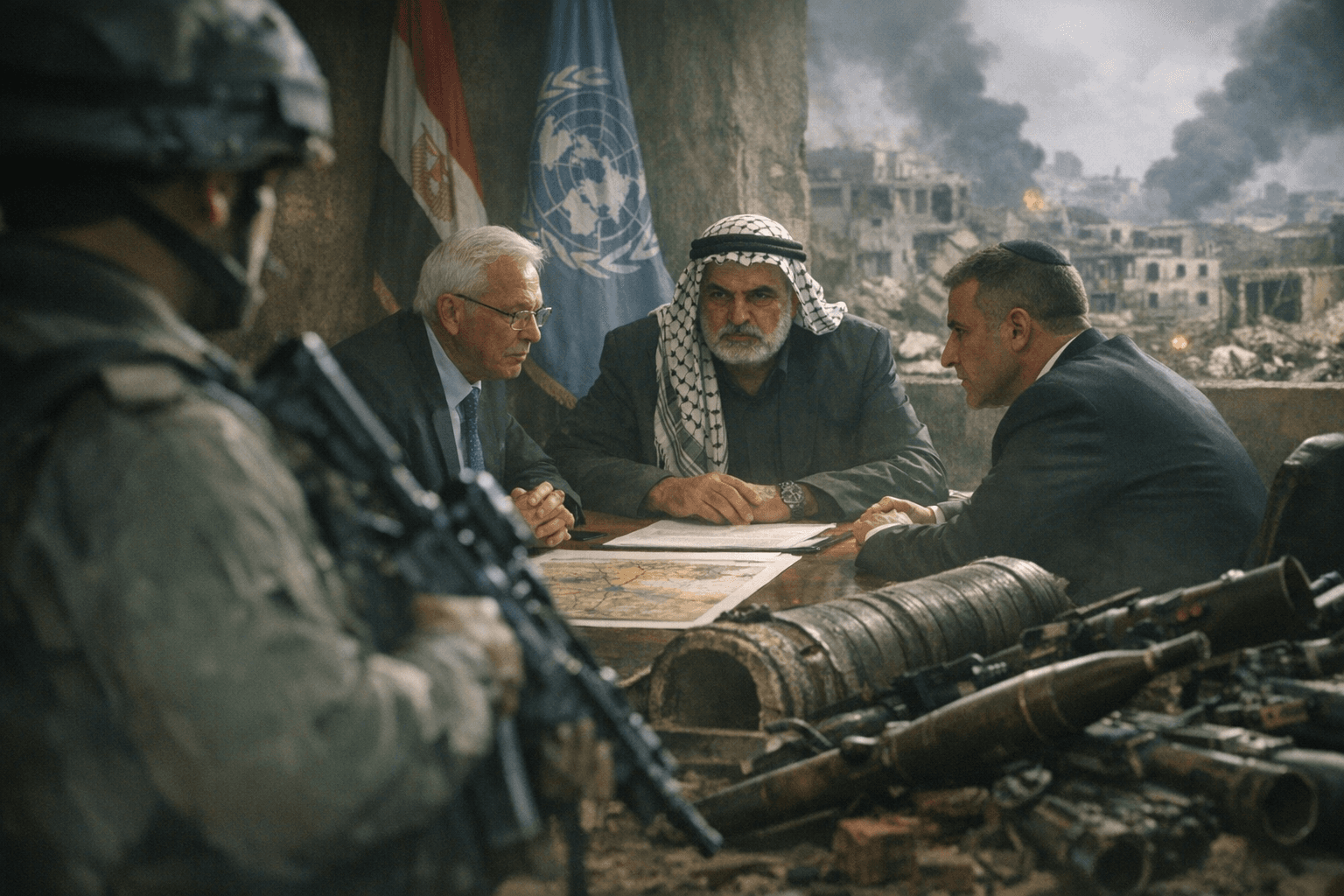
President Trump's Board of Peace presented Hamas with a detailed proposal for how the Palestinian militant group could relinquish its weapons, officials said, a potentially crucial step in securing a lasting ceasefire in the devastated Gaza Strip. Mediators delivered the proposal in Cairo last week; it calls for Hamas and all other armed groups in Gaza to hand over all their weapons and for a new transitional leadership to be solely responsible for all arms in the territory.
The proposal requires Hamas to, within 90 days, hand over its heavy weaponry, including missiles and rocket launchers, along with maps of its tunnel network. A buy-back program would also offer jobs and funds to armed group members who agree to surrender their personal weapons, though that process is expected to take longer than the initial three-month timeline. A source familiar with the plan described the guiding principle as "one weapon and one law under one government, which is the technocratic committee," adding: "The plan is very specific and demands the full handover of weapons without games. Everything, in full."
Board of Peace High Representative Nickolay Mladenov publicly outlined the principles of the disarmament proposal at the U.N. Security Council's monthly session on the Israeli-Palestinian conflict, saying: "It has been presented to the parties, and the engagement on it is very serious." Mladenov characterized verification as the third core principle, asserting that "reconstruction of Gaza is strictly contingent on the decommissioning of weapons." Israeli Prime Minister Benjamin Netanyahu echoed that linkage directly: "There will be no reconstruction of Gaza before the disarmament of Gaza."
A Hamas official, speaking on condition of anonymity, told reporters the group received the written document and criticized it as a "take it or leave it" offer. He said Hamas would first wait to see the outcome of the Iran war before responding. That posture underscored what analysts and Hamas leaders have signaled for months. Hamas's ideology is rooted in armed resistance to Israel, and many of its members view giving up their weapons as tantamount to surrender; analysts said it is unlikely the group would accept the proposal as it stands.
The proposal arrived against a backdrop of deepening complications on the ground. The work of the Board of Peace has been largely put on hold since the U.S. and Israel launched the war against Iran on February 28, triggering a new regional conflict that has engulfed more than a dozen countries. Members of the new Palestinian transitional committee tasked with running postwar Gaza still had not entered the territory, and no new Palestinian police force or multinational stabilization force had been formed.
The NCAG formally began work in Egypt on January 16, 2026, with Ali Shaath as chief commissioner, but its assumption of de facto governance in Gaza has been delayed, with Israel blocking committee members from entering the territory. Donors have been reportedly concerned about committing funds before Hamas is disarmed and uncertain about funding through the Board of Peace rather than the U.N.
Israel estimates that Hamas still retains roughly 60,000 rifles, mostly AK-47s, and 20,000 fighters within its ranks, despite heavy losses from two years of fighting. Israel's representative to the U.N. Security Council stressed that disarmament "does not mean weapons hidden underground while promises are made above ground."
Hamas negotiators have indicated some openness to partial concessions. Privately, Hamas has reportedly shown openness to decommissioning offensive weapons, including missiles, or freezing or storing parts of their arsenal, but Israel will likely reject any offer short of full disarmament. Muhammad Shehada, a Gaza analyst at the European Council on Foreign Relations, argued the phased plan's full terms "would be promptly rejected by Hamas," suggesting the more realistic outcome would be Hamas "freezing, locking up and decommissioning its offensive weapons (eg rockets), while retaining light weapons to protect themselves against clans and gangs or should the IDF resume military operations," with any retained arms subject to a strict "no use, no public display" rule enforced by NCAG police.
Under the framework, all other stages of the 20-point plan hinge on Hamas's disarmament: reconstruction will not begin until it is clear Hamas is surrendering weapons in earnest, and the international stabilization force, to which several Muslim countries have expressed willingness to contribute troops, will not begin operating until that handover is evident.
Hamas was expected to respond to the proposal as soon as the week following Eid al-Fitr, the Muslim holiday that ended Sunday. Mladenov warned at the Security Council session: "If this process fails, if the current status quo is allowed to become permanent, the consequences will be devastating.
This article was produced by Prism’s automated news system from verified source data, official records, and press releases, then run through automated quality and moderation checks before publishing. The system is built and supervised by the people who set the standards it runs under. Read our full AI policy.
Did this article answer your question?