Gemval February 2026 Charts Publish Per-Carat Prices for Birthstones
Gemval's February 2026 charts publish per-carat retail price tables for dozens of gemstones and list ruby valuation entries such as Ruby Valuation Report #133730 (7.35ct, Burma, heated).
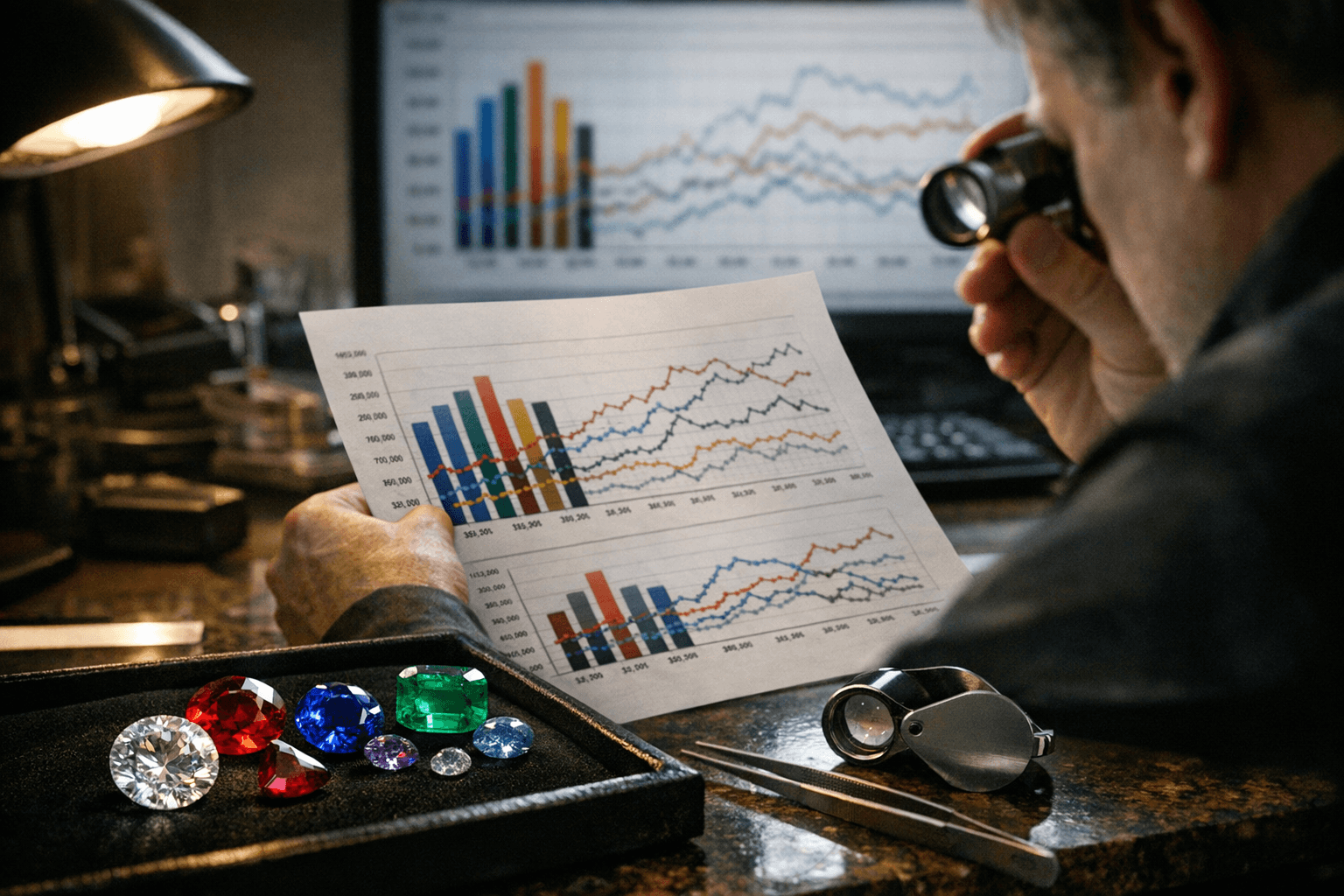
Gemval's February 2026 market-value charts "publish per-carat retail price tables and distribution charts for dozens of gemstones — diamond, ruby, sapphire, emerald and many semi-precious stones." The extract provided alongside the charts also contains the fragment "The dataset allows shoppers, retailers and content teams to be" but the sentence is cut off in the material supplied here, leaving the final clause incomplete.
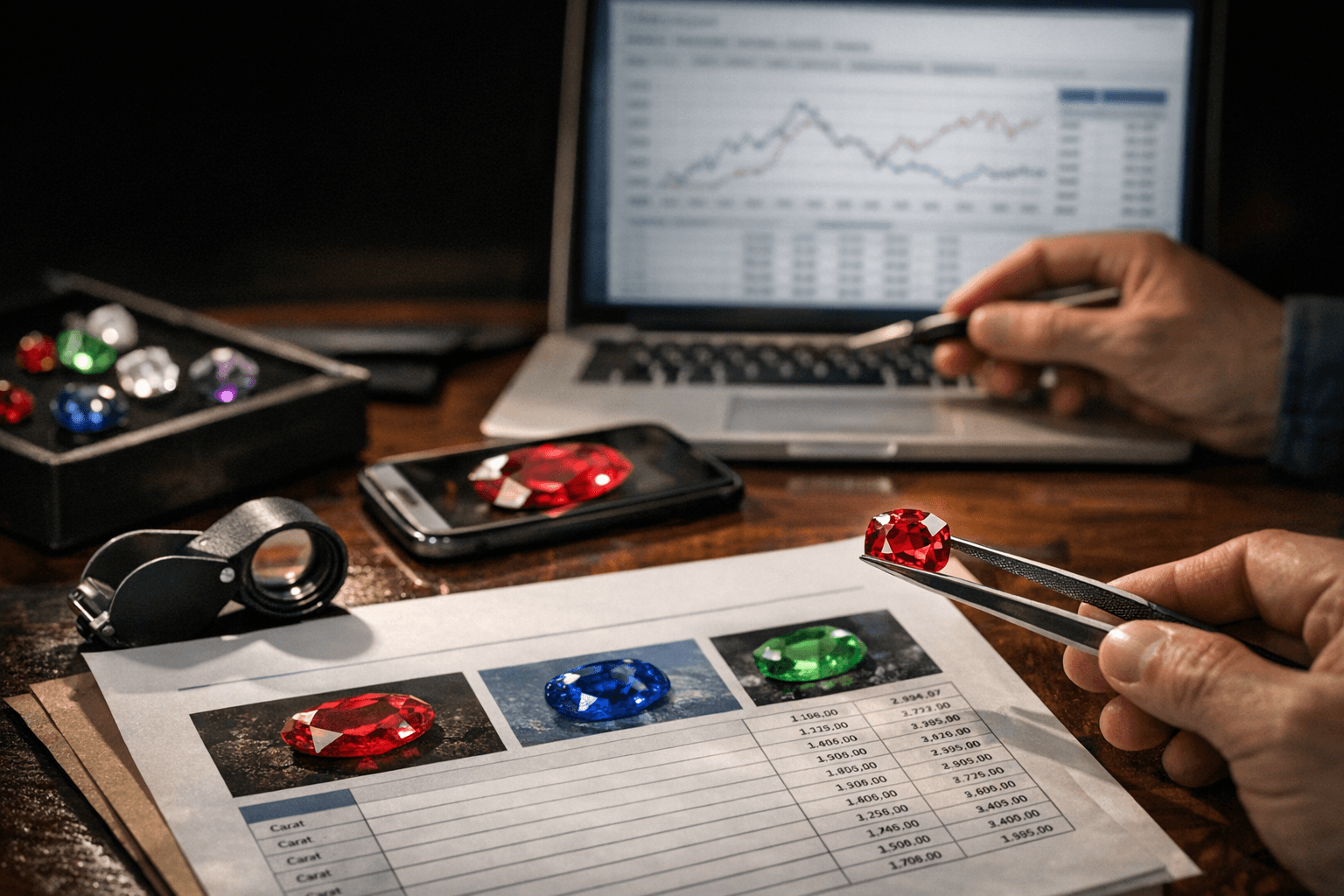
The Gemval extract is unusually granular on rubies: it lists discrete valuation entries with report numbers, carat weights, color codes and origin/heat notation. Examples include "Ruby Valuation Report #133730 (7.35ct, color: 220 - medium slightly purplish Red; strong (Burma, heated))", "Ruby Valuation Report #132346 (5.85ct, color: 220 - medium slightly purplish Red; strong (Burma, heated))", and "Ruby Valuation Report #96061 (1.86ct, color: 220 - medium slightly purplish Red; strong (Africa, unheated))". The sample also shows smaller examples such as "Ruby Valuation Report #87715 (0.60ct, color: 008 - medium Red; very slightly brownish (Burma, unheated))" and multiple entries at around 1.88ct: "Ruby Valuation Report #96069 (1.88ct, color: 220 - medium slightly purplish Red; strong (Africa, heated))" and "Ruby Valuation Report #100501 (1.88ct, color: 220 - medium slightly purplish Red; strong (Africa, unheated))".
Gemval's descriptive text in the extract reiterates classic ruby valuation rules: "Ruby's value is dependent on its quality, color and carat weight. Big, high-quality specimens can be extremely expensive - their price can go up to several thousand USD per carat. Large, transparent rubies are particularly rare. Synthetic rubies also exist, and are sometimes used as a substitute for naturally occurring gemstones; of course, natural ruby's price is much higher, compared to synthetic versions." The extract also preserves notes on optical effects and provenance: "Some rubies that have inclusions display a quality called asterism when polished, where a star-like reflection of light can be observed. Clear, transparent rubies that display asterism are very highly valued." Gemval lists producing countries including Thailand, Myanmar, Madagascar, Sri Lanka, Vietnam and India.
Market-data services that intersect with Gemval's charts include Diamond Labs and The Rare Gemstone Company. Diamond Labs offers an "Interactive Lab Diamond Price Chart | Diamond Labs" and the snapshot in the supplied materials shows a last updated timestamp: "Last Updated: 21 February 2026 at 4:45". Diamond Labs documents its methodology in the UI: "Note: Prices shown are based on our retail price averages. Price snapshots and averages are calculated daily." It adds that "Our pricing algorithm excludes extreme variations and historical data older than 2 years to provide the most relevant market indicators" and cautions that "All prices are indicative only and not guaranteed. Prices shown are per carat." The interactive interface displays carat selectors such as "Carat Range 1.0 - 2.5 ct" and selectable values "0.5ct 1ct 1.5ct 2ct 2.5ct 3ct 3.5ct 4ct 4.5ct 5ct 5.5ct".
The Rare Gemstone Company contributes a 2026 tanzanite per-carat chart with explicit grade bands and adjustment rules. It begins with the caveat "The chart assumes good cutting and proportions and VVS clarity." The table lists ranges such as "0.00 - 1.99 carats | $600 - $700 | $425-$480 | $300 | $200 | $100" for Investment Grade through B Grade, and higher bands for larger stones including "10 carats plus | $800 - $1500 | $580 - $590 | $400 | $300 | $190". Adjustment rules are explicit: "Fine Cutting - Add 5% to 15%", "Poor/Native Cutting - Deduct 15% to 30%", and "Clarity Adjustments VS Clarity - Deduct 5% - 8% SI Clarity - Deduct 15% to 20%". The Rare Gemstone Company also supplies a historical narrative: "From 2002 to 2007 prices surged. From lows of $200 per carat for medium to medium/fine goods they rose to the heady heights of $600+ per carat before dropping back by 20-30% in the ravages of the recession in 2008/2009."

Methodologies differ across the three sources in the materials supplied here. Diamond Labs documents daily calculation and an algorithmic exclusion of data older than two years; The Rare Gemstone Company anchors its tanzanite bands to assumed VVS clarity and prescribes percentage adjustments for cutting and clarity; Gemval's extract demonstrates specific ruby valuation reports but does not include numeric per-carat tables or a published methodology in the material supplied here. Verify per-carat numbers in Gemval's full February 2026 charts and in Diamond Labs snapshots before using these figures to price, insure or trade birthstone pieces, because the published caveats state that "All prices are indicative only and not guaranteed. Prices shown are per carat.
Know something we missed? Have a correction or additional information?
Submit a Tip