Germany rejects Putin's Schroeder peace talks proposal on Ukraine
Berlin said Putin’s choice of Gerhard Schroeder exposed Moscow’s trust deficit, as officials called the outreach another bogus bid to split the West.
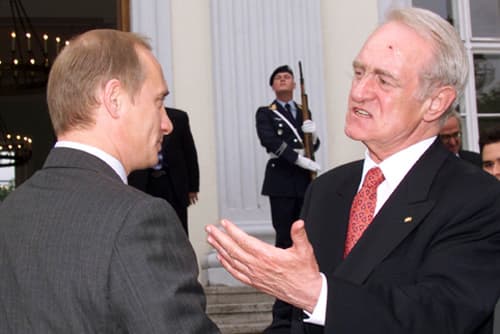
Germany brushed aside Vladimir Putin’s suggestion that Gerhard Schroeder could help coordinate peace talks with the European Union on Ukraine, saying the Kremlin had not shown any real willingness to negotiate. The rejection was blunt: Berlin said Putin’s offer was not credible because Russia had not changed its conditions for ending the war, and a German official said the first test would be whether Moscow extended the three-day ceasefire then in place.
Putin floated Schroeder after Victory Day celebrations in Moscow and said he would “personally” prefer the former German chancellor as a mediator. That choice was no accident. Schroeder, now 82, led Germany from 1998 to 2005 and has long been controversial for his friendship with Putin and his role in Russian energy projects. He approved the first Nord Stream pipeline before leaving office in 2005, then joined the board of the venture behind Nord Stream 2 in 2016. The pipeline never went ahead because of Russia’s full-scale invasion of Ukraine in 2022.
Berlin’s answer made clear it did not want to legitimize Schroeder as a shortcut around the harder diplomatic work. German officials said any discussion involving the European Union would have to be closely coordinated with member states and with Ukraine itself, not shaped by a Kremlin proposal delivered through a figure with deep ties to Russia. One German official described Putin’s comments as part of “a series of bogus offers” aimed at dividing the Western alliance.
Schroeder’s office declined to comment after he was named as a possible mediator. His political standing in Germany remains toxic, especially inside his own Social Democratic Party. Michael Roth and other SPD politicians have argued that any broker must be acceptable to Ukraine and cannot be seen as “Putin’s buddy.”
The wider European context also mattered. European Council President António Costa had recently said there was “potential” for the EU to negotiate with Russia and discuss Europe’s future security architecture, which helped explain why Putin singled out an EU-facing channel at this moment. But Germany’s response showed how narrow that opening remains. Even when Moscow talks about peace, European governments are weighing whether the offer signals movement or simply another attempt to buy time, split allies, and soften pressure without changing the war on the ground.
This article was produced by Prism’s automated news system from verified source data, official records, and press releases, then run through automated quality and moderation checks before publishing. The system is built and supervised by the people who set the standards it runs under. Read our full AI policy.
Did this article answer your question?