Germany’s air show opens under shadow of war and defense rifts
Berlin’s air show opened with more than 750 exhibitors, but the collapse of Europe’s €100 billion FCAS fighter project dominated the hangars.
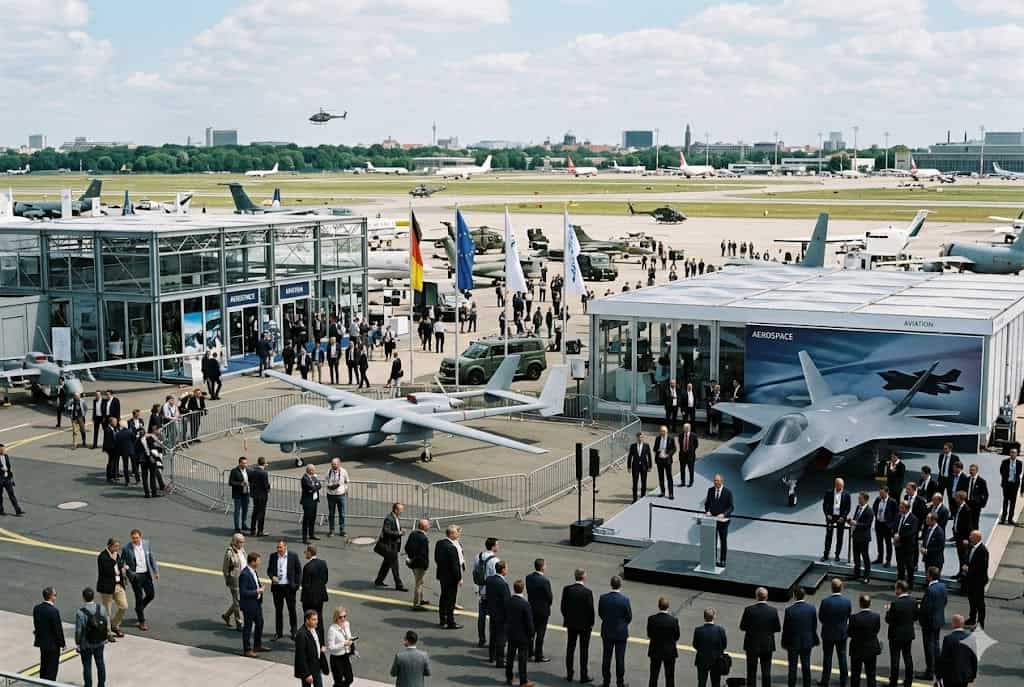
Europe’s biggest aerospace gathering opened in Berlin with a warning attached: the continent wants faster rearmament, but its most ambitious fighter project had just broken apart. The mood at ILA Berlin was shaped by the war in Iran, rising security anxiety across Europe and the abrupt collapse of the Franco-German Future Combat Air System.
The biennial show ran from June 10 to 14, with trade days from June 10 to 12 and public days on June 13 and 14. ILA said it expected more than 750 exhibitors from 37 countries, more than 100 aircraft on display, three stages and more than 300 speakers, turning Berlin ExpoCenter Airport into a dense marketplace for military and civilian aerospace buyers. The event traces its roots to 1909, when the first international air exhibition in Frankfurt drew 500 exhibitors and 1.5 million visitors.
That history gave the show added weight, but the debate around FCAS dominated the opening. The program, launched in 2017 and expanded when Spain joined in 2019, had been designed to replace France’s Rafale and Germany’s Eurofighter Typhoon around 2040. Reporting around its collapse put the project’s value at about €100 billion, underscoring how much had been lost as Airbus and Dassault Aviation clashed over industrial control.
German Chancellor Friedrich Merz tried to recast the failure as a narrower setback rather than a broader rupture. He said German and French defense ministers would work out a reworked defense data project by July, including a combat cloud meant to connect jets, drones and other sensors such as ground radar. Separate coverage said defense officials were due to meet in mid-July to reset cooperation around smaller projects, a sign that Berlin and Paris are searching for a path forward even as the flagship fighter plan is dead.

Outside the exhibition halls, the geopolitical tension was visible on the streets. Protesters blocked access roads on opening day, forcing hundreds of visitors to walk to the venue, while dozens of police stood by and some demonstrators were carried away. The scene matched the larger contradiction hanging over the show: European leaders warn of greater danger from Russia and pressure from Washington to spend more, yet the continent still struggles to coordinate the kind of industrial cooperation needed to turn that urgency into hardware.
Israel also arrived at the fair with a strong presence. More than a dozen Israeli defense companies were reported to be participating, and the Israel Ministry of Defense led a 15-company delegation. Israel said its defense exports surpassed $19 billion in 2025, another reminder that the market for combat-tested systems is expanding even as Europe’s own procurement system remains slow, fragmented and politically fragile.
This article was produced by Prism’s automated news system from verified source data, official records, and press releases, then run through automated quality and moderation checks before publishing. The system is built and supervised by the people who set the standards it runs under. Read our full AI policy.
Did this article answer your question?