Germany's private sector contracts at fastest pace in 18 months
Germany's private sector sank to an 18-month low in June as services fell to 46.8, deepening doubts about the eurozone's growth engine.
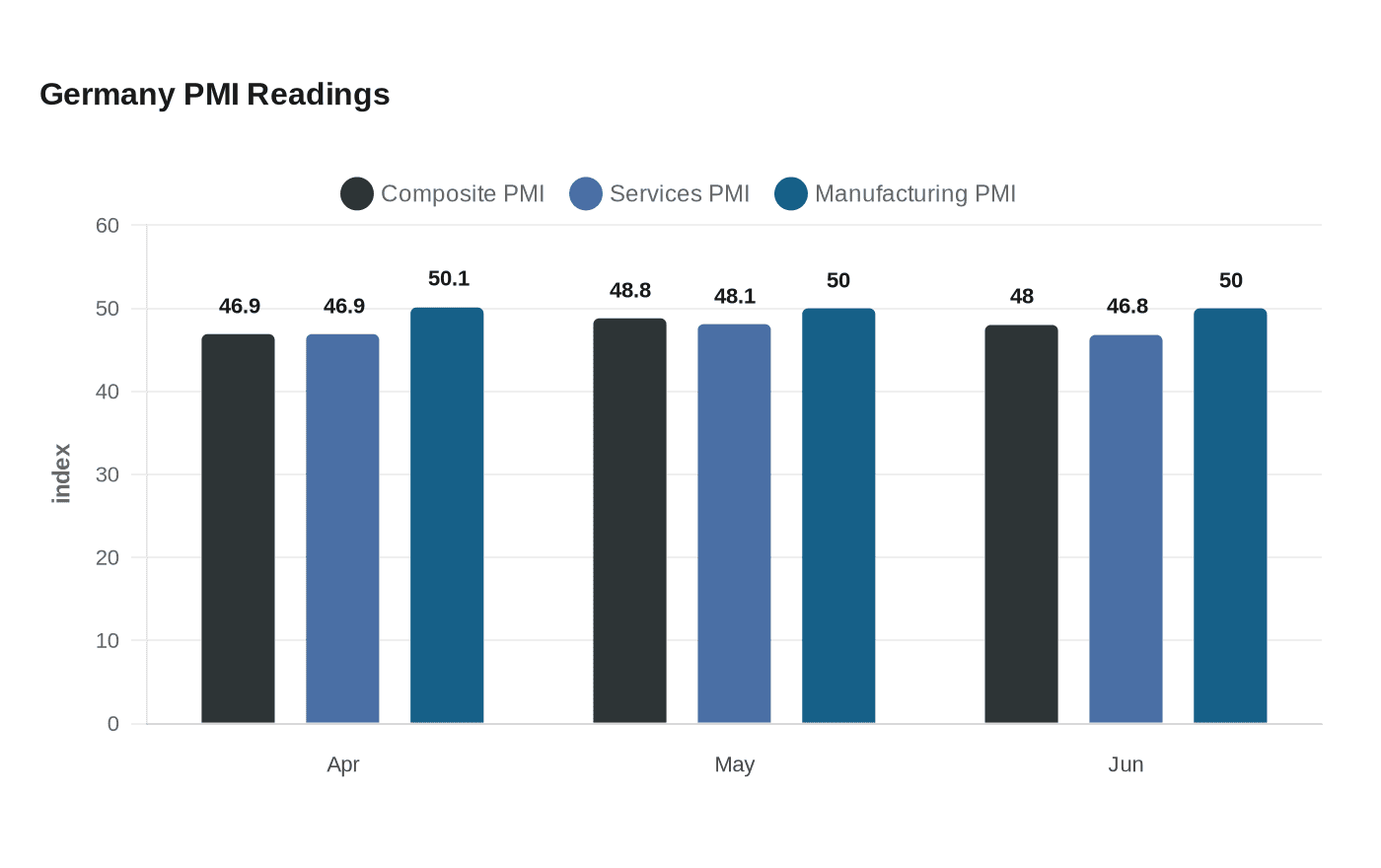
Germany’s private sector shrank at its fastest pace in 18 months in June, a setback driven by a deepening services slump that swamped a flat reading from manufacturing. The flash Composite Purchasing Managers’ Index fell to 48.0 from 48.8 in May, missing expectations of 49.6 and staying below the 50 threshold that separates growth from contraction.
The weakness was concentrated in services, where the flash PMI dropped to 46.8, its lowest level since November 2022. That followed a reading of 46.9 in April and a partial rebound to 48.1 in May, showing that the sector’s recovery attempt quickly lost momentum. Manufacturing was essentially unchanged, with the factory PMI edging down to 50.0 from 50.1, but that stability in industry was not enough to offset the broader pullback in domestic demand.
Phil Smith of S&P Global said business activity had fallen for a third month running and at the quickest rate in that sequence, raising the likelihood that Germany slipped back into contraction in the second quarter. He also said the service sector continued to drag on the economy, with both business activity and new work falling more quickly in June. New business declined for a fourth straight month and at the fastest rate since December 2024, another sign that companies are still seeing scant momentum in demand.
That matters well beyond Germany’s borders. As Europe’s largest economy, Germany sets the tone for exporters, suppliers and investors across the eurozone, and weakness in services is harder to dismiss than another soft factory reading. The PMI survey, published ahead of comparable official economic data, is closely watched as an early signal of hiring, investment and consumer confidence. Germany briefly returned to growth in June 2025, when the composite index reached 50.4, making June’s reversal a sharp reminder of how fragile the recovery has been.
There was at least one small relief for policymakers. Input costs cooled to a four-month low and firms’ output price inflation slowed to its weakest pace in three months, easing pressure on margins. Business expectations for the next 12 months slipped only slightly, but sentiment remained below long-run averages. The wider macro backdrop is still subdued, with the European Commission forecasting 0.6% GDP growth in 2026 and 0.9% in 2027 after just 0.2% growth in 2025, while the ifo Institute expects 0.8% growth in both 2026 and 2027. If services fail to stabilize soon, June may be remembered not as a wobble, but as evidence that Germany’s recovery is running out of road.
This article was produced by Prism’s automated news system from verified source data, official records, and press releases, then run through automated quality and moderation checks before publishing. The system is built and supervised by the people who set the standards it runs under. Read our full AI policy.
Know something we missed? Have a correction or additional information?
Submit a Tip