Global shares mixed as Iran ceasefire optimism fades, U.S. futures fall
Ceasefire hopes lifted stocks briefly, but stalled Iran talks and renewed fighting sent futures lower and kept oil near $80 a barrel.

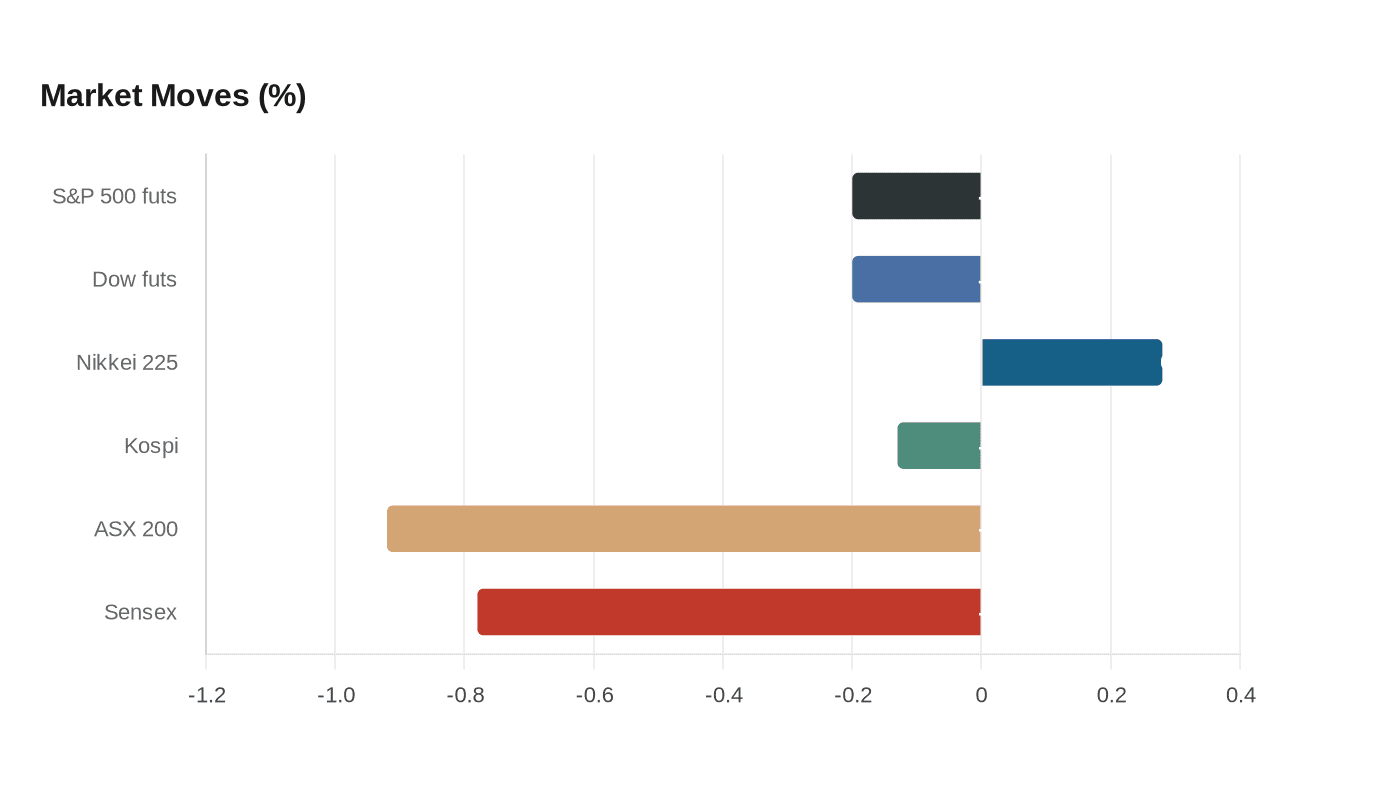
Global markets slipped back into caution as hopes for a U.S.-Iran breakthrough faded and traders refocused on the risk that fighting in the region could disrupt oil flows through the Strait of Hormuz. U.S. futures were lower, with both the S&P 500 and Dow Jones Industrial Average down 0.2%, as investors reacted to postponed Swiss negotiations, fresh reports of strikes in southern Lebanon and continuing heavy fighting from Hezbollah.
The move showed how quickly sentiment can turn when geopolitics, energy prices and central-bank policy collide. A RaboResearch analyst said both sides were trying to show good faith, but the agreement still had “a strong undertow.” That warning matched the market tone: relief from earlier ceasefire optimism gave way to a more defensive posture as traders weighed whether the deal could hold and whether the Strait of Hormuz, a critical route for global oil shipments, would stay open without disruption.

Across Asia, the reaction was uneven but broadly weaker. Japan’s Nikkei 225 ended at 71,250.06, up 0.28%, after earlier touching a record high, while South Korea’s Kospi fell 0.13%, Australia’s S&P/ASX 200 dropped 0.92% and India’s Sensex lost 607.08 points, or 0.78%, to 76,802.90. In Europe, Germany’s DAX edged higher, France’s CAC 40 was nearly flat and Britain’s FTSE 100 slipped. With U.S. stock and bond markets closed for the Juneteenth holiday, overseas exchanges were left to absorb the geopolitical headlines with limited help from Wall Street.
Energy markets remained central to the nervousness. Brent crude traded around $80.58 a barrel and U.S. crude around $77.33, levels that showed traders were still pricing in geopolitical risk even after the first wave of optimism over the peace framework. The oil reaction matters far beyond energy shares: higher crude prices can feed into transportation, consumer goods and inflation expectations, which in turn shape returns in retirement accounts that are heavily exposed to broad equity and bond markets.
The policy backdrop added another layer of sensitivity. The Federal Reserve held its benchmark rate at 3.50% to 3.75% on June 17, while the Bank of Japan raised its policy rate to 1.0% on June 16, the highest in 31 years. Those decisions left global investors navigating a tighter web of rate and currency signals just as the Middle East headlines were moving markets hour by hour. For now, the lesson is blunt: gains built on a ceasefire headline can fade fast when the fighting does not.
This article was produced by Prism’s automated news system from verified source data, official records, and press releases, then run through automated quality and moderation checks before publishing. The system is built and supervised by the people who set the standards it runs under. Read our full AI policy.
Know something we missed? Have a correction or additional information?
Submit a Tip