Goldman Sachs Forecasts China Will Top Global GDP at $57T by 2075
Goldman Sachs projects China will be the world’s largest economy in 2075 at $57.0 trillion, with India at $52.5T and the U.S. at $51.5T.

Goldman Sachs Research forecasts China will top the global GDP table in 2075 with $57.0 trillion, narrowly ahead of India at $52.5 trillion and the United States at $51.5 trillion, a projection laid out in the report by Kevin Daly and Tadas Gedminas. The report is titled "The Path to 2075 - Slower Global Growth, But Convergence Remains Intact" and frames a multi-decade shift in economic weight toward Asia.
The bank’s timetable has China overtaking the U.S. around 2035 and India catching up by about 2075. Goldman Sachs projects China’s share of world GDP will rise from roughly 10 percent today to 15 percent by 2050, before easing to about 13 percent by 2075 as demographic headwinds slow potential growth. The authors write that U.S. potential GDP growth is expected to be materially faster than China’s at the 2075 horizon because of a better demographic outlook.
Goldman Sachs lays out a 2050 snapshot in which the five largest economies measured in U.S. dollars will be China, the U.S., India, Indonesia, and Germany. The report also projects a dramatic reweighting of market capitalizations and GDP shares for emerging markets - EMs’ share of global equity market capitalization is forecast to rise from about 27 percent in 2022 to 35 percent in 2030, 47 percent in 2050, and 55 percent in 2075. The bank adds that India’s market-cap share could climb from a little under 3 percent in 2022 to 8 percent in 2050 and 12 percent in 2075.
Country-level caveats are explicit in the report and related coverage. Goldman forecasts China to average about 4 percent GDP growth from 2024 to 2029 compared with 1.9 percent for the U.S., even as the report flags structural headwinds for China including an aging population, a weak property sector, and tariffs that are cooling growth. The report also highlights India’s drivers - domestic demand, digitalization, infrastructure expansion and a young workforce - as underpinning its rise.
Per-capita income projections in Exhibit 17, cited by Edward Conard, underscore persistent wealth gaps even as aggregate sizes change. Exhibit 17 shows U.S. real GDP per capita rising from $69,000 in 2021 to $132,000 in 2075, versus forecast 2075 per-capita levels of $55,000 for China and $31,000 for India, a split Conard summarizes by noting the U.S. would remain more than twice as rich as China and India.
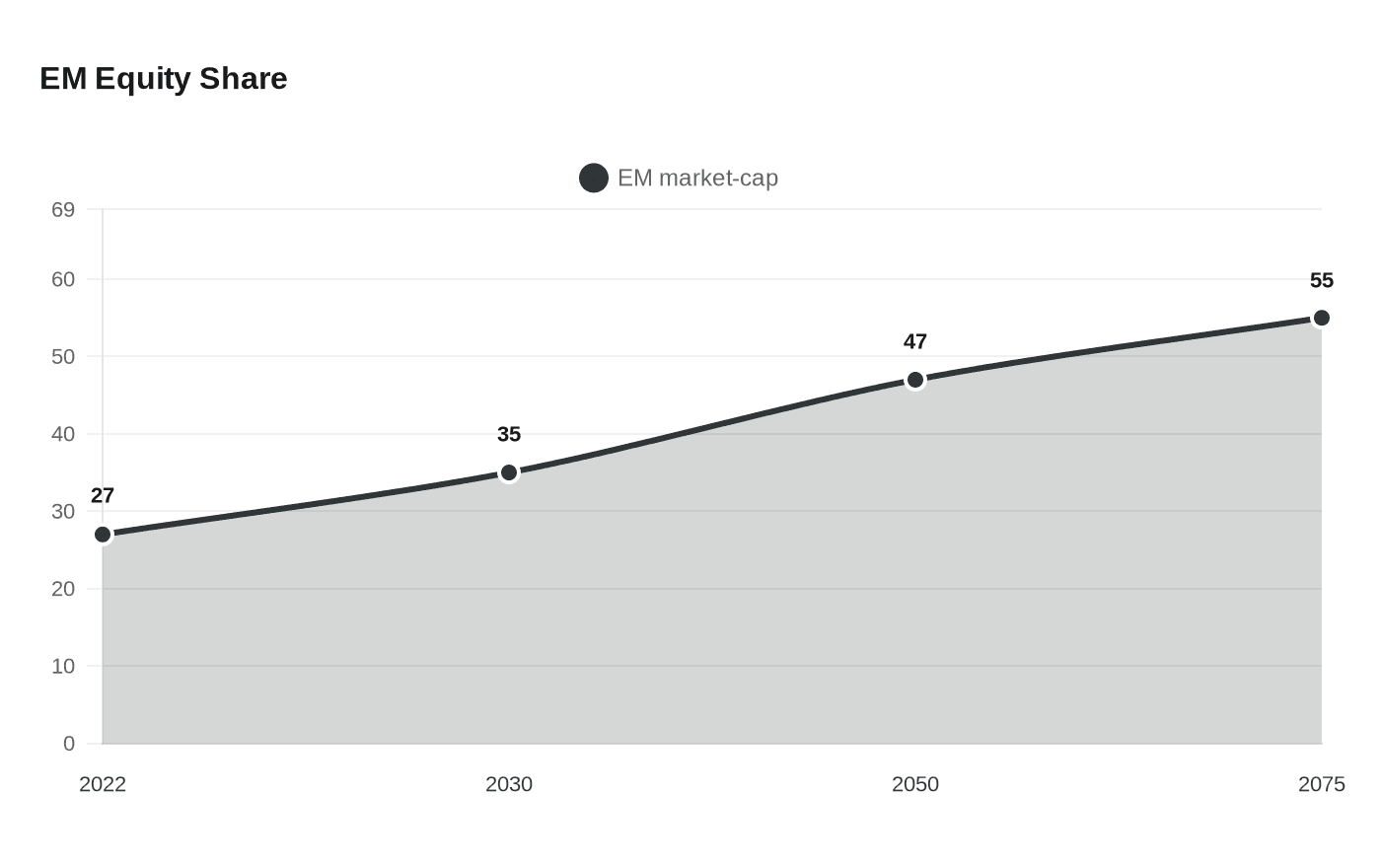
The report situates these long-run projections against recent shocks - disappointing post-Global Financial Crisis productivity, a rise in protectionism, the COVID-19 pandemic and the war in Ukraine - while cautioning that outcomes depend on policies and institutions. Daly and Gedminas write that "one implication of faster-growing market capitalization relative to GDP is that the importance of EM equity is likely to increase significantly," a shift that has direct implications for Goldman Sachs teams covering allocations, client strategy and EM research.
Know something we missed? Have a correction or additional information?
Submit a Tip