Goldman Sachs Says Emerging Markets Outperform S&P 500 in 2026
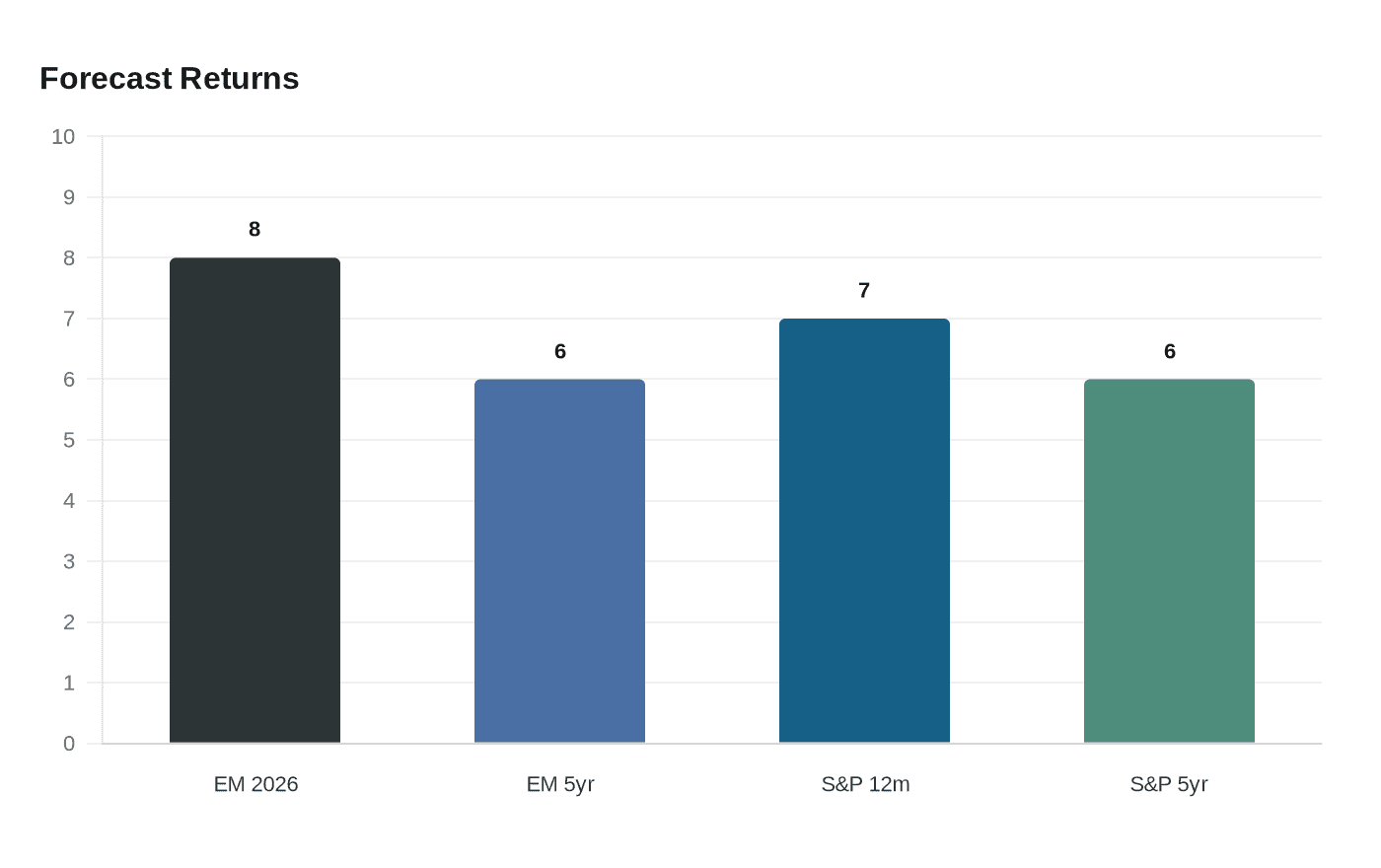
Goldman Sachs says emerging markets are beating the S&P 500 year-to-date in 2026 and forecasts 8% returns for EMs in 2026 versus 7% for the S&P 500 over the next 12 months.

Goldman Sachs is flagging a clear allocation tilt: emerging markets are outperforming the S&P 500 year-to-date in 2026, and the firm’s wealth forecasts put emerging-market equities ahead for returns this year. The firm’s guidance, posted to its corporate LinkedIn account that has 5,696,854 followers, begins with the line, “Emerging markets continue to outperform the S&P 500 in 2026,” and names J. Stratford Dennis as head of emerging market equities trading in Goldman Sachs Global Banking & Markets.
The bank’s forward return forecasts call for 8% for emerging markets in 2026 and a 6% average through 2030, while the S&P 500 is forecast at 7% growth over the next 12 months and 6% average over the next five years. Goldman’s public research team frames these projections within a macro backdrop the firm expects for 2026: global GDP growth of 2.8% versus a 2.5% consensus, US GDP of 2.6% versus a 2.0% consensus, and a base case that includes 50 basis points of Federal Reserve cuts next year.
Goldman’s internal analysts point to Asia as the engine behind recent EM strength. An Am Gs note says, “Asia was the key driver of EM outperformance in 2025, led by South Korea, Taiwan and China as hyperscalers’ capex and semiconductor demand fueled one of the strongest upcycles on record.” The research adds that 24-month forward EPS growth expectations suggest persistence, and that SK Hynix’s order books for next year are already full. The note emphasizes supply-chain facts: “Around 70% of YTD global exports of semiconductors and AI hardware originate from EMs,” and the MSCI EM index’s IT sector weight has risen from about 14% a decade ago to 27% today.
That structural shift underpins Goldman’s positioning and risk advice. The Am Gs piece lists explicit portfolio implications: global equity corrections tend to favor defensive sectors such as Healthcare and high-dividend stocks; European equities may outperform because of lower exposure to the AI theme; and long-dated government bonds and liquid alternatives can reduce overall portfolio drawdown. The analysts also flag a downside scenario labeled “Germany letdown,” where a failure to deliver on infrastructure and defense budgets could drag euro area growth below expectations.
Goldman’s research team expects policy and currency moves to matter for allocations. Their #2026 Outlooks economists expect a weaker US dollar in 2026, three more Bank Rate cuts in the UK taking Bank Rate to 3%, and Japan to expand about 0.8% next year. The group explicitly warns that “sturdy global growth coupled with non-recessionary Fed cuts should be positive for global equities,” while also noting that tensions from “hot valuations” may increase volatility.
The firm’s LinkedIn post drew 171 likes and seven comments. One commenter shown as “阿雷提诺·萨沙 · 未来战略总监 sacha” echoed the bank’s themes in French and English, warning that “Emerging markets outperforming the S&P 500 is a reminder that leadership rotates” and that sustainability depends on liquidity, fiscal discipline and corporate earnings durability. Goldman’s mix of macro forecasts, EM tech and AI supply-chain data, and explicit hedging advice gives a precise roadmap for traders and portfolio managers weighing an overweight in emerging markets for 2026 — while flagging valuation-driven volatility and a specific geopolitical risk in Germany.
Know something we missed? Have a correction or additional information?
Submit a Tip