Google lowers Play Store fees, launches Registered App Stores and expanded billing
Developers get lower Play Store cuts: baseline commission moves toward 20%, subscriptions fall to 10%, program tiers to 15% and a 5% Play Billing charge is introduced, with US/UK/EEA rollout by June 30, 2026.

Sameer Samat posted an Android Developers Blog titled "A new era for choice and openness" on March 4, 2026, laying out three headline moves: expanded billing choice for developers, a Registered App Stores program to certify rival stores, and a reshape of Play Store fees. Google filed the policy proposal in federal court in San Francisco and has asked U.S. District Judge James Donato to review the plan, with Google requesting an April 9 hearing for the revisions.
The clearest money change is the cut to the longstanding 30 percent split. Betanews and Telecompaper report Google will reduce its standard Play Store commission from 30% to 20% for most developers, and Techzine frames the new base service fee at 20% for new installs. Subscription businesses stand to gain the most: Betanews and Techzine both report subscriptions drop to a 10% rate. Google also carved out program incentives: Betanews and Techzine say participants in the Apps Experience program and the revamped Google Play Games Level Up program may qualify for a 15% commission on transactions tied to new installs.
A new billing architecture complicates the math. Techzine reports Developers using Google Play Billing will now pay a market-specific billing rate of 5 percent, in addition to the service fee, while Pymnts and Bloomberg frame that same number as a flat 5% fee for developers who opt into Google’s billing services and note that others will be free to use third-party payment processors. Respawn supplies alternative language, reporting a 5% royalty on Google Play transactions for publishers in the UK, the US, and the EEA and citing a 15% rate for the first $1 million in annual developer revenue and a 10–20% service fee range for e-commerce transactions; those Respawn points are unique in the reporting and should be checked against Google’s policy text.
The Registered App Stores program is explicit about intent: Techzine and Betanews describe it as a registration and certification route so alternative app stores that meet quality and safety standards can be sideloaded via a simplified installation flow, and Pymnts reports Google will share its Play Store catalog with rivals after registration. Betanews says the program will ship alongside a major Android release before the end of the year, with U.S. access arriving after other regions. Because the court must approve the plan, those registration mechanics hinge on Judge Donato’s sign-off.
Rollout timing is specific and phased: Betanews and related reporting list the updated fee structure reaching the European Economic Area, the United Kingdom, and the United States by June 30, 2026, Australia on September 30, 2026, Korea and Japan by December 31, 2026, and a worldwide extension by September 30, 2027. The litigation backdrop matters: Betanews notes Google’s filing in San Francisco, Judge Donato previously ordered a far more extensive overhaul in October 2024, and Pymnts/Bloomberg reported Donato called an earlier settlement a "sweetheart deal" during a January hearing.
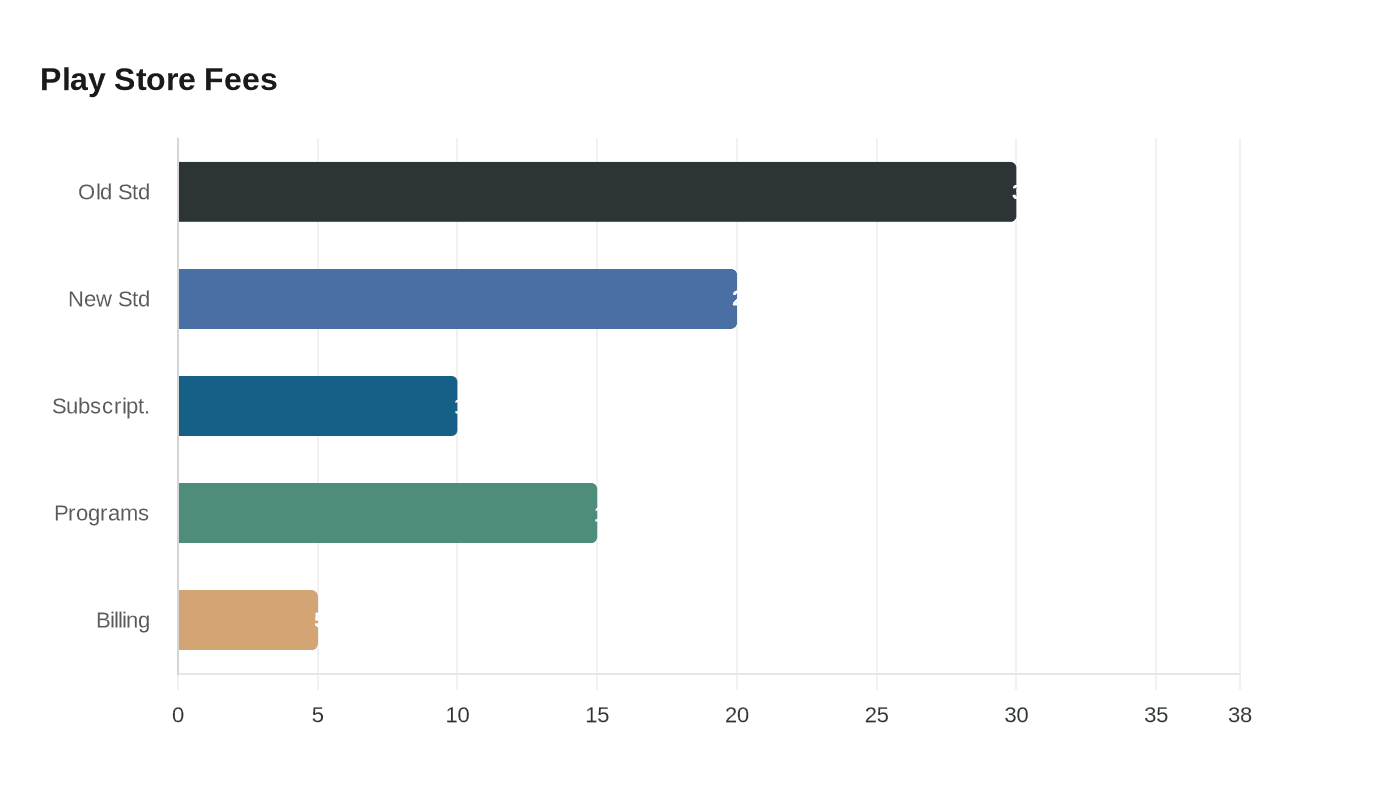
If Judge Donato approves the proposal at the April 9 hearing, the math for developers will change fast: a move toward 20% baseline cuts, a 10% subscription share, program-based 15% tiers, and the practical choice to route payments through Google for a reported 5% billing fee or to run alternative processors. Those are the facts now on the table; the precise legal definitions of "service fee," "billing fee," and any first-$1M carve-outs will require checking Google’s policy text and the court filing before developers adjust pricing, monetization, or distribution plans.
This article was produced by Prism’s automated news system from verified source data, official records, and press releases, then run through automated quality and moderation checks before publishing. The system is built and supervised by the people who set the standards it runs under. Read our full AI policy.
Did this article answer your question?