G.O.P. Congressman's Anti-Muslim Remarks Signal a Dangerous Party Drift
Republican lawmakers' anti-Muslim statements are escalating with no pushback from party leaders or the White House, alarming advocates who fear worse lies ahead.
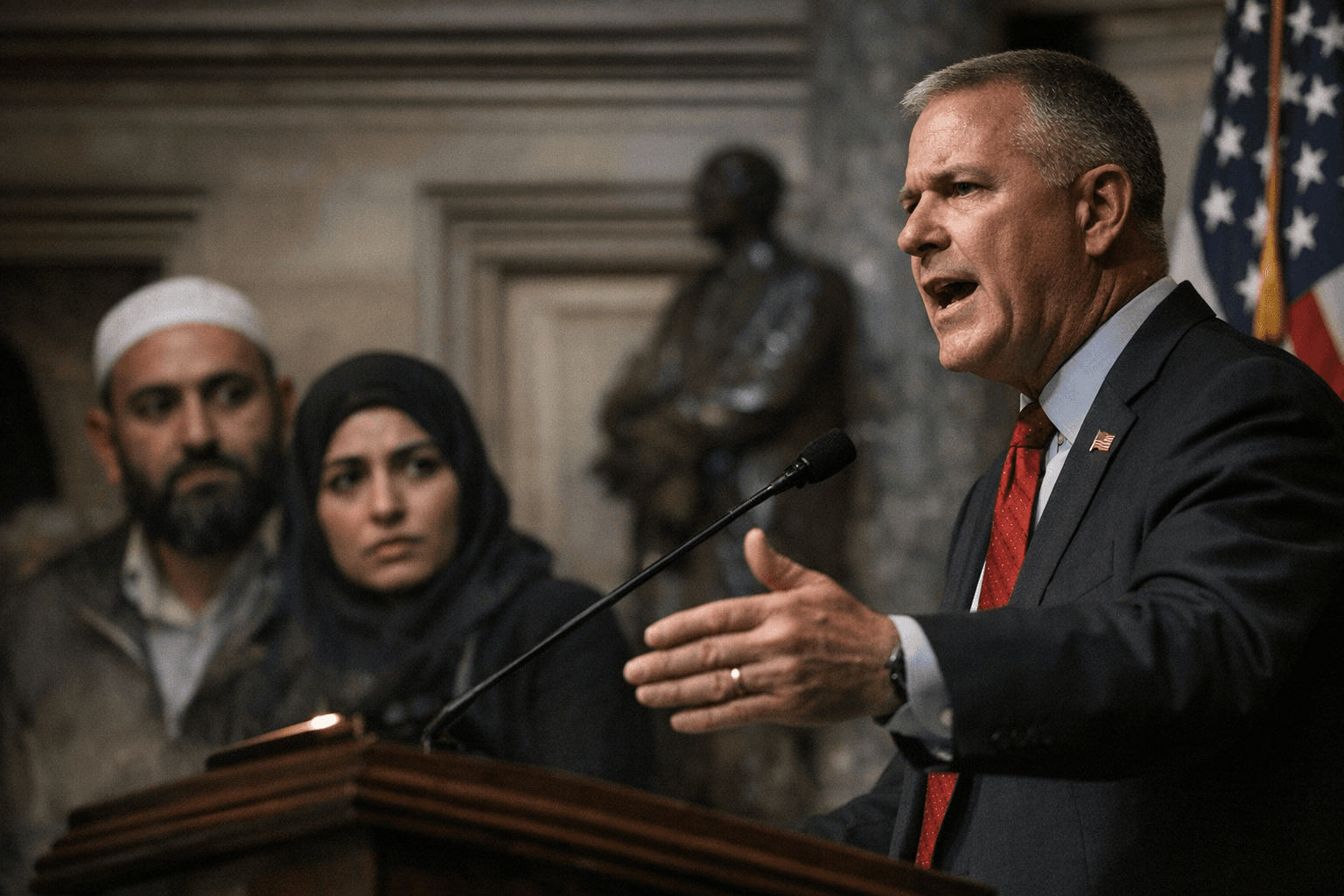
Comments by Representative Andy Ogles of Tennessee, made both on Capitol Hill and in Nashville, have sharpened a debate the Republican Party leadership has largely refused to join, underscoring what advocates describe as a growing tolerance for Islamophobia within the G.O.P.'s ranks.
Ogles's remarks were not an isolated incident. Weeks earlier, Representative Randy Fine of Florida declared that "if they force us to choose, the choice between dogs and Muslims is not a difficult one." Democrats called for his resignation. Top Republicans refused to criticize him.
Their silence reflected something broader. As one assessment of the political climate put it, there is "nothing particularly unusual about Islamophobic statements from the ranks of the G.O.P." That normalization has made institutional condemnation harder to muster and, critics argue, has given license to further escalation.
Senator Tommy Tuberville of Alabama, described as a leading purveyor of anti-Muslim statements, provided the starkest example earlier this month. He shared a photograph placing Mayor Zohran Mamdani of New York, who is Muslim, next to an image of the World Trade Center ablaze, and wrote: "The enemy is inside the gates." The post drew no public rebuke from Republican leadership.
The pattern is not accidental or spontaneous. The recent wave of anti-Muslim language from elected Republicans reflects a nationwide shift that took hold last year and has been steadily growing, with no pushback from President Trump, who campaigned on banning Muslims from the United States, or from party leaders. That absence of accountability at the top of the party has functioned as a structural permission slip for elected officials further down the chain.
Muslim advocates expressed alarm that the rhetoric would intensify. Their concern centers on the escalating war in the Middle East, which they said threatens to rekindle the surge of Islamophobia that swept the United States after the September 11 attacks. That period saw a documented spike in hate crimes, employment discrimination, and surveillance targeting Muslim communities across the country. Advocates fear the current political environment, amplified by social media and emboldened by official silence, could produce a similar or worse response.
The political calculus for Republicans appears straightforward, if troubling: anti-Muslim rhetoric carries little internal cost. No prominent Republican demanded Fine's removal. No congressional resolution condemned Tuberville's post. Trump, whose first term included an executive order widely referred to as a Muslim ban, has offered no correction to the tone his party has adopted.
For Muslim Americans, the message being sent from Washington is unmistakable. Elected officials are not merely tolerating hostility toward their communities; in several cases, they are generating it, with imagery designed to associate Muslim identity with terrorism and with enemies inside the country's borders.
The Ogles comments, the Fine remarks, and the Tuberville post are data points in the same line: a political party testing how far it can go, and finding, so far, that the answer is further than most would have predicted two years ago.
This article was produced by Prism’s automated news system from verified source data, official records, and press releases, then run through automated quality and moderation checks before publishing. The system is built and supervised by the people who set the standards it runs under. Read our full AI policy.
Did this article answer your question?

