Government Videos Reveal a Nation That Asks Only for YouTube Clicks
When the White House mixes real Iran bombing footage with scenes from Gladiator and GTA, it isn't just propaganda; it's governance by viral content, and American civic life has quietly normalized it.
When War Becomes a Playlist
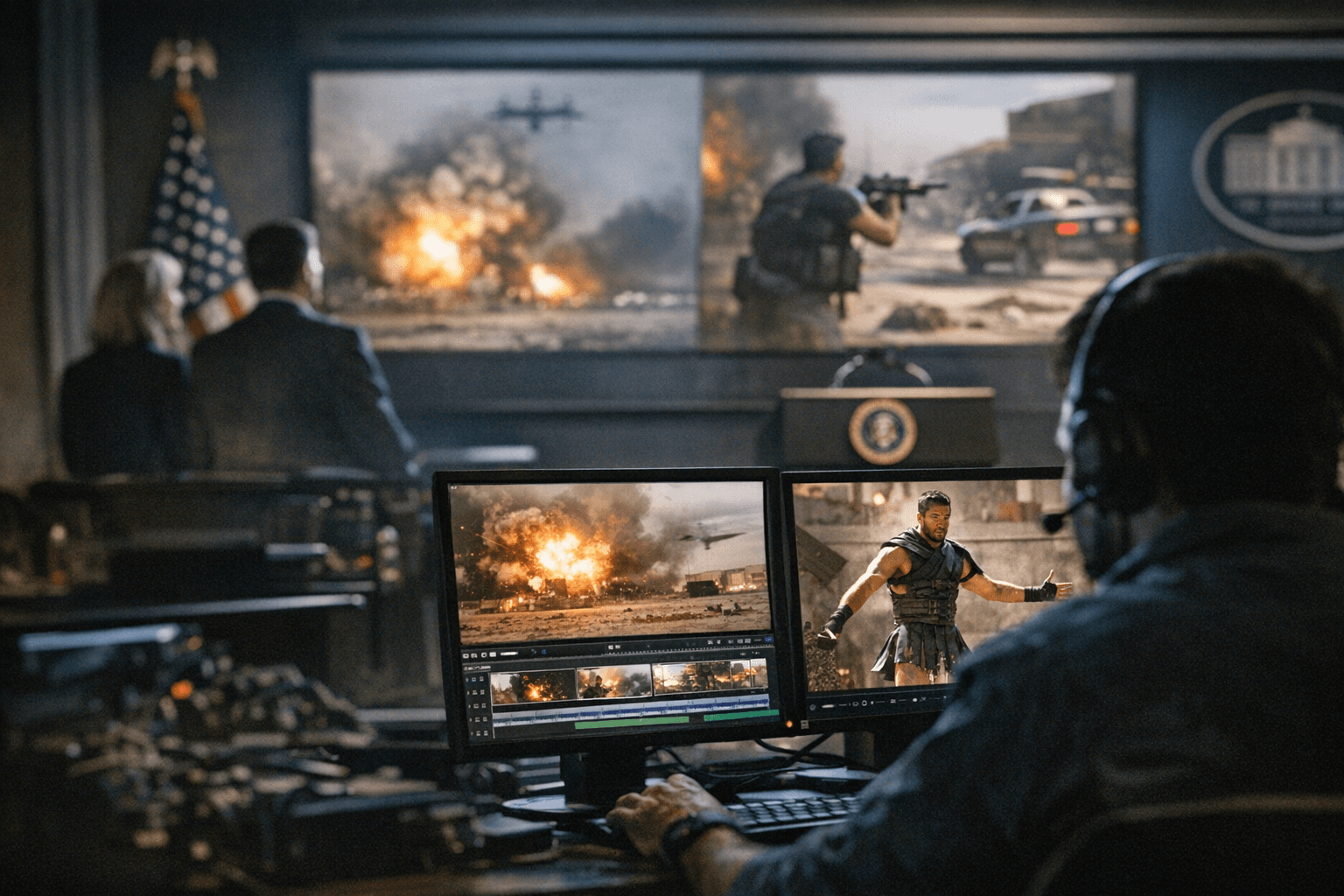
Somewhere between a B-2 bomber releasing its payload over Iran and a clip from *Top Gun: Maverick*, the Trump White House discovered that the most powerful weapon in modern political life might be the algorithm. The White House spliced scenes from *Call of Duty* with real airstrike footage, clips from *Grand Theft Auto: San Andreas* and *Braveheart*, and audio nods to *Top Gun* and *Mortal Kombat*. Labeled simply "JUSTICE THE AMERICAN WAY," a 40-second clip featured scenes from *Iron Man*, *Gladiator*, *Braveheart*, *Top Gun: Maverick*, *Better Call Saul*, *John Wick*, *Tropic Thunder*, and *Deadpool*. It is not immediately obvious whether this is a government communication or a trailer for a summer blockbuster. That ambiguity is almost certainly the point.
The videos, a particularly egregious example of the administration's war propaganda, stitched together real footage of bombing raids with stylized graphics resembling video games and scenes lifted from action films. One video featuring audio from President Donald Trump, Defense Secretary Pete Hegseth, and Secretary of State Marco Rubio has the feel of a movie trailer, with weapons systems including B-2 bombers, High Mobility Artillery Rocket Systems, F-18 fighters given starring roles alongside administration officials.
The Other Side of the Feed
The White House does not have a monopoly on this playbook. In March 2026, AI-generated videos depicting Trump and Israeli Prime Minister Benjamin Netanyahu as LEGO minifigures flooded social media, some set to original rap tracks with surprisingly catchy hooks, likely also AI-generated. They told stories of the horrors of war: little shoes and a plastic backpack near rubble evoked the bombing of the Shajareh Tayyebeh girls' school in Minab, Iran. Some connected the war to Trump's ties to the convicted sex offender Jeffrey Epstein.
The Iranian LEGO videos are clearly designed to undermine support for the war, but that is too narrow a measure of success. The deeper effect is environmental: viral propaganda creates the atmosphere through which a conflict is perceived, shaping what feels salient, what seems ridiculous, who seems triumphant, and what feels righteous. The White House videos, by contrast, are not trying to convert opponents; they are performing dominance for an audience that already agrees.
Propaganda Has Always Followed the Medium
As propaganda theorist Jacques Ellul argued in the early 1960s, propaganda evolves with the communication systems that carry it. In Ellul's era, those systems were radio and television. Today they are TikTok, X, Instagram, and YouTube Shorts, and the grammar of persuasion has been rewritten accordingly. The measure of success is no longer whether a message is true or even believed; it is whether it gets shared.
The White House also posted cryptic videos on X and Instagram that it was not immediately clear were posted intentionally, following earlier instances of Trump administration social media accounts sharing meme-style content. The line between deliberate strategy and chaotic virality has become so thin as to be functionally irrelevant. Either way, attention is captured and the news cycle is shaped.
Governance by Content
The war videos represent only the sharpest edge of a broader governing style. White House Press Secretary Karoline Leavitt held up a printout of a social media post with pictures of alleged undocumented criminals arrested by Immigration and Customs Enforcement in Minnesota during a press briefing. Policy announcements, immigration enforcement, and military operations have all been filtered through the logic of social content: will it trend, will it outrage, will it go viral?
The war on Iran is the first major conflict where the propaganda battle might be won or lost in memes, with pro-Iran accounts unleashing viral videos mocking President Trump and U.S. forces. This is a genuinely new form of information warfare, but it rests on a foundation that neither side fully controls: an audience that has been trained, across years of algorithmic conditioning, to process conflict as entertainment.
What Clicking Requires
The deeper question embedded in every slickly edited White House upload is a civic one. Packaging war in the familiar language of blockbusters and video games asks nothing complicated of the viewer: no sacrifice, no rationing, no draft card, no war bond. It asks only that you watch, perhaps share, and feel, briefly, a rush of vicarious dominance before scrolling on.
This is what distinguishes the current moment from earlier wartime communication. World War II propaganda asked Americans to grow victory gardens, buy bonds, and accept shortages. The propaganda of 2026 asks for a thumbs-up and 40 seconds of attention. The production is impressively sophisticated. What it demands of its audience is impressively little. A nation whose government communicates primarily through entertainment mash-ups has quietly redefined civic participation as passive consumption, and the scroll continues either way.
This article was produced by Prism’s automated news system from verified source data, official records, and press releases, then run through automated quality and moderation checks before publishing. The system is built and supervised by the people who set the standards it runs under. Read our full AI policy.
Did this article answer your question?

