Guantánamo Bay Base Glows While Cuban Neighbors Suffer Darkness Under Trump Embargo
The U.S. naval base at Guantánamo Bay runs on a $368.8M self-sufficient power plant while Cuban towns next door endure up to 20 hours of darkness daily.
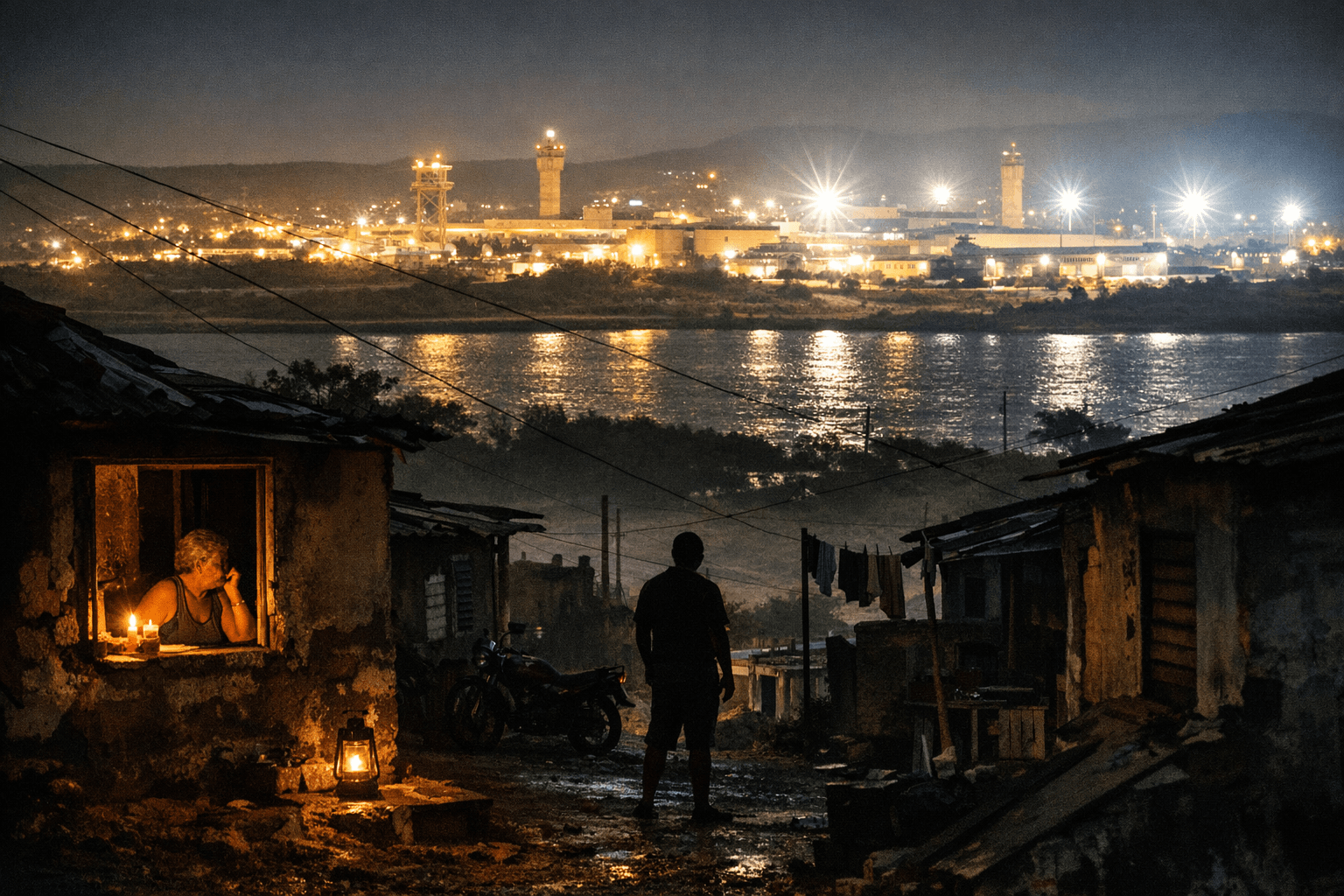
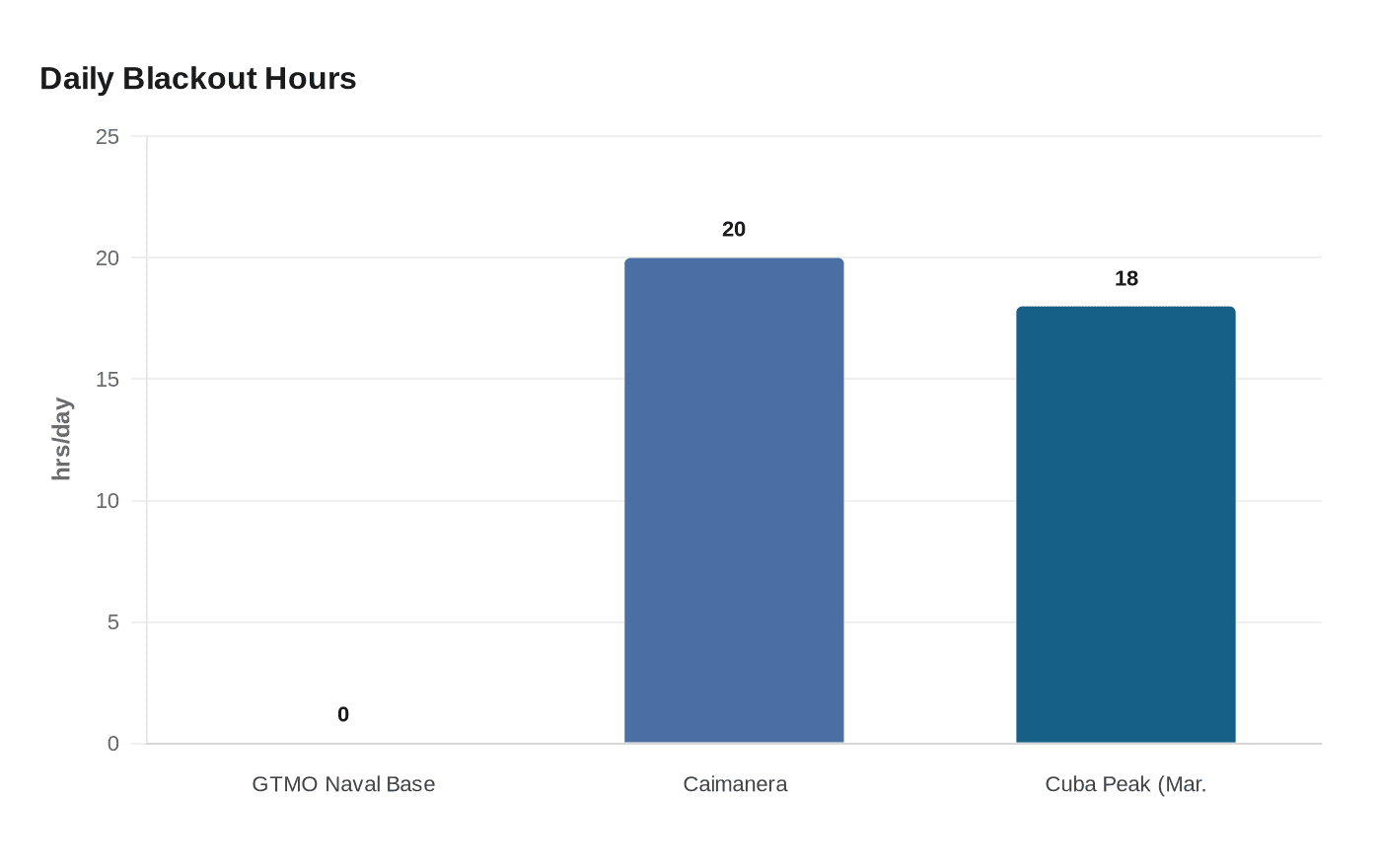
Separated by a minefield and a geopolitical chasm, two realities coexist on the eastern tip of Cuba. Inside the perimeter wire of Naval Station Guantánamo Bay, a $368.8 million liquefied natural gas power plant, commissioned in September 2023, keeps 30 tenant commands and a population of roughly 6,000 fully lit and fully operational. Across that fence, in the Cuban town of Caimanera, whose residents are the closest Cuban neighbors to the U.S. installation, the lights have been going out for up to 20 hours a day.
That contrast is not incidental. It is the product of deliberate policy on both sides of the wire, and it has sharpened into something harder to ignore as Cuba's energy crisis deepened through the first months of 2026.
The Trump administration's de facto oil blockade severed Cuba's primary supply lines after Venezuelan President Nicolás Maduro's capture in January cut off the island's principal fuel source, forcing the Cuban government to enact emergency measures to address widespread fuel shortages. In early March, Cuban President Miguel Díaz-Canel said Cuba had not received any oil shipments in three months.
Cuba's electric grid suffered a total collapse on March 16, 2026, as the nation struggled with crumbling infrastructure and the U.S. oil blockade. The blackouts, which peaked on March 17 and typically lasted for up to 18 hours a day, were driven by frequent breakdowns of the Antonio Guiteras Thermoelectric Power Plant, the island's largest electricity provider, compounded by the absence of fuel shipments from Cuba's former allies. A second nationwide blackout struck on March 21.
Many provinces experienced up to 20 hours of darkness per day, as aging 1970s-era power plants proved incapable of functioning without consistent maintenance and fuel. The fuel shortage prevented the harvesting of crops and undermined food sovereignty efforts. It also hampered UN World Food Programme relief efforts following Hurricane Melissa. In response, the Cuban government closed schools and universities and limited public transport. Garbage accumulated throughout Havana and other cities due to the lack of fuel for trash trucks.
The eastern provinces bore some of the earliest and most acute suffering. On February 4, the provinces of Guantánamo, Santiago de Cuba, Holguín, and Granma suffered a total blackout, while the western part of the island and Havana faced serious electricity difficulties. That means the province sharing a name with the American base, and home to Caimanera, went dark weeks before the rest of the country followed.
The United Nations warned of a possible humanitarian "collapse" in Cuba as a result of the fuel shortages. Analyst Augustin, speaking to Al Jazeera, offered a stark assessment of Washington's strategy: "The US is purposely de-industrialising Cuba. By targeting energy, it's targeting all of the infrastructure on which life depends." Augustin added: "Sanctions kill. There's a lot of academic literature that shows that."
Naval Station Guantánamo Bay, for its part, was engineered precisely to avoid such vulnerability. Military commanders understood that when a mission is situated on an island, energy independence and resilience are not merely desired goals but necessities. The story of Guantánamo Bay's energy self-sufficiency stretches back to the early 1960s, when the Cuban Revolution severed the base from mainland supplies including water and energy. The $368.8 million LNG plant, completed through a partnership with the Naval Facilities Engineering and Expeditionary Warfare Center, represents the endpoint of that decades-long pursuit of insulation, providing an affordable and resilient power source for every command on the installation.
On March 13, Díaz-Canel publicly confirmed for the first time that his government was engaged in diplomatic talks with the United States aimed at addressing the severe energy blockade. He framed the outreach as an effort to find "solutions," even as he rejected any notion of capitulation. In a social media post, Díaz-Canel wrote that U.S. officials "intend to announce plans to take over the country, its resources, its properties, and even the very economy they seek to suffocate in order to force us to surrender."
What national security looks like, in this geography, depends entirely on which side of the fence you occupy. For the Navy, it means a self-sustaining grid immune to the island's collapse. For Caimanera, it means watching those lights burn through the darkness they are being forced to live in.
This article was produced by Prism’s automated news system from verified source data, official records, and press releases, then run through automated quality and moderation checks before publishing. The system is built and supervised by the people who set the standards it runs under. Read our full AI policy.
Did this article answer your question?


