Gulf-Drafted Security Council Resolution Faces Opposition From Permanent Members
Three veto-holding Security Council powers, Russia, China, and France, blocked Bahrain's push to authorize force to reopen the Strait of Hormuz, forcing a fourth, watered-down draft.

Three veto-wielding permanent members of the United Nations Security Council, Russia, China, and France, blocked Bahrain's effort to authorize force to reopen the Strait of Hormuz, forcing the Gulf state to circulate a fourth and substantially diluted draft resolution as it holds the Council's rotating presidency for April.
The final text authorizes the use of defensive, but not offensive, action to ensure vessels can safely transit the strait. It is a significant retreat from Bahrain's original draft, which explicitly cited Chapter VII of the United Nations Charter, which allows the Security Council to authorize measures ranging from sanctions to military force.
The economic pressure forcing the confrontation is severe. Roughly one-third of seaborne crude oil trade moves through the strategically important waterway, alongside 19 percent of global liquefied natural gas flows and 14 percent of global refined products trade. Iran has effectively closed the strait since the United States and Israel struck Iranian targets at the end of February. Oil prices have surged since the conflict began, which has now exceeded a month. Private insurance coverage for Hormuz transits rose from around 0.25 to 0.5 percent of vessel value per transit to 5 percent or more. Several of the world's leading maritime insurers, including Norway's Gard and Skuld, Britain's NorthStandard, and the London P&I Club, canceled war-risk coverage for vessels in the region entirely.
The alignment blocking the resolution is historically unusual. The last time Russia, China, and France were the only three permanent members of the Security Council to align on a major issue was in 2003, when they opposed the joint UK-U.S. resolution for the invasion of Iraq, forcing London and Washington to withdraw it. Russia and China are both diplomatically aligned with Tehran. France has taken a different line from its Western partners, with diplomats saying Paris has proposed an alternative resolution rather than supporting Bahrain's text. A Security Council resolution requires at least nine votes in favor and no vetoes from its five permanent members: the United States, Russia, China, Britain, and France. With three of those five opposed, the vote's outcome remained in doubt even as Bahrain moved to schedule it for Friday.
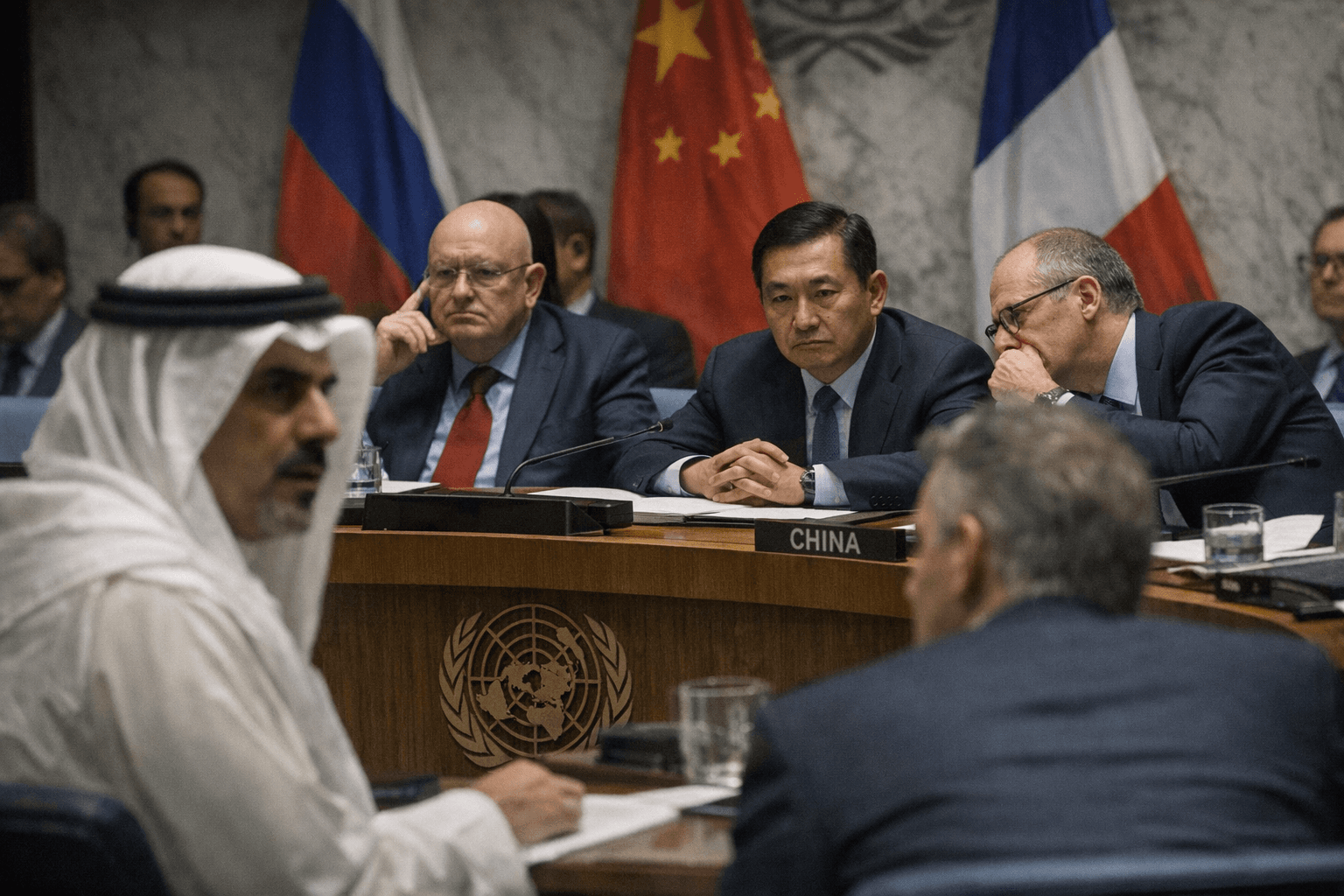
Bahrain's Foreign Minister, Abdullatif bin Rashid Al Zayani, addressed the Council Thursday, calling Iran's blockade an "unlawful and unjustified attempt to control international navigation in the Strait of Hormuz" that threatens the interests of nations around the world and "requires a decisive response." His UN Ambassador, Jamal Fares Alrowaiei, who chairs the Council during April, put it in starker terms: "We cannot accept economic terrorism affecting our region and the world."
The unresolved vote carries direct implications for U.S. naval planning. President Trump signaled that the U.S. Navy will begin escorting tankers through the Strait of Hormuz if necessary, and directed the U.S. Development Finance Corporation to provide war-risk insurance backstops. But no country has so far publicly agreed to Trump's call to send warships to secure the strait, and the U.S. military has acknowledged it is not ready to accompany oil ships through the waterway. Without a Security Council resolution authorizing force, any naval operation would proceed in a grayer legal environment, complicating both the diplomatic case for allied participation and the rules of engagement for vessels operating under fire.
Bahrain circulated a revised draft that retained language authorizing "all necessary means" but dropped an explicit reference to binding enforcement, hoping to overcome objections particularly from Russia and China. That concession did not resolve the impasse, and further diplomatic hours of negotiation ahead of Friday's scheduled vote left the outcome uncertain.
This article was produced by Prism’s automated news system from verified source data, official records, and press releases, then run through automated quality and moderation checks before publishing. The system is built and supervised by the people who set the standards it runs under. Read our full AI policy.
Did this article answer your question?