Hawaii Faces Worst Flooding in More Than 20 Years Across Islands
Oʻahu resident Melanie Lee returned to find her home reduced to mud. No deaths were reported, but Gov. Josh Green says damage could top $1 billion.

Melanie Lee had lived on Oʻahu for nearly 20 years. When she finally saw what remained of her home on Monday, it was buried in mud. "We lost everything," she told CBS News. "My children's pictures. Just real sentimental stuff. Now it's like, now where we go from here?"
Hawaii has been grappling with recovery from a pair of massive storms that unleashed up to 4 feet of rain in parts of Oʻahu and Maui over the past week, Gov. Josh Green said. The state has suffered its worst flooding in more than 20 years, after heavy rains fell on soil already saturated by downpours from a winter storm a week earlier. No one was killed in the storms and flooding, but the damage and recovery are both financially and emotionally costly.
Muddy floodwaters smothered vast stretches of Oʻahu's North Shore, a community world-renowned for its big-wave surfing, and raging waters lifted homes and cars, prompting evacuation orders for 5,500 people north of Honolulu, though they were later lifted. On the morning of March 20, one home on Kaihūlo Drive in Mokulēʻia, near Waialua, was swept entirely onto the beach. More than 200 people were rescued from rising waters, and crews searched by air and by water for stranded residents. The National Guard and Honolulu Fire Department airlifted 72 children and adults from a spring break youth camp at a retreat on Oʻahu's west coast called Our Lady of Keaʻau.
Officials blamed the devastation on the sheer amount of rain that fell in a short amount of time on saturated land. Parts of Oʻahu received 8 to 12 inches of rain overnight. Kaʻala, the island's highest peak, received nearly 16 inches in a single day, according to the National Weather Service. The storms were driven by weather systems known as "Kona lows," which feature southerly or southwesterly winds that bring in moisture-laden air, and two struck the state within two weeks of each other.
Officials watched the Wahiawa Dam closely, which has been vulnerable for decades, after it was rated "at risk of imminent failure." The dam remains intact, and water levels have since receded, according to USGS monitoring data. Concerns about the 120-year-old Wahiawa Dam have subsided since the storm's peak.
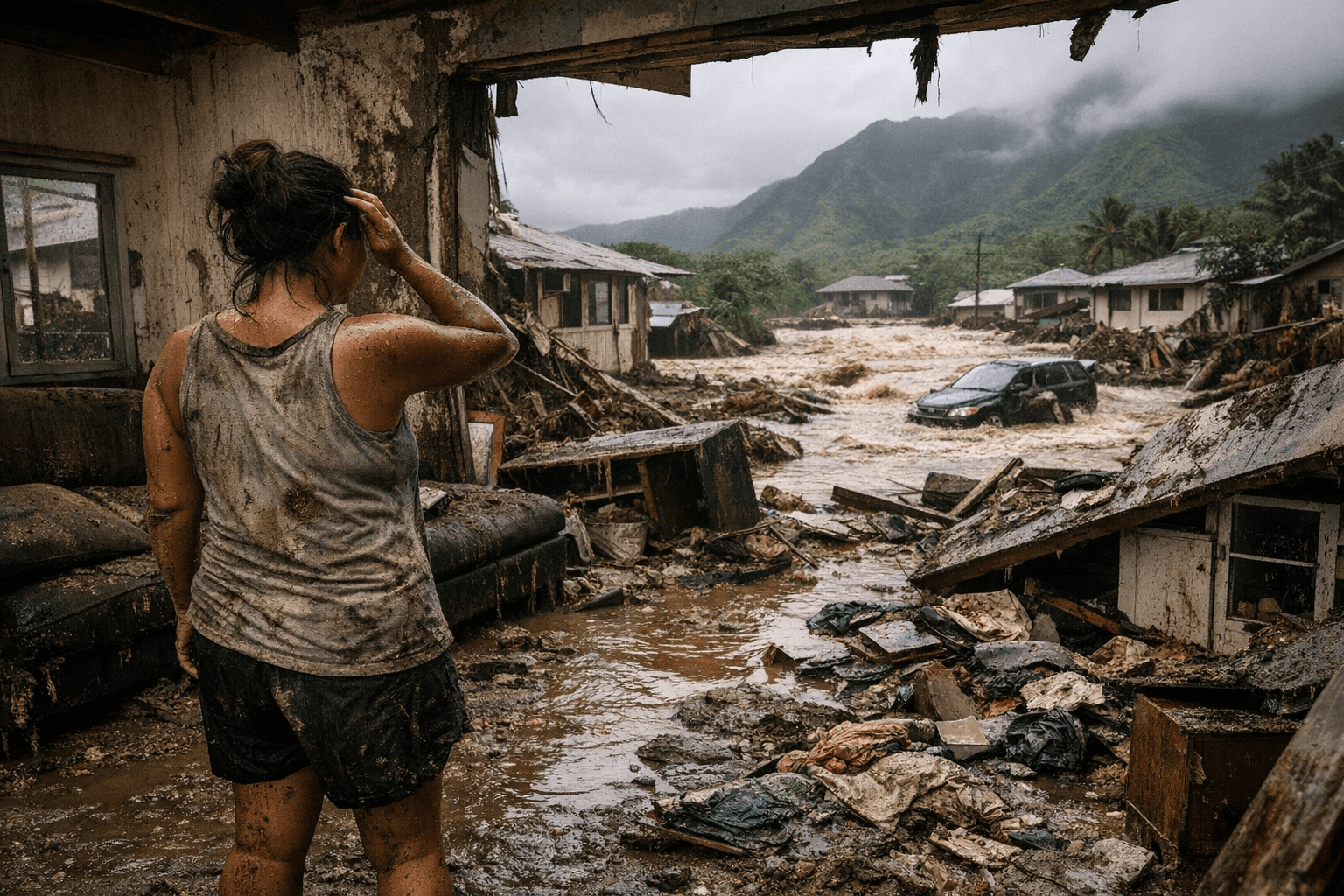
Maui was also hit hard, as the storm blasted down riverbeds, blew out bridges and roads, and swallowed vehicles. Officials have not been able to fully assess the destruction, but Gov. Green said the cost of the storm could top $1 billion, including damage to airports, schools, roads, people's homes, and a hospital in Kula, Maui. Honolulu Mayor Rick Blangiardi called the destruction unambiguous: "There's no question that the damage done thus far has been catastrophic."
Green said the 2026 flooding is the state's most serious since the 2004 Manoa Flood, when floodwaters inundated homes and destroyed irreplaceable documents in the basement of Hamilton Library at the University of Hawaiʻi at Mānoa. That event caused roughly $85 million in damage; the current estimate is more than ten times that figure.
To support recovery, Green formally requested a presidential major disaster declaration and is seeking a federal cost share of up to 90%. FEMA has been brought in early to conduct damage assessments alongside state teams. Green said in a statement that "the scale of damage we are seeing — from washed-out highways to overwhelmed water systems — makes clear that federal partnership is essential," as he requested a disaster declaration from President Donald Trump.
Green said Sunday night that "while the immediate threat from the storm has passed, recovery efforts continue across the islands as state and county crews assess damage, clear debris and restore impacted infrastructure." A boil water advisory remained in effect for the North Shore water system, stretching from Waialua to Turtle Bay, with residents told not to use tap water for drinking, brushing teeth, or cooking unless it is boiled first.
Know something we missed? Have a correction or additional information?
Submit a Tip

