Healthy life expectancy falls sharply in England’s most deprived areas
England’s poorest areas are losing healthy years fast, with the gap now about 20 years and widening as illness arrives earlier and lasts longer.

England’s most deprived communities are now spending far more of life in poor health than the least deprived, with the gap in healthy years stretching to roughly two decades. The latest figures show the divide is not only about dying earlier. It is about poorer people living longer with illness, disability and the daily limits that come with bad health.
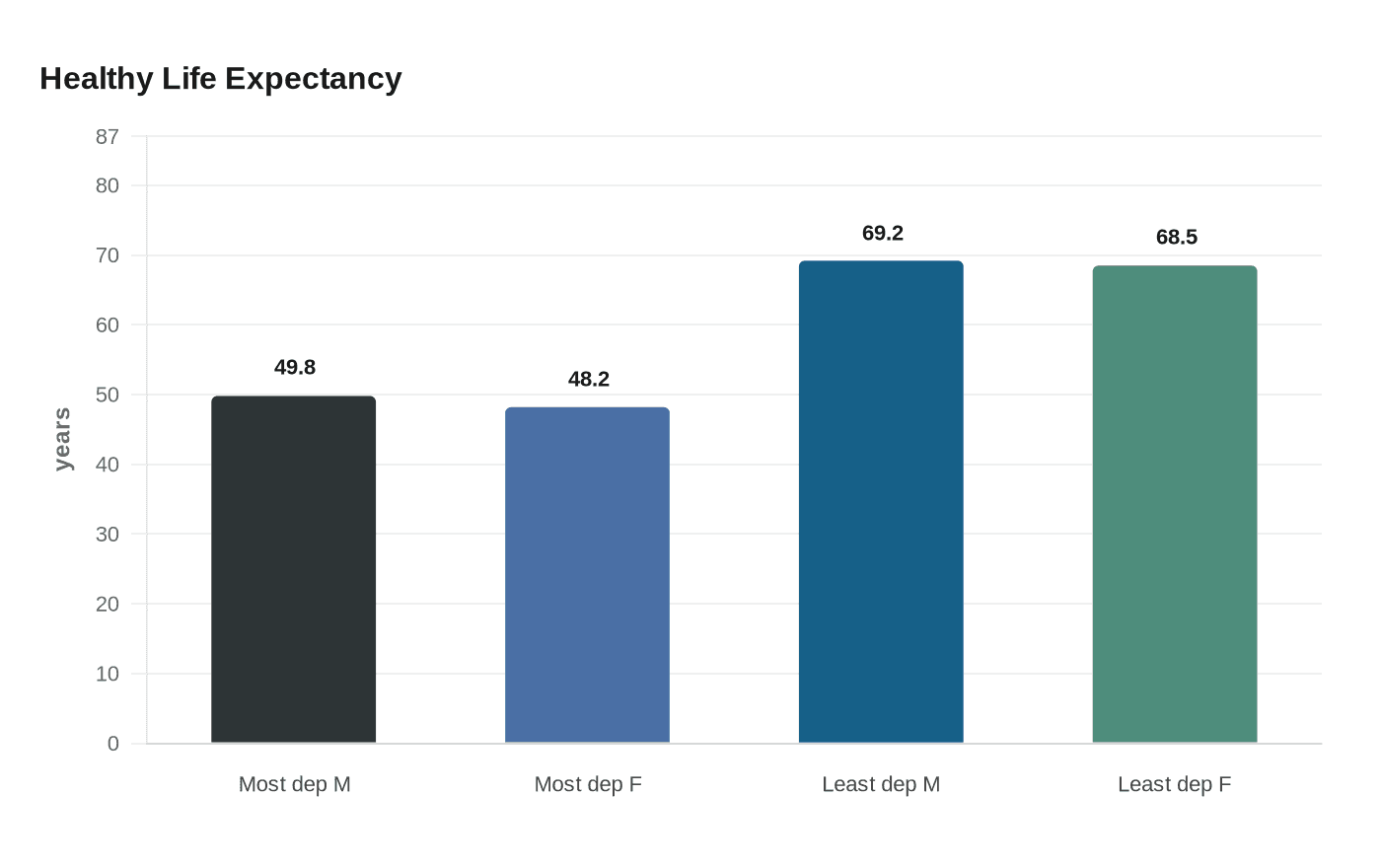
New Office for National Statistics data, released on 15 April 2026, showed that in 2022 to 2024 healthy life expectancy at birth in England’s most deprived areas was 49.8 years for males and 48.2 years for females. In the least deprived areas, the figures were 69.2 years for males and 68.5 years for females. That left a healthy life expectancy gap of 19.3 years for men and 20.1 years for women, using the slope index of inequality. The life expectancy gap was smaller, at 10.4 years for males and 8.0 years for females.
The new data also showed the deterioration has accelerated in the worst-off places. Compared with 2019 to 2021, healthy life expectancy in the most deprived English areas fell by 2.2 years for males and 3.2 years for females. Life expectancy in those areas remained below pre-pandemic levels, even as it rose across every deprivation decile compared with 2019 to 2021.
The pattern points to long-running structural pressures rather than isolated individual choices. The House of Commons Library says the biggest risk factor for avoidable mortality is tobacco, followed by high BMI, high cholesterol and high blood pressure. It says those risks are closely tied to income deprivation, education and other socioeconomic factors. Poor housing, obesity and the effects of deprivation have all been identified as likely drivers of the widening gap.
The scale of the problem is not confined to England. In Wales, the healthy life expectancy gap was even larger for women, at 23.1 years, and 20.6 years for men. The Office for Health Improvement & Disparities said in 2020 to 2022 the gap in England was already around 20 years for both sexes, while its Health Inequalities Dashboard found physical inactivity in the most deprived areas was 2.3 times higher than in the least deprived areas in 2023 to 2024.
The policy response has been set out clearly, but the numbers show the distance still to travel. The UK government has committed to halving the healthy life expectancy gap and improving healthy life expectancy by five years by 2035. The British Medical Association estimated in March 2026 that health inequalities cost taxpayers £68 billion, or £82 billion in 2025/26 prices, underscoring how deprivation is feeding both poorer lives and a heavier bill for the public finances.
This article was produced by Prism’s automated news system from verified source data, official records, and press releases, then run through automated quality and moderation checks before publishing. The system is built and supervised by the people who set the standards it runs under. Read our full AI policy.
Did this article answer your question?


