Hegseth echoes Trump border rhetoric in Europe speech
Hegseth folded Trump’s border fight into D-Day remembrance, recasting Allied memory in the language of migration and invasion.
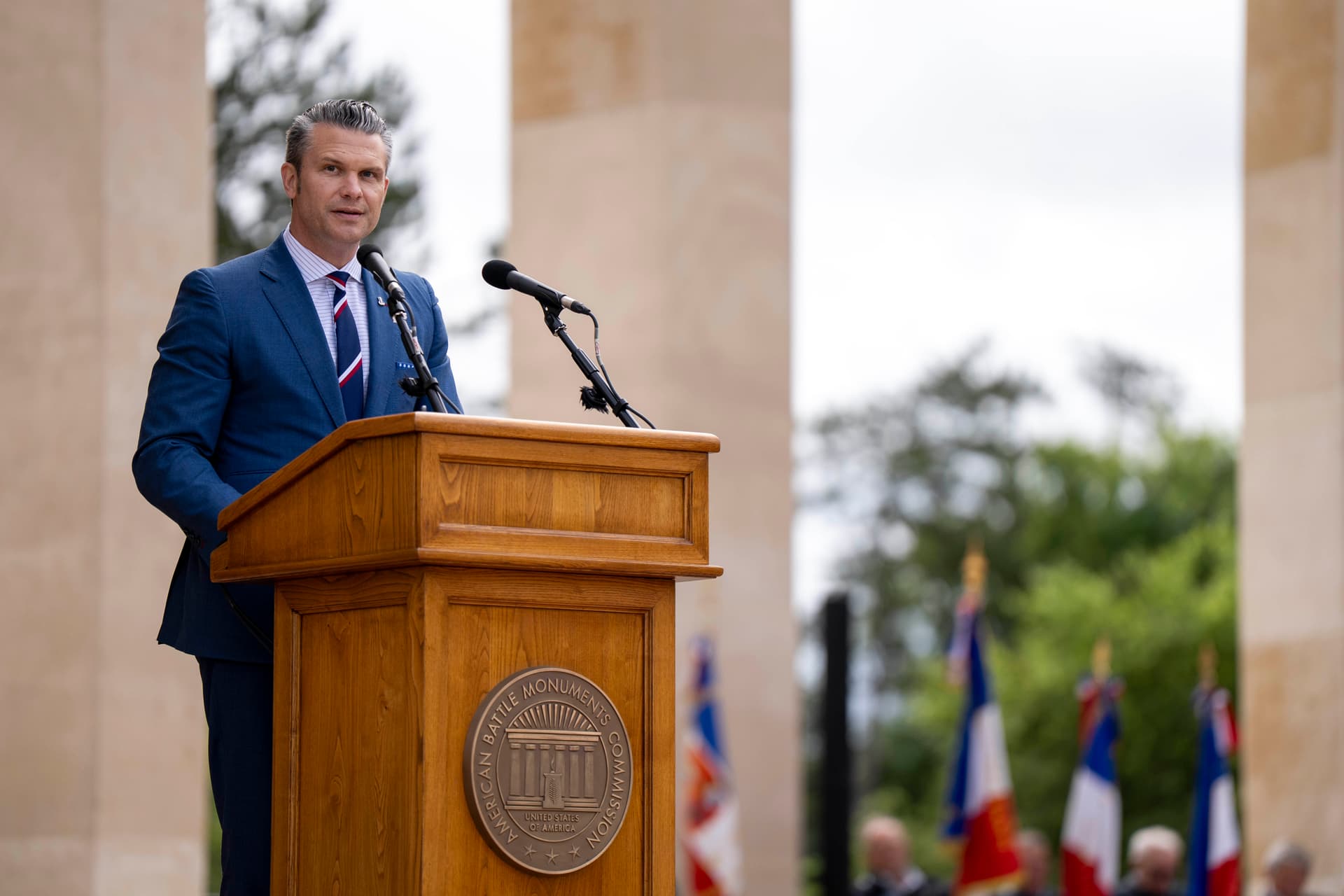
Pete Hegseth used a Europe speech tied to the 82nd D-Day commemoration to echo the Trump administration’s border-security message, bringing migration rhetoric into a ceremony meant to honor Allied sacrifice and wartime unity.
That choice mattered because D-Day, marked on June 6, 1944, has long served as one of the clearest symbols of U.S.-Europe solidarity. By invoking the language of invasion and border control in that setting, Hegseth imported a domestic culture-war frame into commemorative diplomacy, shifting attention from the Allied landings in Normandy to the politics of who belongs, who enters and who is viewed as a threat.
The contrast is striking. D-Day remembrance usually emphasizes shared military purpose, coalition warfare and the costs of defending open societies against authoritarian aggression. Hegseth’s rhetoric instead linked security to migration pressure, echoing the broader Trump-era habit of treating border enforcement as a core national defense issue. In that framing, movement across borders is not a humanitarian or economic question first, but a strategic vulnerability.
That message has immediate political value in Washington, where immigration remains one of Trump’s most effective rallying issues. It also carries clear implications for Europe, where migration has already reshaped domestic politics in countries from France to Germany to Italy. When a senior U.S. official speaks in Europe using the same vocabulary, the speech signals that transatlantic security is being recast through the same lens that drives U.S. border politics at home.

For U.S.-Europe relations, the deeper signal is about priorities. The Trump administration is increasingly presenting security as a bundle of domestic grievances and external threats, with migration folded into the same narrative as military deterrence. That approach may resonate with voters who want a harder line on borders, but in a place built to commemorate Allied unity, it also narrows the gap between ceremonial diplomacy and partisan messaging.
The result is a sharper, more politicized version of commemorative diplomacy. On a day meant to remember cooperation against invasion, Hegseth’s speech suggested that even the language of remembrance is now being pulled into the Trump-era debate over borders, identity and the meaning of security.
This article was produced by Prism’s automated news system from verified source data, official records, and press releases, then run through automated quality and moderation checks before publishing. The system is built and supervised by the people who set the standards it runs under. Read our full AI policy.
Did this article answer your question?


