Hegseth urges Asian allies to spend more as China warning grows
Hegseth pressed Asian allies to spend more on defense as China skipped the Singapore forum again, deepening pressure on regional burden-sharing.

The real question in Singapore was not whether Pete Hegseth would warn about China, but whether he was using Asia’s premier defense summit to demand a bigger bill for the region’s own security. At the Shangri-La Dialogue, the U.S. defense secretary pushed allies to spend more, arguing that a stronger and more self-reliant network was needed to deter aggression and preserve the balance of power in the Indo-Pacific.
The 23rd Shangri-La Dialogue ran from 29 to 31 May 2026 and drew 44 countries, along with 54 ministerial-level delegates and more than 42 chief-of-defence-force-level delegates and senior defense officials, according to Singapore’s defence ministry. The forum, organized by the International Institute for Strategic Studies, is widely seen as Asia’s premier defense summit, which made Hegseth’s message especially consequential. Washington’s language there is often read as a signal of broader strategy, and this year it was aimed as much at allied capitals as at Beijing.
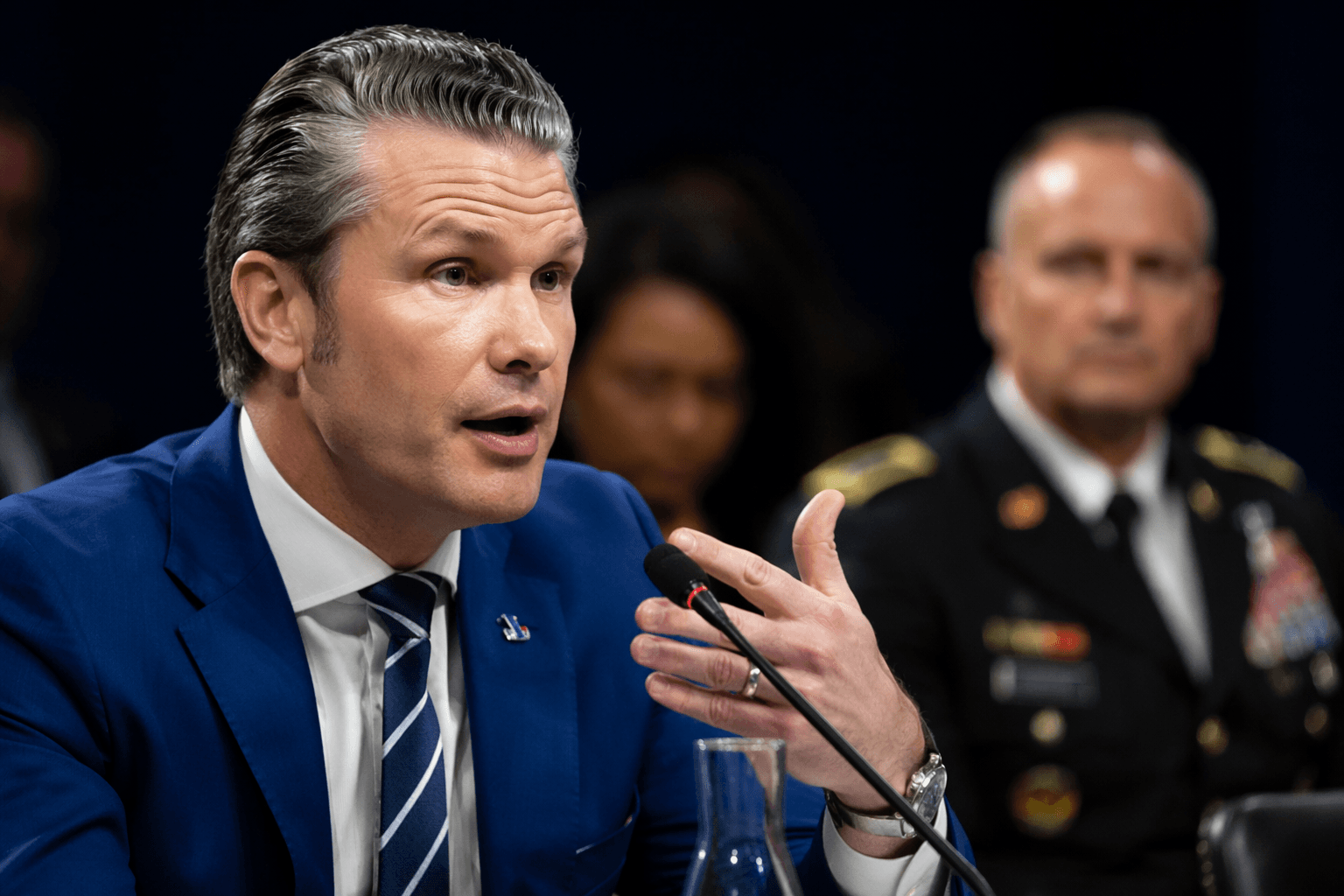
Hegseth paired reassurance with pressure. He warned of what he described as China’s historic military buildup and its expanding activities across the region and beyond, while also making clear that the United States wanted partners to do more of the work on shipbuilding, missile defense, basing and intelligence-sharing. He said the Pacific could not be allowed to fall under the sway of any single hegemon without destabilizing the regional order, a pointed line that framed burden-sharing as a strategic necessity rather than a favor to Washington.
China did not send Defence Minister Dong Jun for the second year in a row, instead dispatching a lower-level delegation of experts and scholars tied to the People’s Liberation Army. That absence narrowed the chance for direct exchange at a gathering built around high-level dialogue. Germany’s chief of defense, Gen. Carsten Breuer, said China was “losing a chance” by not sending a ministerial-level delegation.
Beijing answered sharply. China’s Foreign Ministry accused Hegseth of “vilifying” China and taking a Cold War, bloc-confrontation approach. It also said the United States should not use the Taiwan issue as leverage against China. Some reports said Hegseth avoided explicit mention of Taiwan in his prepared remarks and described U.S.-China relations as better than they had been in many years, but he still drew a hard line against Chinese dominance.
That balance, between reassurance and deterrence, is now central to U.S. policy in Asia. Hegseth’s push for more allied spending reflected a broader American demand for burden-sharing that reaches beyond the region, but in Singapore it landed with immediate force. For governments weighing trade, diplomacy and military risk, the message was plain: build more capacity now, or face a more dangerous strategic environment later.
This article was produced by Prism’s automated news system from verified source data, official records, and press releases, then run through automated quality and moderation checks before publishing. The system is built and supervised by the people who set the standards it runs under. Read our full AI policy.
Know something we missed? Have a correction or additional information?
Submit a Tip