HEVC licensing remains fragmented as Access Advance expands patent pool coverage
HEVC’s problem was never just compression quality. Fragmented licensing, patent risk, and enforcement pressure helped steer vendors and streamers toward safer formats.
How HEVC became a market puzzle
HEVC, also known as H.265, arrived as a technically strong codec, but the market never treated it like a simple engineering upgrade. It became a licensing decision, a legal risk calculation, and a product strategy choice all at once. That is why a format with real hardware advantages still ended up unevenly supported across devices, browsers, and streaming services.
The licensing stack that made HEVC hard to buy into
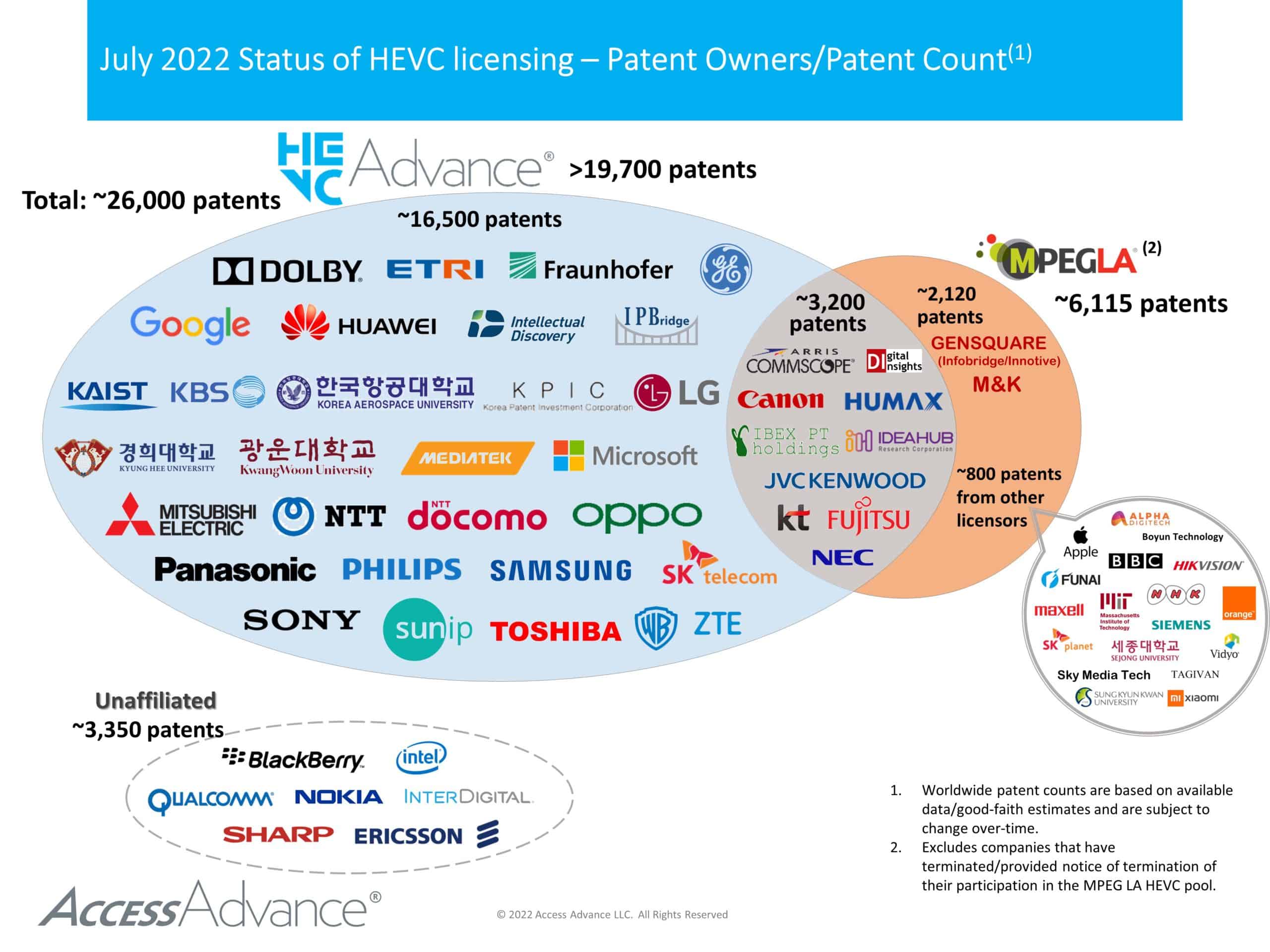
The first major HEVC license came from MPEG LA on September 29, 2014, and it bundled patents from 23 companies. Its pricing was straightforward on paper: US$0.20 per HEVC product after the first 100,000 units each year, with an annual cap. That early license also did not charge separate royalties for HEVC content streamed over the internet or sold on Blu-ray, which made it easier to understand than later, more layered arrangements.
Then the landscape split further. Access Advance’s HEVC Advance pool says it licenses patents essential to HEVC under FRAND terms, and by July 2025 it said the pool covered more than 27,000 patents. Access Advance also uses duplicate-royalty rules and device or software first-sale licensing rules, which matter because the same product can carry multiple HEVC encoders or decoders without multiplying the royalty bill. In that structure, multiple HEVC encoders or decoders in one product trigger only a single royalty at the highest applicable rate, while cloud-based services can face separate annual royalties.
That complexity became even more pronounced in 2025. Access Advance said licensees who joined by December 31, 2025 could lock in current rates and caps through 2030, while new rates beginning January 1, 2026 were aligned with the VVC Advance royalty structure. On December 15, 2025, Via Licensing Alliance’s HEVC and VVC program was acquired by Access Advance, consolidating another major licensing path into the same orbit. The effect was not simplification so much as concentration under one larger patent-pool umbrella.
Why technical support did not translate into universal support
The key reason HEVC never became frictionless is that software vendors do not just ship code, they ship legal exposure. Microsoft’s HEVC Video Extensions listing makes that practical reality visible: the codec is designed to use hardware support on newer devices, including Intel 7th Generation Core processors and newer GPUs, but software playback support can vary depending on resolution and PC performance. In other words, a device can be technically capable of decoding HEVC and still be treated differently depending on licensing, cost, and the user experience a vendor wants to support.
Intel’s own product evolution helps explain the split. Kaby Lake-era products brought full fixed-function H.265 and HEVC 10-bit decode and encode acceleration, while earlier generations had only partial support or none for some HEVC modes. That means support is not binary across the installed base. Vendors may keep HEVC only where hardware makes decoding efficient, limit it to newer machines, or shift it into paid extensions and licensed apps rather than absorb the broader patent exposure across every product line.
For consumers, that creates a familiar but frustrating pattern: a file that plays on one laptop may stumble on another, even when both seem modern enough. The underlying issue is not just compatibility. It is the way patent costs and licensing rules filter down into product decisions, leaving some users with built-in support and others with a prompt to install an extension, use a different app, or abandon the format entirely.
Why the web moved on first
HEVC’s biggest market problem may be that the web had other options. Industry commentary has long pointed to fragmented licensing and multiple patent pools as a reason many publishers moved toward royalty-free codecs such as VP9 and AV1. That was not just a preference for newer technology. It was a rational response to legal uncertainty, because royalty-free formats reduced the chance of unexpected fees, disputes, or pool conflicts.
That choice had a major downstream effect. HEVC became common in hardware and device ecosystems, but it never became the default for general web distribution. Browser support and streaming delivery followed the safer path, which is why the modern video stack often feels split between what chips can decode and what websites are willing to serve. A codec can be excellent in silicon and still lose in distribution if the licensing burden is too hard to predict.
This is where the social impact becomes visible. When support is uneven, consumers do not experience a clean technology transition. They experience format headaches, paid add-ons, playback failures, and confusion over why one video works on one service but not another. The burden lands hardest on people using older devices, shared computers, budget hardware, or school and workplace machines where installing extensions is restricted.
Enforcement pressure made the risk harder to ignore
The licensing debate also got sharper because it was not abstract. In 2024 and 2025, Access Advance licensors pursued HEVC-related patent enforcement against major companies, including Microsoft and Roku. One report said Microsoft ultimately took a Via LA HEVC pool license in October 2025 after related disputes in Germany. That matters because it shows how regional enforcement, litigation risk, and licensing negotiations can shape product support just as much as engineering road maps do.
Once enforcement enters the picture, vendors have to think about more than codec quality. They must weigh the cost of participating in one pool, the possibility of overlapping claims from another, and the reputational risk of shipping a feature that could trigger legal conflict later. For a platform vendor, removing HEVC support or pushing it behind a paid extension can be a defensive move, not a technical judgment.
What this means for streaming, browsers, and devices
The practical result is a market where HEVC remains important but inconsistent. It shows up where hardware acceleration is valuable, especially for 4K and UHD playback, but it is far less reliable as a universal delivery format. Browsers and streaming publishers often choose VP9 or AV1 because those formats avoid the patent maze, while device makers may reserve HEVC support for newer chips, licensed software, or specific product tiers.
- Newer devices may decode HEVC smoothly in hardware.
- Older machines may depend on software playback, with performance varying by resolution.
- Some vendors limit HEVC to paid extensions or licensed applications.
- Web publishers often avoid it altogether in favor of royalty-free formats.
That creates a layered ecosystem:
The result is a codec that succeeded inside hardware and failed as a common denominator. HEVC’s story is not that the codec was weak. It is that fragmented royalty pools, duplicate licensing rules, and enforcement pressure made it harder to ship broadly and safely. In the end, the market rewarded the formats that were easier to distribute, not necessarily the ones that compressed video best.
This article was produced by Prism’s automated news system from verified source data, official records, and press releases, then run through automated quality and moderation checks before publishing. The system is built and supervised by the people who set the standards it runs under. Read our full AI policy.
Did this article answer your question?