Hillsborough County complaint alleges raised concrete at Home Depot caused serious injury
Hiraida Santamaria filed a Hillsborough County complaint on March 3, 2026, alleging a hazardous raised concrete mass in a Home Depot parking lot caused serious injury and disability.
Hiraida Santamaria sued Home Depot U.S.A., Inc. in the Circuit Court for Hillsborough County on March 3, 2026, docketed as case 26-CA-002426, alleging that a hazardous raised concrete mass in a Home Depot parking lot caused serious injury and disability. The complaint names Home Depot as defendant but does not list the store address, precise circumstances of the fall, or medical diagnoses in the filed summary.
The claim is framed as a slip-and-fall premises liability case, a category Nationlaw defines plainly: "A slip and fall claim is a type of premises liability case. It arises when someone is injured because of a dangerous condition on someone else’s property." Nationlaw notes Florida property owners "have a legal duty to keep their premises reasonably safe and to warn guests of hazards that aren’t obvious," and cites Florida Statute §768.0755. Under that statute, the injured person must show three elements: "1. The property owner had actual knowledge (they knew about the hazard) or constructive knowledge (the hazard existed long enough that they should have discovered it). 2. The property owner failed to take reasonable steps to correct or warn about the danger. 3. The hazardous condition directly caused the injury."
Common defenses listed in the legal summaries include comparative negligence, no-notice, and the open-and-obvious doctrine. Nationlaw summarizes these defenses: "Comparative negligence: Arguing that the injured person was partially at fault (e.g., not watching where they were going). Florida follows a modified comparative negligence rule... No notice: Claiming they had no knowledge of the hazard... Open and obvious doctrine: Arguing that the danger was so obvious a reasonable person would have avoided it." Billbonelawgroup adds that property owners "frequently assert that the dangerous condition was 'open and obvious'."
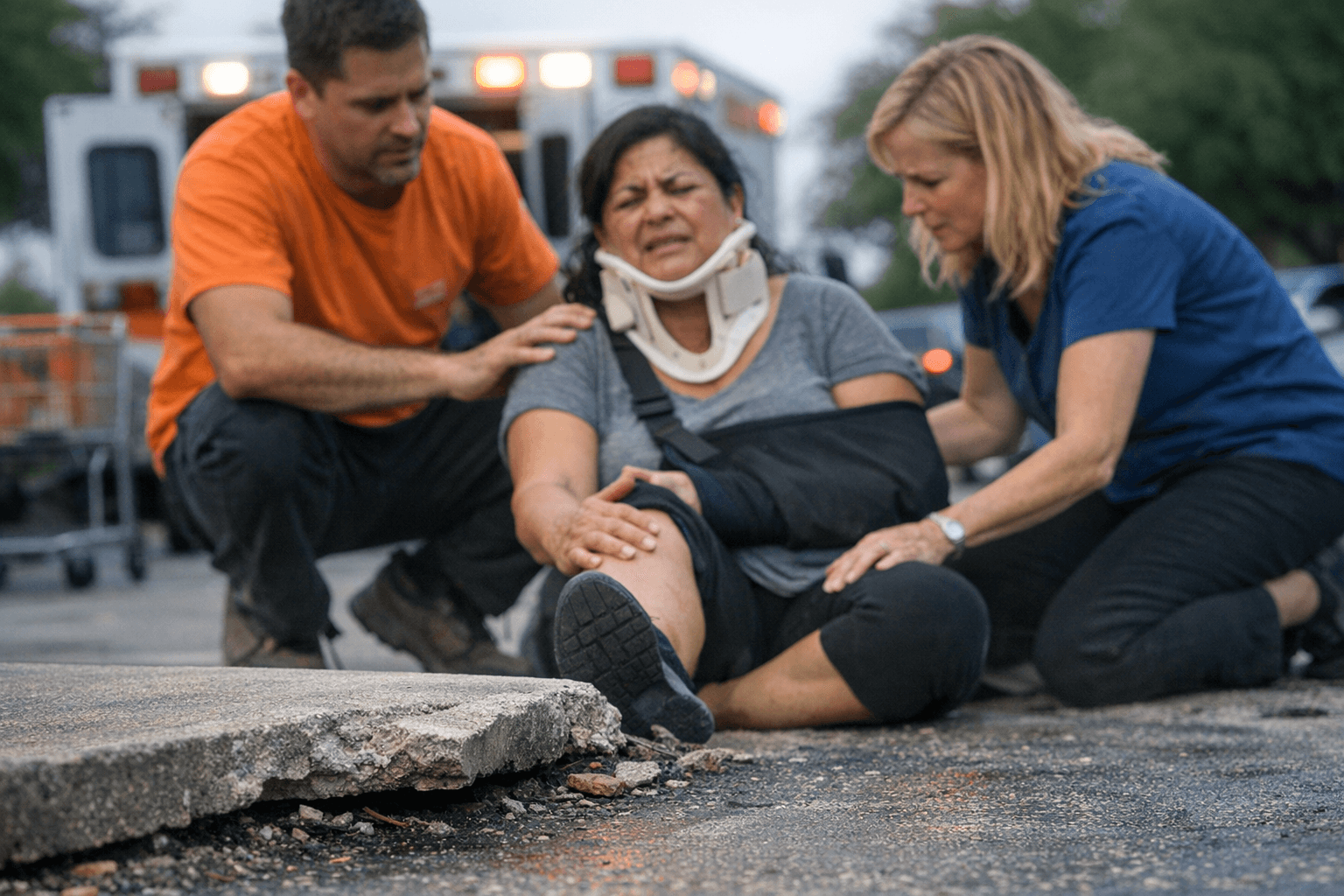
Legal background on trip hazards underscores the mechanics alleged by Santamaria. Shinerlawgroup explains the distinction between trips and slips: "When a person stumbles because their foot catches on an object beneath them, the resulting fall is often dismissed as an ordinary accident. Yet this type of incident is legally and mechanically distinct from slips caused by loss of traction." Shinerlawgroup also cites broader data: "According to the National Safety Council, nearly 40 percent of all trip related injuries in Florida occur on sidewalks with visible cracks, raised concrete, or missing sections." The firm warns that "These dangers frequently remain unaddressed for months or even years, especially on properties managed by organizations with limited resources or weak inspection systems," and that "The absence of warning signs does not excuse negligence when the hazard was predictable and could have been fixed, especially with just a little amount of effort to discover the defect."
The complaint filed March 3, 2026, provides the starting point for further confirmation. Reporters and parties seeking detail should obtain the full complaint and docket for case 26-CA-002426 from the Circuit Court for Hillsborough County to identify the specific Home Depot location, any attached photographs or medical records, and whether the plaintiff alleges actual or constructive notice. Billbonelawgroup notes the kinds of evidence courts consider central to these claims: "Evidence showing the financial impact of the injury, including medical bills and lost wages, can further demonstrate the extent of damages suffered by the injured person," and "A pattern of similar incidents at the same location strongly supports an argument that the condition occurred with regularity and was therefore foreseeable.
Know something we missed? Have a correction or additional information?
Submit a Tip