Hochul says limited Long Island Rail Road service resumes Tuesday noon
Limited Long Island Rail Road service resumed at noon Tuesday after a strike that stranded nearly 300,000 daily riders and exposed how fragile commuter rail can be.

Limited Long Island Rail Road service was set to resume at noon Tuesday, a brief but disruptive strike reminder that North America’s largest commuter rail system can grind to a halt when labor talks break down. For riders from Long Island to Penn Station and Grand Central Madison, the stoppage forced rushed workarounds across already crowded roads, subways and buses.
The walkout began at 12:01 a.m. Saturday, after five LIRR unions broke with management over pay and contract terms. Those unions represent about half of the railroad’s roughly 7,000 workers, or about 3,500 employees, and the strike was the first on the LIRR since a two-day stoppage in 1994. The railroad carries about 250,000 to 300,000 riders each weekday, a scale that made even a short shutdown immediately felt across Long Island, Queens, Brooklyn and Manhattan.
Gov. Kathy Hochul said negotiations continued through Sunday night and into early Monday under pressure from the National Mediation Board and her administration, but the sides did not reach a full agreement before service was partially restored. Hochul framed the dispute around affordability for Long Islanders, while Metropolitan Transportation Authority Chair and CEO Janno Lieber said the agency could not accept a deal that would blow up the MTA budget or force fare hikes. Union leaders said workers were seeking raises that would keep pace with inflation and the region’s high cost of living.
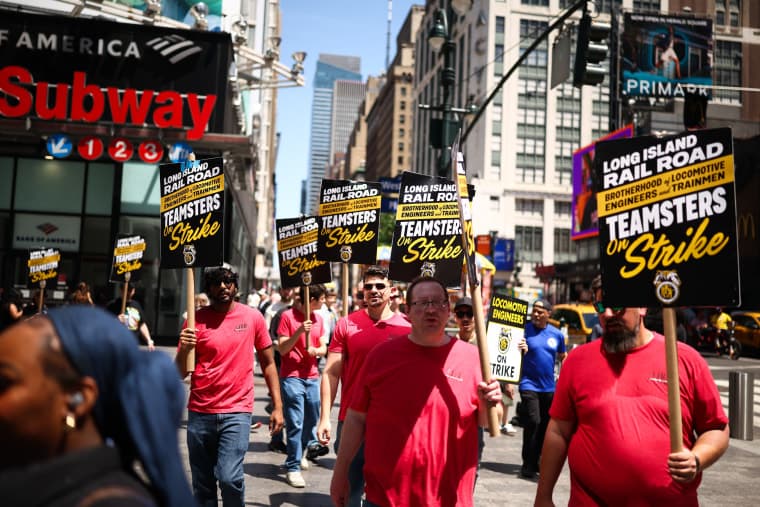
During the stoppage, the MTA said limited shuttle buses would operate during weekday peak hours for essential workers and commuters who could not telecommute. Those shuttles were free and tied to subway transfer points in Queens, offering some connection to stations including Howard Beach-JFK Airport and Jamaica-179 St. Other riders had to lean on limited bus links or work-from-home arrangements, while travel to busy stations such as Hicksville, Mineola, Ronkonkoma, Bay Shore and Huntington was thrown into uncertainty.
The episode underscored both the leverage held by transit workers and the vulnerability of a system that millions depend on every day. It also sent a warning well beyond New York: when commuter rail negotiations collapse, the effects spread quickly to workers, employers, taxpayers and the broader transportation network, and a temporary settlement may only pause the same contract tensions that could return in the next round.
This article was produced by Prism’s automated news system from verified source data, official records, and press releases, then run through automated quality and moderation checks before publishing. The system is built and supervised by the people who set the standards it runs under. Read our full AI policy.
Did this article answer your question?