Home Depot forklift safety rules managers must enforce on store floors
Stores should reinforce OSHA forklift standards to protect employees and customers. Training, inspections and pedestrian controls reduce collisions and liability.

OSHA's Powered Industrial Trucks standard (29 C.F.R. § 1910.178) and NIOSH guidance set clear employer obligations for forklift safety that are directly relevant in Home Depot stores, where sit-down forklifts, walkie riders and pallet jacks operate in aisles, parking lots and loading zones shared with customers and associates. Store leaders who treat these rules as operational priorities can cut injury risk and limit regulatory and legal exposure.
At the core of the standard is training and documented competency. Employers must ensure each operator receives initial and periodic refresher training and that evaluations confirm competence on site-specific equipment and conditions. For Home Depot this means operators must be trained on the particular models used in that store, understand aisle widths, overhead obstructions, load centers and customer traffic patterns, and have written records of training and evaluations available for review.
Daily equipment checks and maintenance are another nonnegotiable. OSHA and NIOSH recommend pre-shift inspections to identify defects in forks, hydraulics, tires, lights and brakes. Defective trucks should be removed from service promptly and repaired by qualified technicians. In a retail setting that can require clear tagging procedures, accessible repair reporting systems and downtime planning so associates are not forced to work around unsafe equipment.
Controlling pedestrian-forklift interactions is essential where material handling happens near sales floors, garden centers or parking areas. Employers must limit pedestrian access to active forklift zones when possible, mark travel lanes and loading areas with adequate lighting and signage, and use spotters when an operator's view is obstructed by loads or racking. Speed controls, reduced-load lifts and two-person rules for complex moves are practical administrative measures that reduce collision potential.
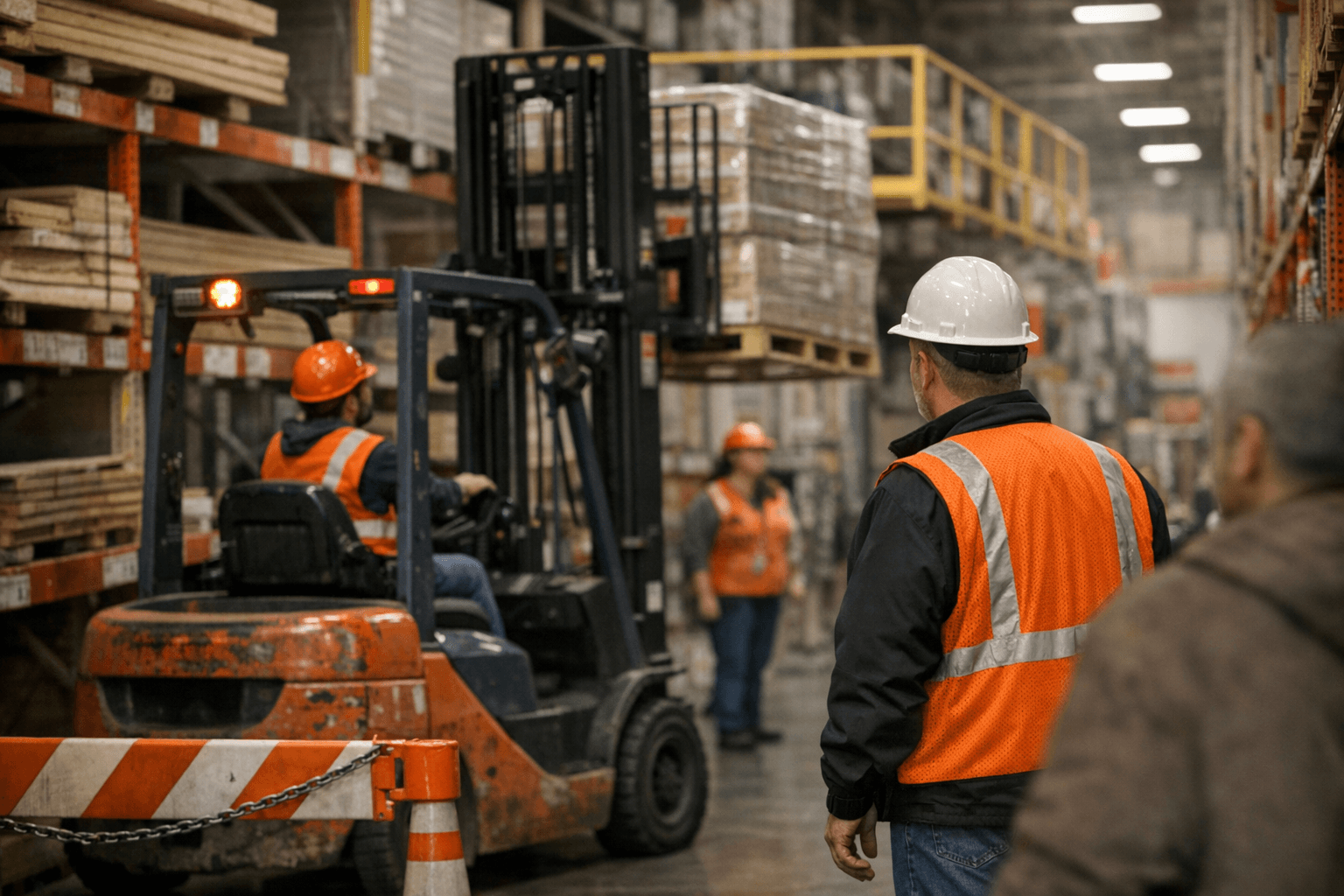
Administrative controls and staffing choices shape day-to-day safety. Scheduling heavy pallet moves during low-customer periods, assigning dedicated spotters for transport through customer-facing aisles, and enforcing strict equipment operation policies reinforce safer work rhythms. Managers should also track incident and near-miss data to adjust staffing and training priorities.
For associates, compliance means more than a checklist: expect scheduled refresher courses, routine pre-shift inspections and clear direction on when and where foot traffic should avoid forklift operations. For supervisors, the work is managerial as much as operational: keep thorough training records, plan maintenance windows, and build staffing that supports required spotters and safe lifts.
Implementing these standards reduces the most common causes of forklift incidents in retail environments and protects both employees and customers. Ongoing audits, regular refresher training and visible enforcement by store leadership will determine whether safety practices stick or remain just good intentions.
Know something we missed? Have a correction or additional information?
Submit a Tip