Home Table Tennis Setup: Optimize Space, Lighting, Table and Solo Drills
A compact, practical guide to creating a useful home practice area for hobby and club players, with clear space, lighting, table and robot considerations that matter for training at home.
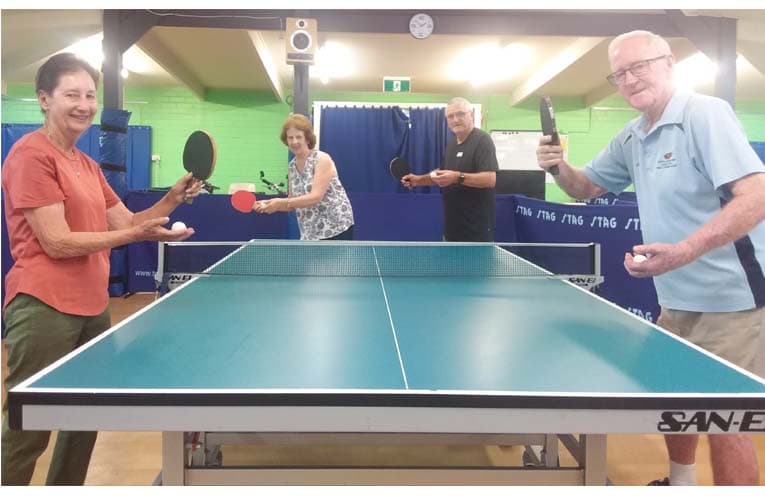
A compact, practical guide to creating a useful home practice area for hobby and club players. Start with the table: regulation dimensions are essentially a 9 ft by 5 ft surface, listed as 2.74 m × 1.525 m and alternately as 2.73 m × 1.53 m in some tests, with table height at 76 cm. Thickness matters for bounce and accessory fit; one poster contrasted an "indoor table (25mm) where I know I get the competitive grade (ITTF approved) bounce" with a Sponeta SDL Outdoor at 10 mm, which the manufacturer claims is "the closest to indoor bounce one can get from an outdoor table."
Space needs diverge depending on goals. For official competition the ITTF handbook sets a large playing-space: 14 m × 7 m × 5 m high. For home setups sources offer a range. Themenscave lists a casual-home minimum of 6.76 m × 3.83 m and adds "P.S. The Men’s Cave team has tested the measurements mentioned above, so we guarantee they’re legit!" Allabouttabletennis warns that "any area smaller than the recommended size of 8.5 m × 4 m (28 feet × 13 feet) will mean that you'll be restricted in either the type of strokes you can use and/or your style of play." The Original Report gives a "Minimum recommended footprint for basic practice: 9.0 m length × 4.5 m width (for realistic movement). If yo" and truncates. GreaterSouthern offers an "ideal room" of 19 ft long and 11 ft wide (approximately 5.75 × 3.5 m) and recommends "an additional 3-6 feet (1-2 m) of space around all sides of the table" to accommodate adult movement.
Single-player drills and playback require vertical clearance. Many tables fold for solo practice; GreaterSouthern notes "you really need about 6 ft (2 m) from the floor to use the playback position" and cautions to consider ceiling fans, light fixtures, and artwork. Lighting and flooring impact visibility and safety: "Uniform lighting over the whole of the playing area is essential," Allabouttabletennis states, and recommends a minimum ceiling height of 3 m (10 feet) determined by lighting criteria. That source also advises non-reflective flooring that provides good contrast and highlights the specialist Taraflex sports surface used in top events. Climate matters too; Allabouttabletennis lists ideal room temperature as 15–20°C with relative humidity of 40–50%.
Robots and topspin practice raise compatibility questions. One player asked about the Butterfly Amicus Prime and wrote, "There I'm somewhat inclined to got for the Butterfly Amicus Prime. I know this however was designed for 25mm thick tables (indoor tables). I was wondering if I could still use it on an outdoor table by just adding some board for thickness. As I understand the robot has sort of a clamp. I guess this would work, but then again I would be using a top robot on an outdoor table (lol)." That player later posted an UPDATE: "Thanks for all recomendations. I settled on a Sponeta S8-37 indoor table and was lucky enough to find a cheap Newgy 2040 to start my journey." Treat robot clamp fixes as user-level workarounds and verify clamp specs with manufacturers before relying on them.
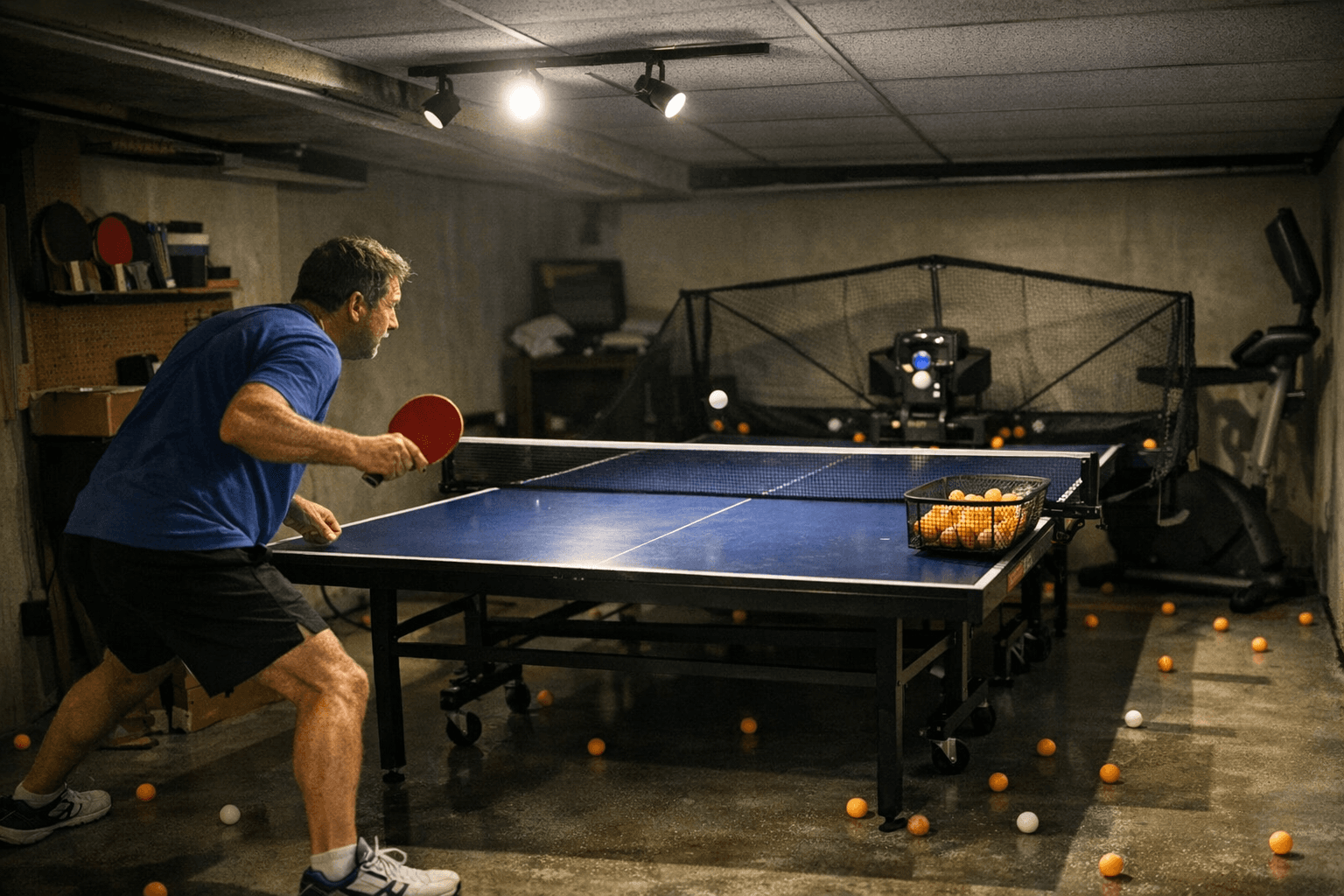
Social use and sightlines matter in homes. GreaterSouthern reminds readers that "table tennis at home is a form of entertainment for everyone! Many people like to gather around a game to watch, cheer, and wait for their turn. Consider where spectators will sit and stand, making sure they have enough room to be comfortable without getting in the players’ way."
What this means for your setup is straightforward: measure first, decide whether you prioritize competition-style bounce and robot compatibility or durability and outdoor flexibility, and match room height, lighting, flooring, and a sensible perimeter to that choice. Verify robot clamp ranges and manufacturer bounce claims for outdoor tops before buying, and if you want tournament-like movement, aim toward the larger footprint figures rather than the tight cellar fit.
Know something we missed? Have a correction or additional information?
Submit a Tip