Hormuz Crisis Sends Oil Prices Surging in History's Largest Supply Disruption
Brent crude peaked at $126 a barrel and tanker traffic collapsed to near zero after Iran's IRGC blocked the Strait of Hormuz, triggering the largest oil supply shock since the 1970s.
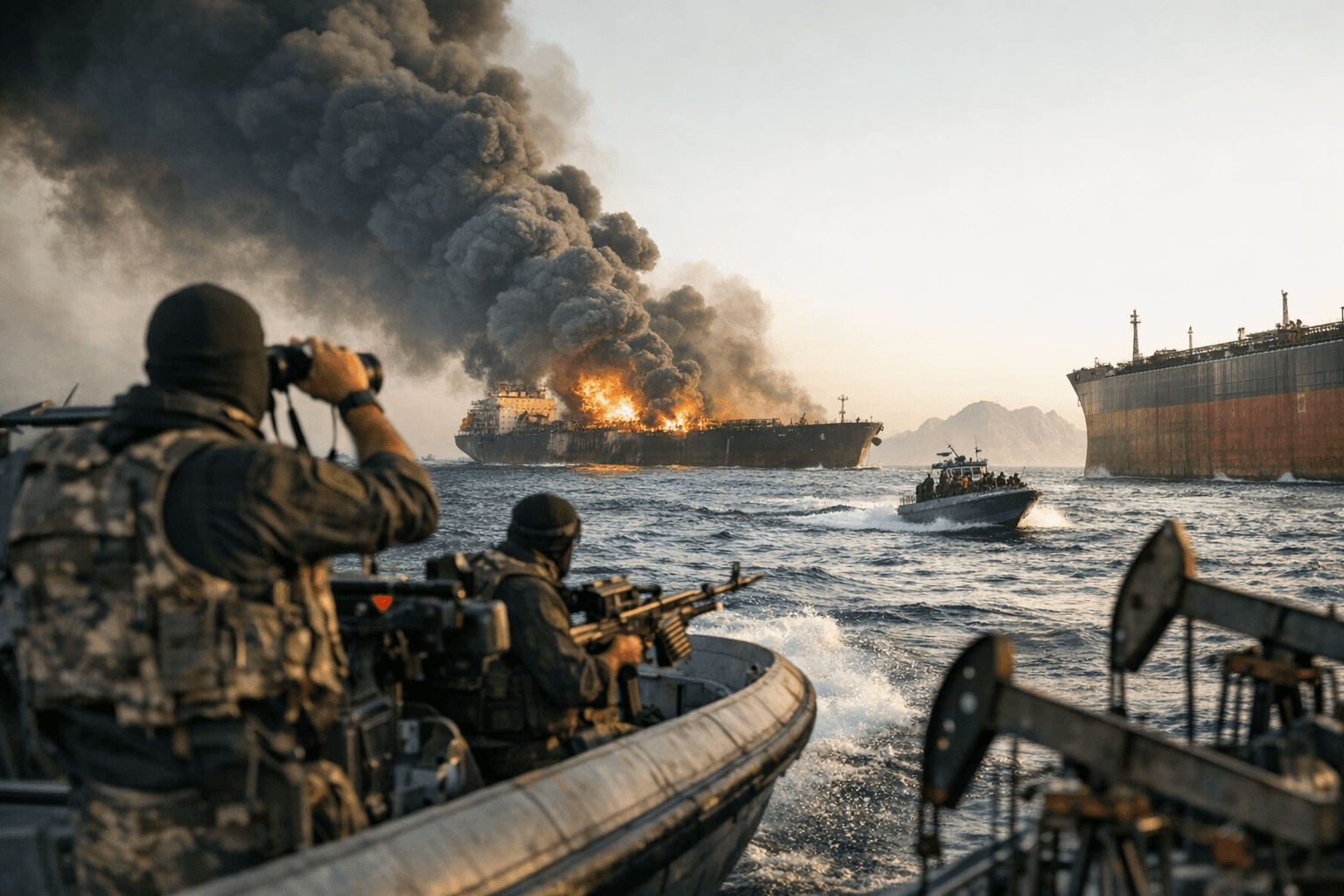
The most consequential chokepoint in world energy markets has proven once again that its 21-mile width can determine the price of oil in every corner of the globe. Since Iran's Islamic Revolutionary Guard Corps effectively sealed the Strait of Hormuz on February 28, 2026, the world has witnessed the largest oil supply disruption in recorded history, with tanker traffic collapsing from 20 million barrels per day to fewer than two transits daily through most of March.
Brent crude, which settled at $73 per barrel the day before U.S. and Israeli forces struck Iran, crossed $100 on March 8 for the first time in four years and peaked at $126. WTI climbed from $67 to $112. The restriction, which cut Strait shipments by more than 90%, choked off between 12 and 15 million barrels of crude per day, the most severe supply shock since the 1970s oil crisis. American consumers absorbed the blow at the pump: average regular gasoline rose $1.18, or 40%, to $4.16 per gallon, according to AAA. European natural gas jumped from €30 per megawatt-hour to €46 in early March.
The Strait's structural importance is what makes any disruption so destabilizing. The U.S. Energy Information Administration reported that roughly 20 million barrels of oil transited the waterway daily in 2024 and early 2025, representing about one-fifth of global petroleum liquids consumption and more than one-quarter of total seaborne oil trade. One-fifth of global LNG trade, primarily Qatari, moves through it annually. In 2024, 84% of crude and condensate and 83% of LNG through the Strait were bound for Asian markets; China alone sources roughly one-third of its oil supply there. Europe draws 12 to 14% of its LNG from Qatar via the same route. Up to 30% of internationally traded fertilizers also pass through the Strait.
The IRGC declared any vessel linked to the United States, Israel, or their allies a "legitimate target" and warned: "You will not be able to artificially lower the price of oil. Expect oil at $200 per barrel." Iran also reportedly charged $2 million per tanker for safe passage, a levy Capital Economics Group Chief Economist Neil Shearing called a "de facto partial nationalisation of the shipping route," adding roughly $1 per barrel to transport costs.
Institutional responses failed to move the needle. The IEA's 32 member countries unanimously released 400 million barrels from emergency reserves, and IEA Executive Director Fatih Birol stated plainly: "The most important thing for a return to stable flows of oil and gas is the resumption of transit through the Strait of Hormuz." OPEC+ announced a 206,000-barrel-per-day production increase for May, though analysts immediately questioned how that oil could reach markets with the Strait effectively closed. JPMorgan Chase's commodities desk concluded that "policy measures may have limited impact on oil prices unless safe passage through the Strait of Hormuz is assured," and TD Securities Senior Commodity Strategist Ryan McKay projected nearly one billion barrels lost by end of April. "The barrel math becomes increasingly grim," McKay wrote.
A brief opening came April 7, when President Trump announced a ceasefire contingent on reopening the Strait. The Dow surged 1,325 points, or 2.9%, to 47,910, its best single session in a year. WTI plunged 16.4% to $94.41, its sharpest drop since April 2020. Japan's Nikkei 225 and Germany's DAX each gained more than 5%. The rally faltered when Iranian semiofficial news agencies reported passage was again suspended after Israeli attacks on Lebanon.
deVere Group CEO Nigel Green distilled the logic behind the violent swing: "Investors were bracing for escalation that could have choked off a fifth of global oil supply. Remove even part of that threat and capital flows back into equities at speed." With ceasefire terms still contested, Rapidan Energy Group founder Bob McNally framed the core impasse: "That's the whole ball of wax, and so far Washington and Tehran seem to be talking past each other.
This article was produced by Prism’s automated news system from verified source data, official records, and press releases, then run through automated quality and moderation checks before publishing. The system is built and supervised by the people who set the standards it runs under. Read our full AI policy.
Did this article answer your question?

