Hormuz Crisis Threatens Record Oil Prices as Global Supply Cushion Vanishes
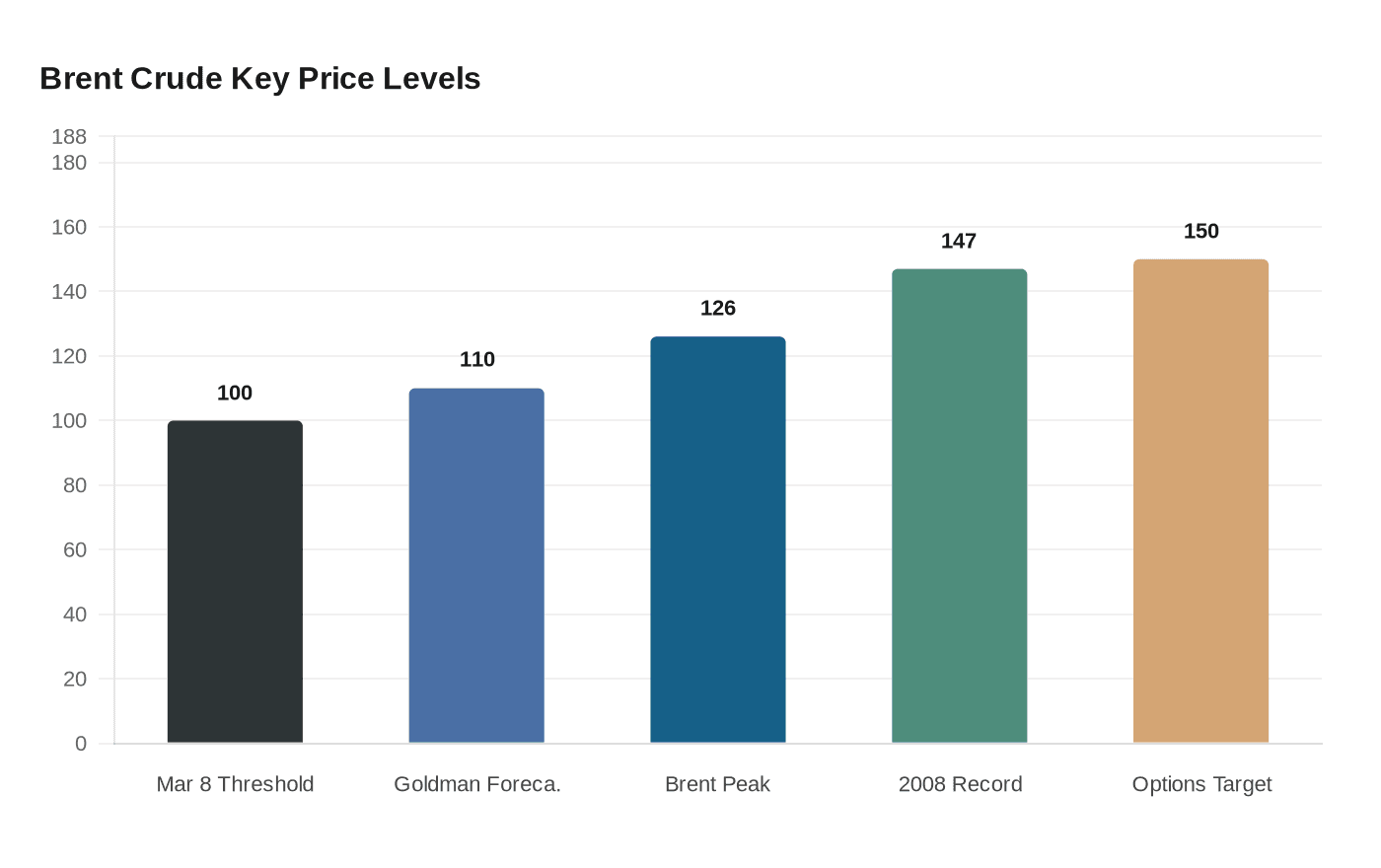
Goldman Sachs warns Brent crude could shatter the untouched 2008 record of $147 as Hormuz flows sit at 5% of normal, with Brent already having peaked at $126 this month.

Daan Struyven, who leads oil research at Goldman Sachs, issued the bank's starkest warning yet on March 20: if Hormuz flows remain at just 5 percent of normal through mid-April, Brent crude will likely exceed $147 per barrel, the record set in July 2008 and left untouched through two decades of subsequent crises. Goldman's commodity desk described the Strait's near-closure as the largest supply shock it had ever modeled. The International Energy Agency's head called it the greatest global energy security challenge in history.
Brent had not traded above $100 in four years before US-Israel strikes on Iran triggered the Strait's closure around March 2. It cleared that threshold on March 8 and climbed to $126 at its peak. Goldman raised its Brent forecast to an average of $110 for March and April, a 62 percent jump from 2025's annual average, and revised WTI estimates to $98 for March and $105 for April. Options traders, reading the same data, began pricing in $150 oil by the end of April.
The Strait channels roughly 20 million barrels of crude and refined products per day, about a fifth of global supply. Its effective closure severed the primary route for Gulf oil reaching China, India, Japan, South Korea, and much of the developing world. Saudi flows to China and India tightened immediately, and the world's top oil exporter reduced Asia sales as war-driven logistics pressures intensified. What the market had absorbed as a regional shock quickly spread outward, reaching European and American consumers who had initially felt insulated.

Several major energy companies declared force majeure, releasing themselves from contractual supply obligations. Insurance premiums for tanker ships surged across Gulf shipping lanes as war-risk exposure spiked, pushing freight costs higher for any cargo willing to attempt the route.
Governments moved simultaneously on multiple fronts. The IEA authorized a coordinated strategic petroleum reserve release. Japan, alongside Britain, France, Germany, Italy, and the Netherlands, issued a joint statement pledging to stabilize energy markets and support the most affected nations. In Tokyo, Japanese officials activated emergency reserves. Vietnam's Ministry of Industry and Trade, on March 10, urged employers to shift to remote work to curb domestic fuel consumption; Pakistan and Thailand followed with similar temporary measures.
The market's vulnerability traces to a structural problem years in the making: spare production capacity that once absorbed disruptions has been steadily eroded, leaving the global oil supply with almost no cushion when the Strait went quiet. That fact has amplified every price signal since March 2 and made the Goldman $147 scenario less of a tail risk than a plausible outcome.
On March 21, Trump posted a 48-hour ultimatum to Iran demanding the Strait's full reopening, threatening strikes on Iranian power infrastructure. Iran rejected the terms. WTI crossed back above $100 within hours. With flows still at a fraction of normal and no diplomatic resolution visible, the record that survived the financial crisis, the shale boom, a pandemic, and a European land war is within reach for the first time since the summer of 2008.
This article was produced by Prism’s automated news system from verified source data, official records, and press releases, then run through automated quality and moderation checks before publishing. The system is built and supervised by the people who set the standards it runs under. Read our full AI policy.
Did this article answer your question?


