House Foreign Affairs Committee Advances Chip Security Act Amid AI-Export Scandal
Super Micro's co-founder was charged with smuggling $2.5B in Nvidia chips to China just days before the House Foreign Affairs Committee advanced the Chip Security Act.

Super Micro Computer co-founder Yih-Shyan Liaw was in federal custody on smuggling charges when the House Foreign Affairs Committee advanced the Chip Security Act on March 26, voting to move H.R. 3447 to the full House floor. The timing was not coincidental.
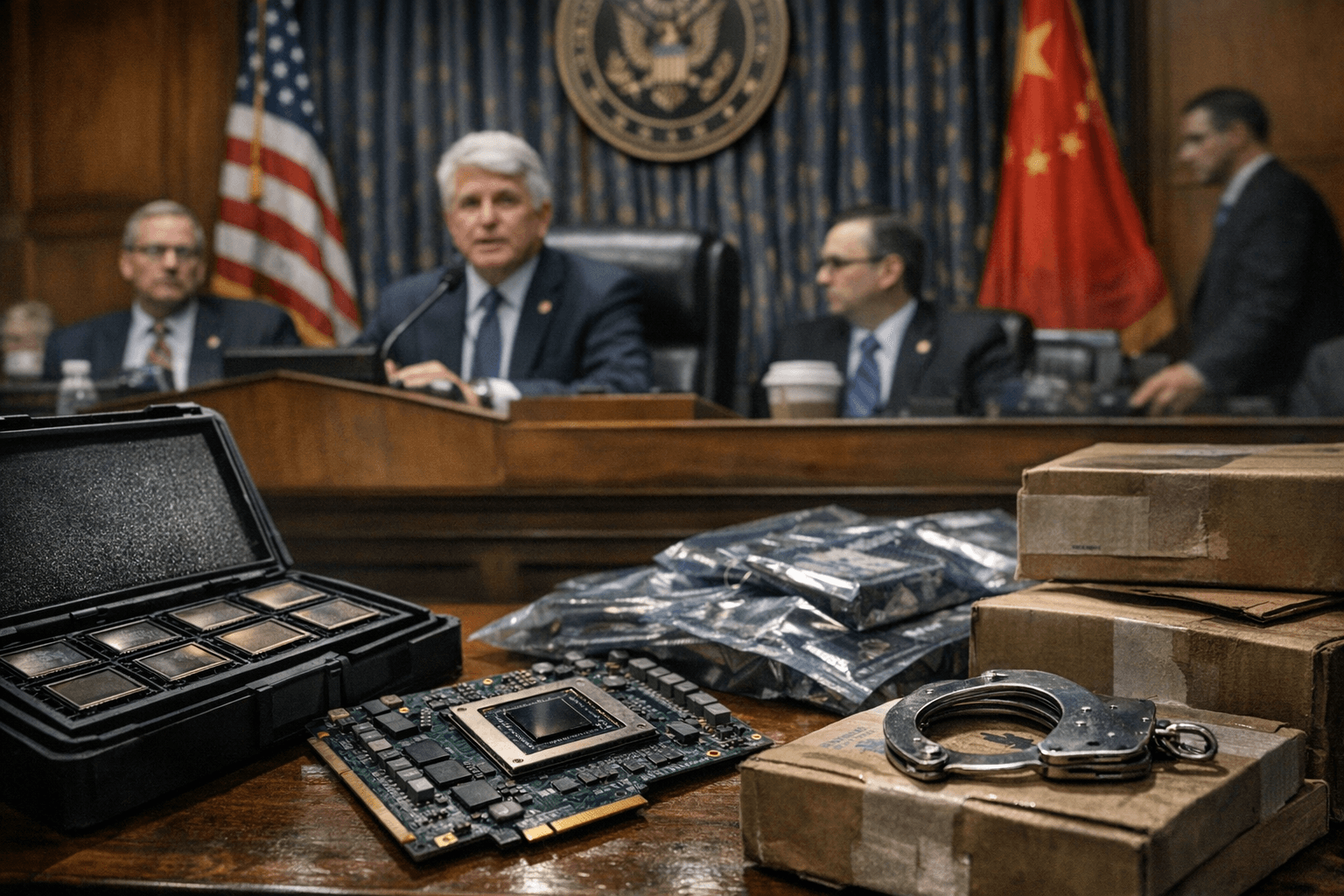
The Justice Department charged Liaw, Ruei-Tsang Chang, and Ting-Wei Sun in an indictment unsealed in federal court in Manhattan, alleging a complex scheme to send U.S.-made servers through Taiwan to Southeast Asia, where they were swapped into unmarked boxes and sent on to China. The indictment charges that the trio conspired to illicitly ship AI servers containing Nvidia chips worth $2.5 billion to Chinese customers between 2024 and 2025. That case was the most prominent in a cascade of federal actions: in November 2025, DOJ accused four individuals of running a front company in Florida that received $4 million in wire transfers from Chinese firms to purchase and export Nvidia chips, and a month later unsealed another indictment against a U.S.-based smuggling operation accused of sending $160 million worth of Nvidia chips to China.
The Chip Security Act, bipartisan legislation co-led by Reps. Bill Huizenga (R-MI) and Bill Foster (D-IL), is designed to close the structural gaps those prosecutions exposed. Huizenga, Foster, Reps. John Moolenaar (R-MI), Raja Krishnamoorthi (D-IL), Rick Crawford (R-AR), Ted Lieu (D-CA), Darin LaHood (R-IL), and Josh Gottheimer (D-NJ) introduced the bill, which was referred to the Committee on Foreign Affairs. Sen. Tom Cotton (R-AR) leads the Senate companion, S. 1705.
Rather than relying solely on export licensing paperwork, the legislation takes aim at the hardware itself. The Chip Security Act would require advanced chips to have built-in security features that can verify their physical location and detect tampering after they are sold abroad, with the goal of stopping powerful AI chips from being smuggled or diverted to banned users or countries. Under the bill's enforcement framework, the Secretary of Commerce would be required to assess secondary chip security mechanisms and would gain new authority to verify that exported chips have not been diverted, with manufacturers obligated to report credible information about any change in a product's location or ownership.
The bill would also require the Secretary of Commerce to verify, in a manner the Secretary determines appropriate, the ownership and location of a covered integrated circuit product that has been exported, reexported, or transferred to a foreign country, and to maintain a record of covered products including the location and current end-user of each.
Huizenga's office specifically cited the House Select Committee on the Chinese Communist Party's report on DeepSeek as evidence that export controls without enforcement teeth are insufficient. "American innovation and AI computing technology has the potential to change everything from how we complete daily tasks to unlocking the next era of scientific breakthroughs," Huizenga said in a statement when the bill was introduced in May 2025.
Not everyone views the legislation as the right remedy. The Information Technology Industry Council warned that the bill would require companies to track exported AI chips in ways that go beyond commercial necessity. The group argued that a government chip tracking mandate would create the impression of deepening U.S. government control over the American AI stack, fueling questions about the security, reliability, and privacy of U.S. technology and pushing the very countries that should be core customers of U.S. providers toward alternatives. ITI recommended greater staffing, resourcing, and oversight of the Bureau of Industry and Security as a more effective path that avoids undermining global trust in American technology.
Critics have also argued that adding tracking and control functions into hardware could introduce new security vulnerabilities that hackers or foreign governments might exploit, increase costs and complexity for chip makers, and make allied countries wary of using U.S. technology.
The committee's decision to advance the bill came the same day a separate set of defendants, Stanley Yi Zheng, Matthew Kelly, and Tommy Shad English, were charged with conspiracy to commit smuggling and export control violations after allegedly attempting to procure millions of dollars' worth of restricted chips from a California-based hardware company. The FBI arrested Zheng on March 22, 2026; Kelly and English surrendered three days later.
The bill now heads to the full House, where it will face the same fault line that has defined the export-control debate since advanced chip restrictions began in 2022: how tightly Washington can police its own technology without eroding the commercial dominance that makes that technology worth protecting.
This article was produced by Prism’s automated news system from verified source data, official records, and press releases, then run through automated quality and moderation checks before publishing. The system is built and supervised by the people who set the standards it runs under. Read our full AI policy.
Did this article answer your question?