House Plans Its Own DHS Funding Bill, Rejecting Senate's Approach
Speaker Johnson rejected the Senate's DHS deal and proposed an 8-week stopgap, as 61,000 TSA workers miss a second paycheck and airport lines stretch past four hours.
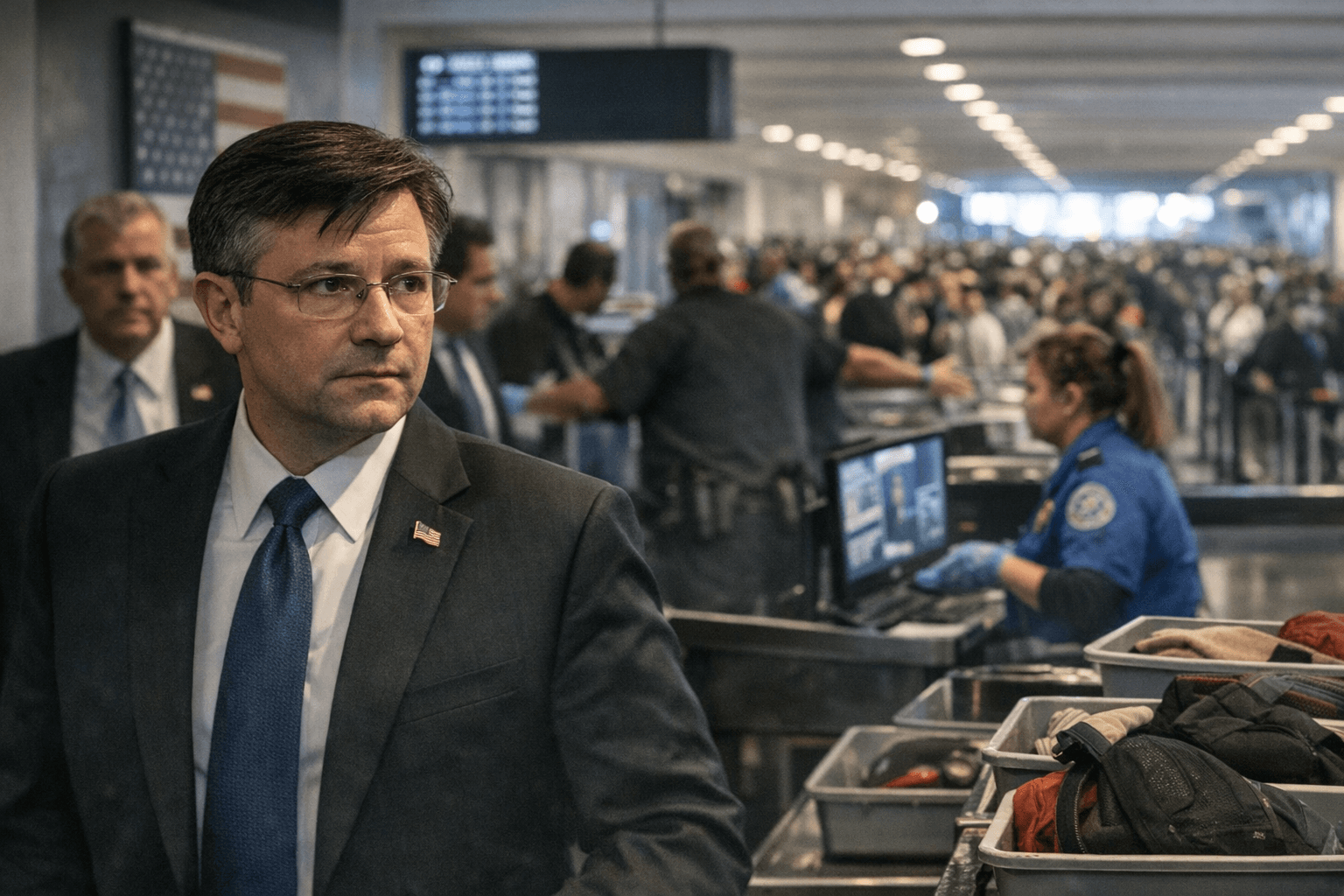
Long lines greeted travelers before dawn at some airport security checkpoints across the country, including at Baltimore-Washington International Airport, where lines snaked outside along the curb as passengers waited to enter the terminal. On Day 42 of the DHS shutdown, Speaker Mike Johnson had a blunt message for the Senate's overnight deal: "This gambit that was done last night is a joke."
The Senate reached a deal early Friday to fund most of DHS, except for Immigration and Customs Enforcement and parts of Customs and Border Protection, in a move to end the partial government shutdown that has disrupted air travel across the U.S. But the bill never got a House vote. Speaker Mike Johnson agreed in a meeting with the Freedom Caucus to put a 60-day continuing resolution that funds all of DHS, including ICE and CBP, on the House floor in lieu of the Senate-passed bill.
The move will prolong the more than five-week-long shutdown of the Department of Homeland Security, requiring the Senate to come back and approve the House bill. Senate Democratic leaders have already said that bill is dead on arrival in their chamber.
The two sides are separated by a narrow but politically combustible set of demands. Rep. Andy Harris, the Maryland Republican who chairs the Freedom Caucus, said they would only support a version of the bill that adds back ICE and CBP funding, plus a federal voter identification requirement. "The only thing we're going to support is adding that funding into the bill, adding that voter ID, sending it back to the Senate, make them come back and do their work," Harris said. Freedom Caucus members huddled in Johnson's office Friday morning before emerging with their position unchanged.
Rep. Chip Roy of Texas sharpened the attack on the Senate's approach. "I mean could the Senate be any more lazy than to send to us a bill that doesn't do the job and then leave town?" Roy asked.
House Democrats rejected that framing entirely. "The only thing standing between ending this chaos or not are House Republicans," House Minority Leader Hakeem Jeffries told reporters. "There's a bipartisan bill that emerged from the Senate with uniform support, and it should be brought to the floor immediately." House Democratic Whip Katherine Clark issued a notice Friday advising that additional votes related to DHS funding "are possible today and throughout the weekend" and that "members are encouraged to remain in D.C."
The procedural clock is working against a quick resolution regardless of which bill moves. A vote held under suspension of the rules, a streamlined process that requires a two-thirds majority, could not be held Friday under House rules, which only allow suspension votes on Mondays, Tuesdays or Wednesdays. House GOP leaders notified members that votes are expected later Friday after the Rules Committee finishes its work. "Upon completion of Rules Committee business, votes are expected in the House this evening," said a notice from House Majority Whip Tom Emmer.
Even that path is contested. Republican leaders could bring up a bill in the House Rules Committee with a rule that has same-day authority, which would require two-thirds of the House to approve; it is not clear if Democrats would provide the votes needed to clear that threshold.
Meanwhile, the human cost of the standoff has passed a grim milestone. By Friday, TSA had reached over $1 billion in missing paychecks because of the shutdown. TSA's acting administrator testified that many workers have "missed bill payments, received eviction notices, had their cars repossessed and utilities shut off, lost their child care, defaulted on loans, damaged their credit line and drained their retirement savings." Roughly 61,000 TSA workers have missed two full paychecks and a partial one since DHS funding lapsed on February 14. Since the beginning of the shutdown, 510 TSA officers have quit, according to TSA, as of Friday afternoon.
Trump signed an executive order on Friday instructing the Homeland Security secretary to pay TSA officers immediately, with payments possible as early as Monday. A handful of airports experienced daily TSA officer callout rates of 40%, and nationwide on Thursday, more than 11.8% of TSA employees scheduled missed work, the most so far. Privately, some GOP lawmakers and senior aides acknowledged they are pushing the party into even more treacherous political territory, with no clear plan to force Senate Democrats to accept their version of the bill and no certainty that Trump's maneuver to unilaterally pay TSA employees will work either.
The Senate for five weeks has been unable to reach an agreement on ICE and CBP funding, and the House's continuing resolution is unlikely to break that logjam. With the FIFA World Cup set to open at U.S. venues on June 11, TSA anticipates a significant influx in passenger volume as fans travel through airports to see the games, and even if TSA were to hire new officers upon conclusion of the shutdown, those officers would not be ready in time without a rapid resolution to the funding standoff.
This article was produced by Prism’s automated news system from verified source data, official records, and press releases, then run through automated quality and moderation checks before publishing. The system is built and supervised by the people who set the standards it runs under. Read our full AI policy.
Did this article answer your question?

