Houthis Fire Missiles at Israel, Widening Iran War to Yemen
Yemen's Houthis fired ballistic missiles at Israel for the first time as 12 American soldiers were wounded at a Saudi airbase, stretching a month-old conflict to its widest front yet.
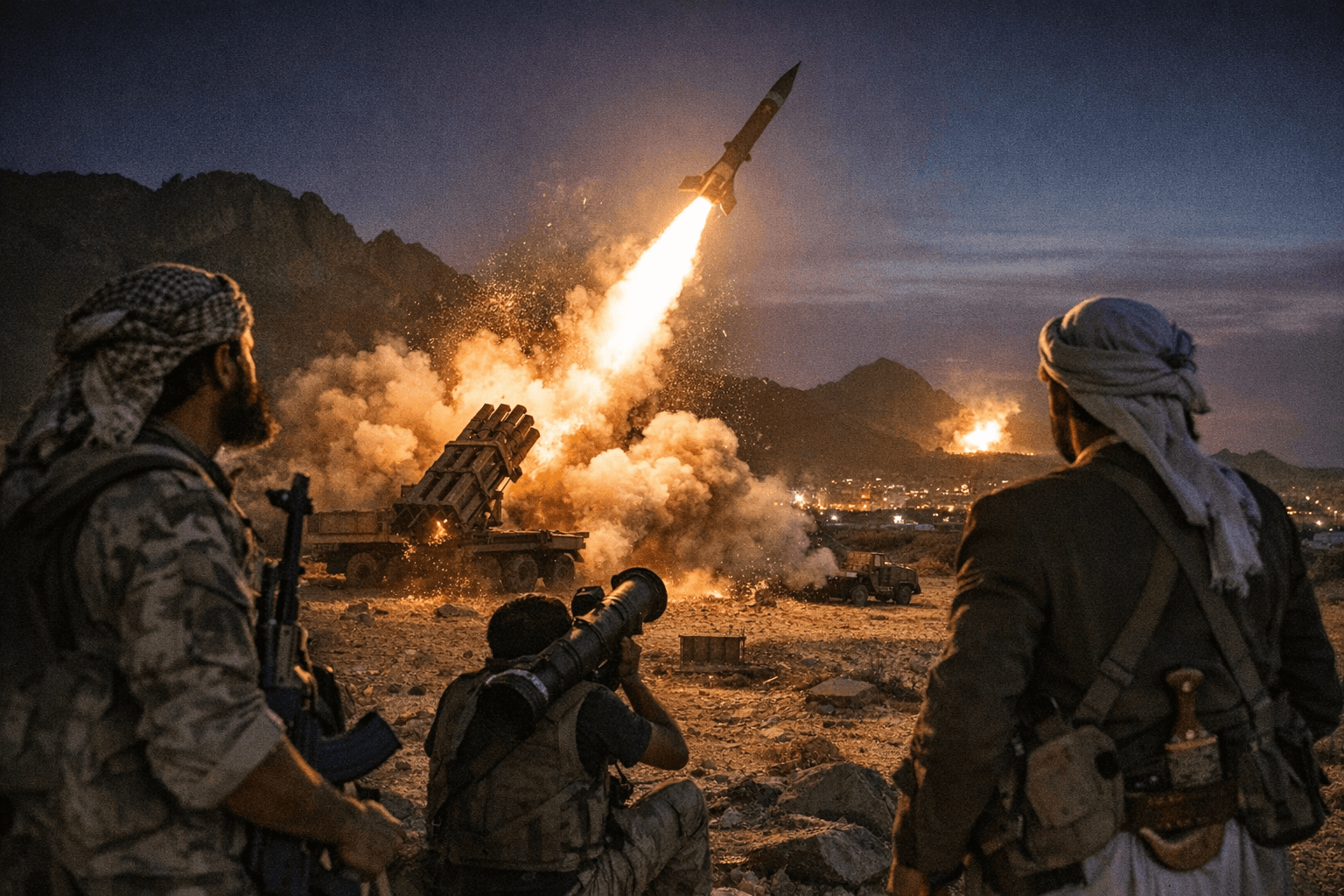
Twelve American soldiers were injured in an Iranian missile strike at Saudi Arabia's Prince Sultan Airbase Saturday, the same morning Yemen's Houthi movement fired ballistic missiles at Israel for the first time since the Iran war began, stretching a month-old conflict to its widest geographic boundaries yet.
Israel intercepted the Houthi barrage, and the attack on Israeli military sites was ultimately unsuccessful. But the strategic damage was immediate. By opening fire, the Iran-backed militant group in Yemen forced Israel and the United States to defend against a second front, splitting air defense assets and munitions across a broader theater even as both countries continued absorbing direct Iranian strikes.
The Houthis said they targeted "sensitive Israeli military sites" with a barrage of ballistic missiles and took full credit for the strike. Their paramount leader, Abdul Malik al-Houthi, had telegraphed the move five days into the war, declaring: "Regarding military escalation and action, our fingers are on the trigger, ready to respond at any moment should developments warrant it." On Saturday, the trigger was pulled.
The timing tracked directly to Tehran. Iran's new supreme leader, Ayatollah Mojtaba Khamenei, said Thursday in his first written statement, read by a state television announcer, that Iran may open "new fronts in the conflict." Analysts read that as an instruction to the Houthis. The Axis of Resistance Joint Operation room, run by the Islamic Revolutionary Guard Corps' Quds Force, controls those decisions: how proxy forces enter the fight and when.
The compounding effect is what worries defense analysts most. The Soufan Center assessed that Houthi intervention is calibrated to deplete Israeli and American air defense supplies, enabling a higher percentage of Iran's own remaining missiles and drones to reach their targets. Every interceptor fired at a Houthi ballistic missile is one fewer available for Tehran's next volley. U.S. and Israeli combat aircraft, already committed to striking Iran, may now have to pivot toward Houthi launch sites in Yemen.
The Red Sea risk is the sharpest near-term variable. Farea Al-Muslimi, a research fellow at the Chatham House think tank, said Saturday that "the potential impact on key commercial maritime routes, especially in the Red Sea and the Bab al-Mandab strait, cannot be overstated." The Middle East Institute has described a full escalation scenario in which the Houthis deploy missiles, drones, naval mines, and anti-ship weapons across the Red Sea, targeting maritime traffic and Gulf energy infrastructure. Combined with Iran's possible closure of the Strait of Hormuz, analysts warn that sustained Houthi operations could cause unprecedented disruption to global maritime trade, driving up shipping and energy costs worldwide.
The Houthis had publicly listed three conditions for entering the war: Middle Eastern countries allying with the U.S., American or Israeli use of the Red Sea for military operations, and a continuing campaign against Iran. All three had been met.
Diplomacy had not slowed the acceleration. Through Pakistani officials this week, the U.S. shared a 15-point action list seeking a ceasefire. Iranian officials dismissed it and returned with their own demands. The talks produced no agreement.
About 3,500 additional U.S. troops arrived in the Middle East as the Houthi entry unfolded, raising the personnel exposure at every American position in the region. Separately, Iran's central operational command claimed it struck a Ukrainian anti-drone system depot in Dubai that it said was assisting U.S. forces; Dubai authorities had not immediately confirmed the claim.
With Houthi forces now actively engaged, U.S. planners face a narrowing set of choices: absorb the added strike pressure, commit naval and air assets to suppressing Houthi launch sites in Yemen, or escalate directly against Iran. Each option carries compounding costs. None of them shrinks the war.
This article was produced by Prism’s automated news system from verified source data, official records, and press releases, then run through automated quality and moderation checks before publishing. The system is built and supervised by the people who set the standards it runs under. Read our full AI policy.
Did this article answer your question?


