How gerrymandering is reshaping U.S. elections before voters cast ballots
Safe districts are shifting power to primaries, rewarding the loudest partisans and helping lock in Congress and statehouses before a single vote is cast.
Why the map now matters more than the vote
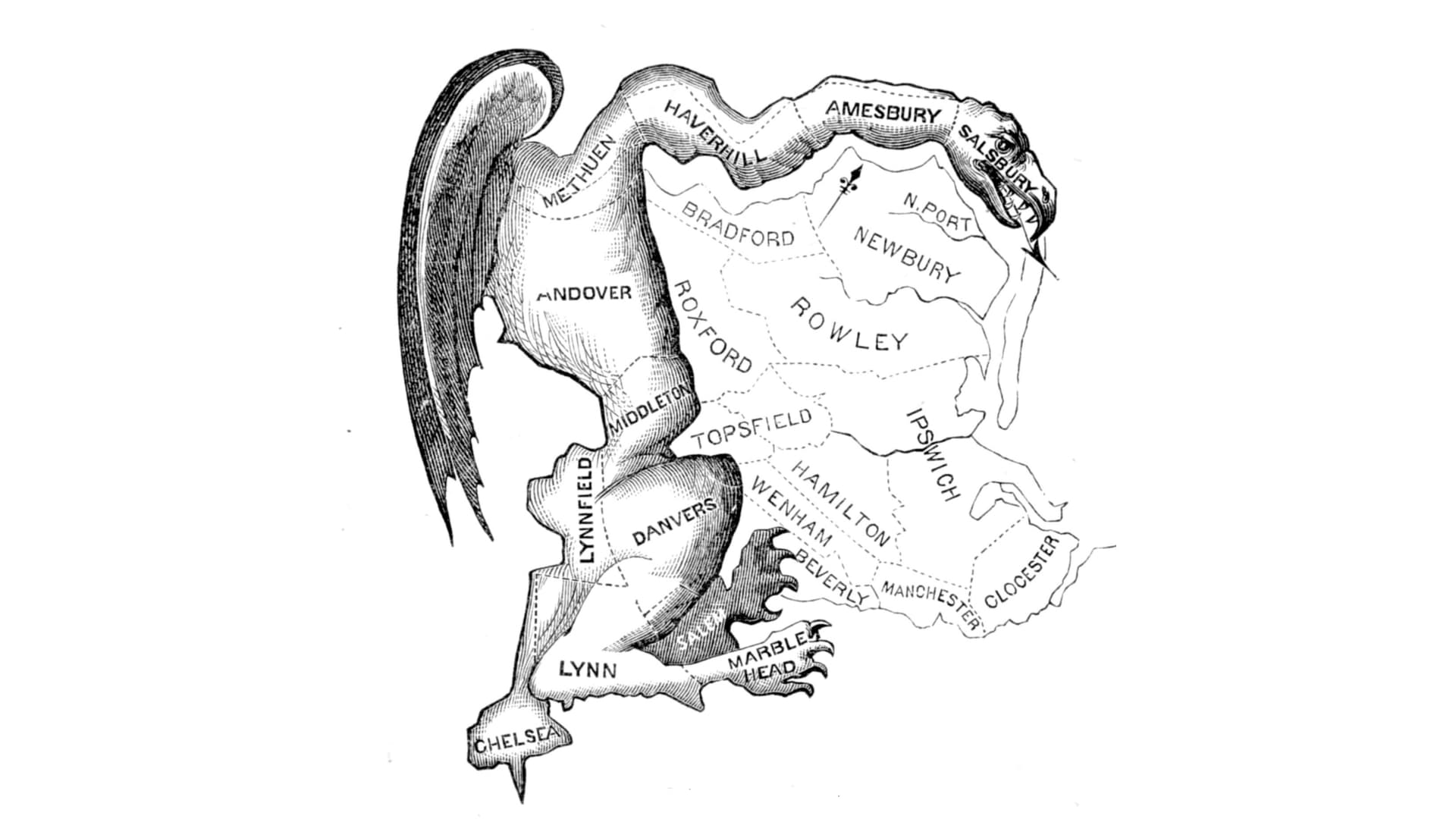
Politicians are no longer content to leave elections to chance. In state capitals across the country, they are trying to choose their voters as often as every two years, using district lines to shape who can win before campaigns even begin. Gerrymandering, the practice of drawing electoral boundaries to give one party an advantage or dilute minority voting power, has become one of the most consequential tools in American politics.
The term itself reaches back to Massachusetts Gov. Elbridge Gerry and an 1812 state Senate map whose strange shape was likened to a salamander. What once sounded like a quirky historical footnote now describes a central mechanism of power. Congressional and state legislative lines are normally redrawn every 10 years after the census, but recent battles show that once-a-decade redistricting is increasingly being used as a partisan weapon.
How the law got here
The modern legal framework began with a series of landmark Supreme Court decisions that forced districts to be built around population rather than geography or rural clout. Baker v. Carr in 1962 and Reynolds v. Sims in 1964 established the principle that legislative districts must be apportioned on a population basis. That was a major shift away from systems that had favored land area or the political weight of rural regions.
Later, Shaw v. Reno in 1993 created another limit by allowing challenges to districts that appear to be racial gerrymanders. Under that ruling, bizarrely drawn districts can violate the Equal Protection Clause when race is the only explanation for their shape. Together, those decisions shaped the rules of the game, but they did not eliminate the temptation to manipulate the map.
The biggest turning point for partisan gerrymandering came in Rucho v. Common Cause in 2019. The Supreme Court held that partisan-gerrymandering claims are political questions beyond the reach of federal courts. In practice, that pushed the fight into state politics, state courts, ballot initiatives, and state litigation, where the outcome often depends on which party controls the institutions drawing the maps.
Why safer seats change political behavior
The damage from gerrymandering is not only visible in odd district shapes. Its deeper effect is on political incentives. When districts are drawn to be safe for one party, the real contest often shifts away from the general election and toward the primary, where the most ideological and motivated voters usually dominate. That shift punishes moderation, because candidates have less reason to appeal to the center and more reason to avoid being outflanked by their own party.
That is one reason map drawing helps explain paralysis in Congress and in statehouses. If a district is effectively decided in a low-turnout primary, compromise can look like weakness and ideological hard line can look like survival. The result is a political system that rewards candidates for speaking to the base, not for building broad coalitions, even in places where the general electorate is more mixed than the district itself suggests.
The current map landscape reflects how geographically sorted the United States has become. A Brennan Center analysis said skewed maps would give Republicans about a 16-seat advantage in the 2024 House race compared with fairly drawn maps, and it estimated that only about 1 in 10 districts are competitive. The same analysis said Republicans had big advantages in 11 states, mostly in the South and Midwest. In that environment, line-drawing can determine control of Congress and state legislatures before voters cast ballots.
What the latest redistricting fights reveal
The post-2020 Census cycle showed how quickly redistricting can become a live political weapon. Delayed census data slowed the process in 2021 and added political turmoil in several states. At the same time, court decisions created an alternative route for challenging gerrymanders through state constitutions, even as control of map drawing remained a decisive factor.
The 2024 election cycle made the consequences especially visible. In Alabama, courts forced the state to use a court-imposed congressional map after litigation under Section 2 of the Voting Rights Act. That made Alabama the only state in the country to use a court-imposed congressional map in the 2024 elections, a striking sign of how redistricting fights can move from legislatures to judges when the map is challenged successfully.
A newer and even more aggressive development is midcycle redistricting, meaning the lines are redrawn between censuses. Pew Research Center says this has been extremely uncommon in the modern era, which is why the 2025 moves stood out so sharply: Texas Republicans redrew congressional districts to strengthen the GOP, and California countered with its own redistricting effort to aid Democrats. That back-and-forth shows how quickly one party’s tactical move can trigger another, turning what used to be a decennial procedure into a recurring partisan arms race.
Why reform is now part of the democratic argument
The current wave of gerrymandering has drawn criticism not just from reform groups but from political scientists, pollsters, and voters who see the process as corrosive to democracy. Harvard Kennedy School has described the present as a “unique moment,” arguing that gerrymanders are more extreme and more aggressive than before. The Brennan Center has made a parallel point, saying partisan mapping can be done with scientific precision and often comes at the expense of communities of color.
Public opinion has hardened as well. Reuters/Ipsos polling in 2025 found that most Americans viewed efforts to maximize partisan gains through redistricting as bad for democracy. That skepticism matters because map drawing is one of the least visible tools in modern politics, yet it can shape who governs long before campaign ads run or ballots are counted.
The core tension remains unchanged: state legislatures hold major power over elections, while federal courts have stepped back from policing partisan line-drawing. That leaves the shape of democracy itself vulnerable to a process that is technical, legalistic, and deeply political all at once. As long as maps can be engineered to lock in safer seats, the incentives that drive American politics will keep tilting away from persuasion and compromise and toward permanent combat.
Know something we missed? Have a correction or additional information?
Submit a Tip