How PopUp Bagels aims to bring New York bagels nationwide
Investors are turning a once-local bagel into a national play, and PopUp Bagels is testing how far scale can go before craft gets diluted.
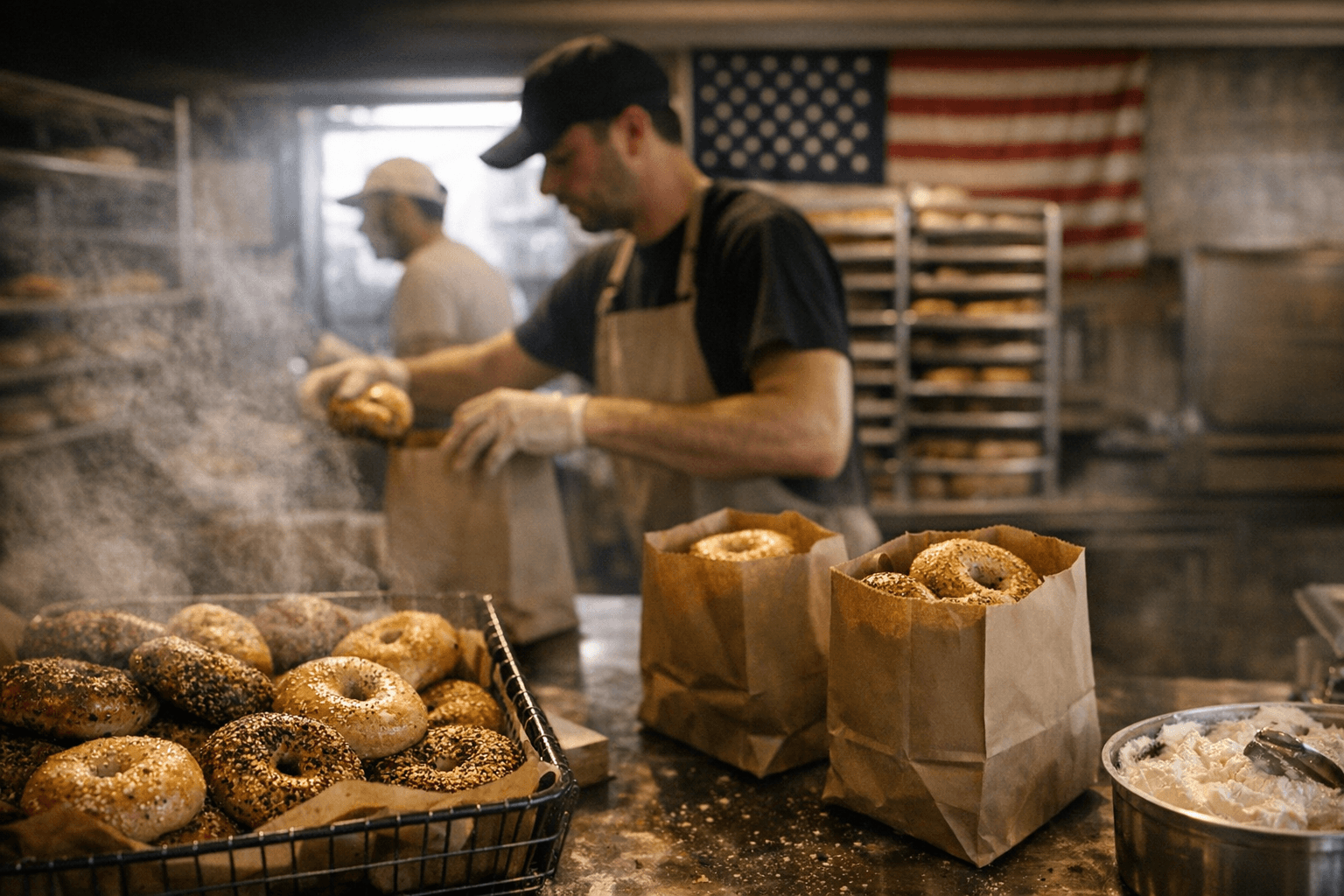
From immigrant staple to national asset
PopUp Bagels is trying to turn a food with deep neighborhood roots into a national brand, and that is exactly why investors are interested. Bagels were once most closely associated with a handful of cities, especially New York and Montreal, because their rise was shaped by Jewish immigrants from Poland and other parts of Eastern Europe. Hersz Lender, a Jewish baker from Lublin, Poland, is credited with bringing the bagel to New York, where the doughy ring evolved from a plain Polish food into a morning staple served with cream cheese and lox.
That history matters because the bagel was never just a menu item. It was a product of migration, density, and adaptation. Between 1881 and 1914, more than two million Jews immigrated from Eastern Europe to the United States, and more than 12 million immigrants passed through Ellis Island between 1892 and 1954. In crowded Lower East Side tenements and other dense immigrant neighborhoods, the bagel became a recognizable urban food, then a symbol of New York itself.
Why investors see a chain opportunity
The pitch behind PopUp Bagels is that a deeply regional food can be standardized without losing the appeal that made it special. That is the financial logic now attracting capital: if a product has enough cultural pull, can it be packaged, branded, and rolled out at chain scale? PopUp Bagels has become one of the clearest tests of that idea.
The company was founded by Adam Goldberg in 2020 after he taught himself to make bagels during the first lockdown. It began in a Connecticut backyard during the pandemic, then spread through social media and word of mouth as a TikTok-fueled phenomenon. By October 2025, Bloomberg said the chain had 16 stores, including seven in New York, and was valued at $60 million. Bloomberg also reported that it planned to open 300 locations across the United States in the next four years.
The money has only gotten bigger. In April 2026, QSR reported that PopUp Bagels had around 30 locations nationwide, had signed 300 new locations as of July 2025, and was aiming for 100 stores by the end of 2027. Bloomberg separately reported that Tiger Global agreed to invest at a $300 million valuation, roughly five times the level the company was quoted at about five months earlier. Stripe became majority owner in October 2025 and remained the largest investor in 2026, according to QSR.
How the model is built to scale
PopUp Bagels is not trying to copy the classic New York bagel shop model piece by piece. Its format is intentionally leaner, with a menu and operating structure designed to make national growth easier than it is for traditional bagel businesses. The chain sells smaller bagels in packs of three or by the dozen, which creates a more repeatable transaction pattern and helps keep the brand focused on a few core products.
The numbers show how disciplined the model is. QSR reported that PopUp Bagels uses only about 55 SKUs, typically needs 10 to 15 employees at opening, and operates in locations around 700 to 1,200 square feet. Bloomberg said each store costs roughly $300,000 to $900,000 to open. That is below the initial investment range for Einstein Bros. Bagels, which says a traditional restaurant can cost about $555,000 to $1,030,500 and requires a minimum five-unit development commitment.
That lower capital burden is central to the expansion story. The chain can open smaller boxes, staff them more lightly, and keep the product line tight. In other words, it is not just selling bagels. It is selling a system that investors can understand, finance, and repeat.
Pricing, labor, and the economics of a bagel shop
PopUp Bagels also shows how the economics of everyday food are changing as they become investment vehicles. The company’s average transaction is north of $24, a strong figure for a category once associated with cheap breakfast fare. That price point suggests the business is not competing only on utility; it is competing on branding, scarcity, and a premium version of an everyday item.
Labor is part of the same equation. A shop that opens with 10 to 15 employees is easier to replicate than one that depends on a large staff or a highly specialized back room. Smaller footprints, limited SKUs, and a tighter labor model reduce complexity, which is exactly what makes the concept attractive to owners who want rapid rollout.
At the same time, that efficiency can sharpen the tension between expansion and craft. A bagel chain can grow faster when it standardizes the product, but standardization is also what makes some customers wonder whether the bagel still feels like a bagel from New York. The business case for scale is clear; the cultural case is more fragile.
Authenticity under pressure
This is where the story becomes bigger than bagels. PopUp Bagels has won attention from New York customers, but some purists question whether a nationally scalable bagel can still feel authentic. That skepticism is not just about taste. It reflects a broader fear that once a regional food becomes a venture-backed platform, the product may stay recognizable while losing some of the texture that gave it meaning.
The company’s celebrity investors, including Michael Phelps, Michael Strahan, Paul Rudd, Patrick Schwarzenegger, and producer John Davis, reinforce the sense that the brand has moved beyond a local bakery story. It now sits at the intersection of food, media, and finance. That kind of backing can accelerate awareness, but it also changes expectations: once a neighborhood staple becomes a national portfolio asset, it is judged not only on flavor but on growth metrics, unit economics, and exit potential.
What this says about the future of regional food
PopUp Bagels is part of a broader pattern in American food culture, where immigrant traditions begin as local necessities and later become mainstream brands. The history of bagels, from Eastern European Jewish bakeries to the crowded streets of New York, shows how identity and commerce have always been intertwined. What is different now is the speed and scale of the financial machinery around that process.
The bagel boom is not just about breakfast. It is about whether a food rooted in place can be expanded into a scalable brand without flattening the qualities that made it distinctive. PopUp Bagels is betting that national growth and regional character can coexist. Investors are betting even bigger, and the market is treating a once-hyper-local staple as if it were the next platform waiting to be unlocked.
This article was produced by Prism’s automated news system from verified source data, official records, and press releases, then run through automated quality and moderation checks before publishing. The system is built and supervised by the people who set the standards it runs under. Read our full AI policy.
Did this article answer your question?

