How the Slinky became a classic American toy
A dropped spring in 1943 became the Slinky, a toy sold in the millions after a Philadelphia debut, clever naming, and a patent that turned gravity into play.
%2Fhttps%3A%2F%2Ftf-cmsv2-smithsonianmag-media.s3.amazonaws.com%2Ffiler%2F5a%2Fb7%2F5ab7576a-7582-42ee-b6de-02f00df08e7b%2Fslinky.jpg&w=1920&q=75)
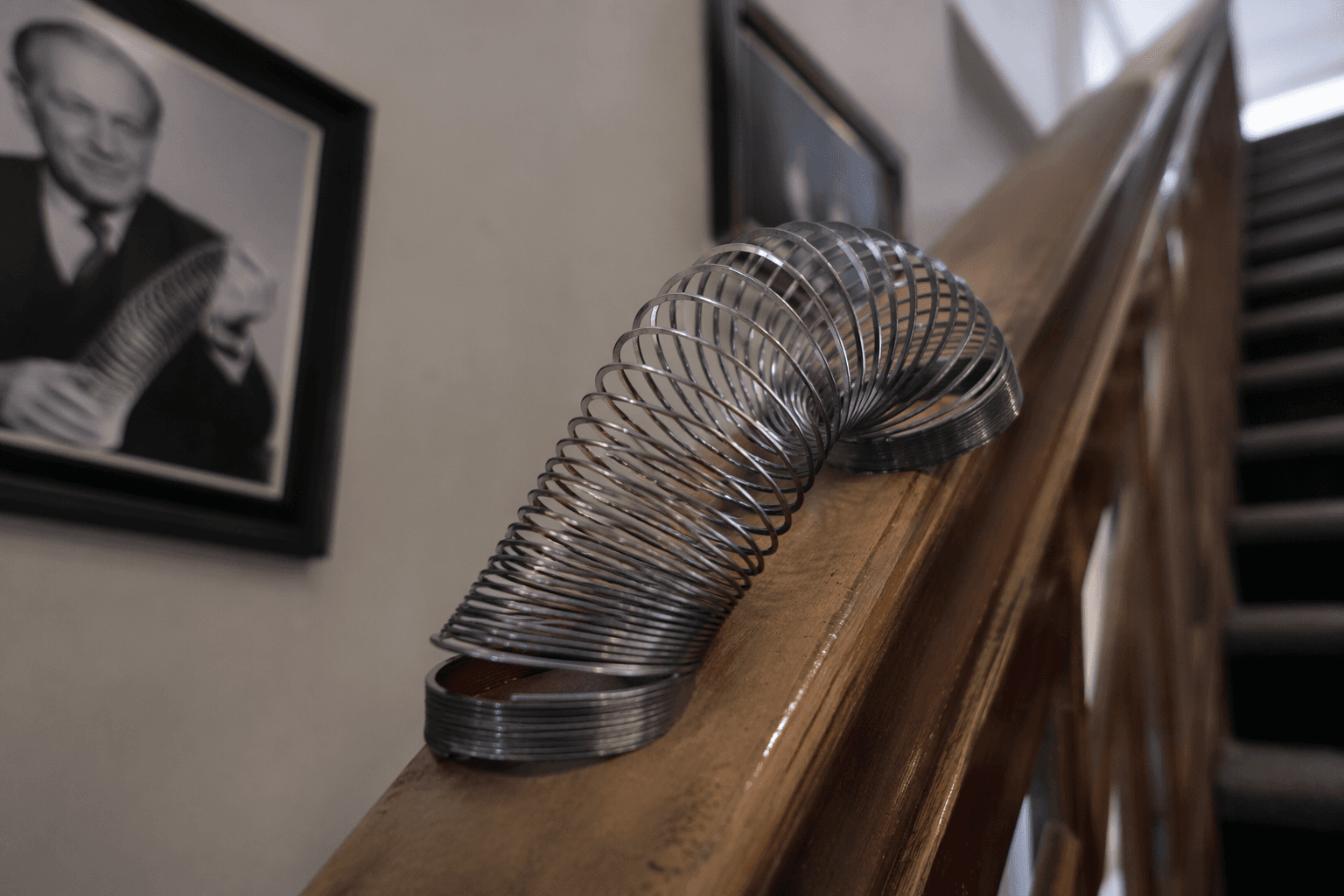
The Slinky began as a Navy hardware project, not a toy, and that accident is what made it endure. Mechanical engineer Richard James was trying to design equipment to secure cargo on rocking ships when a coiled spring slipped, tipped end-over-end across the floor, and suggested a new use entirely. From that moment, a piece of industrial metal started its long conversion into an American icon.
From ship hardware to backyard spectacle
James’s breakthrough came in 1943, during wartime work aimed at helping the Navy keep equipment and shipments in place at sea. The spring’s tumbling motion showed him that the object could move on its own in a way that was simple, visual, and oddly satisfying. That accidental behavior mattered, because the toy’s appeal was never hidden in complicated mechanics, it was built on a movement people could understand instantly.
The basic form also fit the moment. Americans in the 1940s were accustomed to making civilian goods from industrial materials, and the Slinky translated a spring from the machine shop into a handheld novelty. Its charm lay in that reversal: a utilitarian object became something children could send down stairs, across tables, and through the air with little more than a nudge.
Betty James gives it a name and a business
The transformation from oddity to product depended on Betty James. In 1944, she looked through the dictionary and chose the name “Slinky,” a word that suggested motion before anyone had seen the toy on a shelf. The name did real commercial work, because it gave the spring personality and made it easier to remember, say, and sell.
In 1945, Richard and Betty James co-founded James Industries with a $500 loan. That small sum was enough to turn a workshop idea into a company with a clear identity and a single, unmistakable product. The business launched during wartime America, when manufacturing discipline, material scarcity, and practical marketing all shaped what could reach the public.
The Philadelphia launch proved the market
The first major public demonstration came during the 1945 Christmas shopping season at Gimbel’s in Philadelphia. The setup mattered as much as the product: people needed to see the spring move to understand why it was fun. Four hundred Slinkys were on hand, each priced at $1, and they sold out in less than two hours.
That debut established the formula that would carry the toy for decades. The Slinky was not sold as an abstract idea; it was sold as a performance, and demonstrations turned curiosity into purchase. The combination of a memorable jingle, a live demonstration, and a toy that could surprise a crowd made it stand out from other novelties that vanished after a brief fad.
A patent that captured the engineering
James secured the invention in legal form on January 28, 1947, when U.S. Patent 2,415,012 was issued under the title “Toy and Process of Use.” The patent described a helical spring toy that could walk down stairs using gravity after a starting push, a concise explanation of why the object seemed to move with a life of its own. That formulation was more than a technical footnote, because it preserved the exact mechanics that made the toy legible to children and adults alike.
The patent also shows how closely the Slinky sat between engineering and play. It was not a decorative gadget or a passive object, but a device that demonstrated physics in motion. Gravity did most of the work, which is part of why the toy was so easy to reproduce, demonstrate, and scale.

Manufacturing in Clifton Heights turned novelty into longevity
James Industries manufactured the Slinky in Clifton Heights, Pennsylvania, until 1965. That long run tied the toy to a specific place and gave it an industrial footprint beyond the original invention story. The Pennsylvania Historical and Museum Commission later reinforced that connection with a historical marker installed in Clifton Heights in 2019, recognizing both the toy’s birthplace and its manufacturing history.
By the end of the 20th century, more than 250 million Slinkys had been sold. That total helps explain why the toy became more than a one-season sensation: it moved through generations as a familiar object in American homes, classrooms, and toy boxes. In 2000, the National Toy Hall of Fame inducted the Slinky, cementing its status as a standard of American play.
What the Slinky reveals about American innovation
The Slinky’s story fits a recurring American pattern: an accidental discovery, a practical name, a small company, and a dramatic public demonstration that makes the product feel bigger than its materials. It also shows how manufacturing location, retail timing, and simple theater can matter as much as the invention itself. A spring designed for Navy cargo became a mass-market toy because it was easy to understand, easy to show, and easy to remember.
That is why the Slinky still belongs in the country’s broader story as the United States approaches its 250th anniversary. It captures how ordinary objects become national symbols not through grandeur, but through a mix of ingenuity, commerce, and repetition. In the Slinky’s case, the nation did what it often does best: it took something accidental, made it work at scale, and gave it a life far beyond its original purpose.
This article was produced by Prism’s automated news system from verified source data, official records, and press releases, then run through automated quality and moderation checks before publishing. The system is built and supervised by the people who set the standards it runs under. Read our full AI policy.
Did this article answer your question?