How to Assemble a Personalized Self-Care Box for Gifting
Put together a thoughtful, theme-led self-care box—choose a purpose, pick a few curated items (aromatherapy, spa, snacks, tactile tools), pack it pretty, and add a handwritten note.

Start with a purpose. A self-care box can be “DIY, low-cost pampering present” or a targeted “self-soothe” kit: “This is a box you can make that contains things that ground you.” Decide whether you’re gifting relaxation, sleep help, skin pampering, or anxiety relief—every choice changes what belongs inside.
1. Determine the recipient's needs and preferences
Winebasket’s first instruction is simple and decisive: “Determine the recipient's needs and preferences.” Ask: do they unwind with baths, need grounding tools for anxiety, prefer chewy snacks, or spend time outdoors? If they’ve mentioned insomnia or stress, tilt the box toward sleep aids, aromatherapy, or tactile grounding tools. If they love the outdoors, include adventure-ready items like a hammock and headlamp.
2. Choose a theme for the package, such as self-care, relaxation, or wellness
Next, “Choose a theme for the package, such as self-care, relaxation, or wellness.” Make that theme specific: bath & body, aromatherapy, skincare, mindfulness, or outdoor-adventure. Narrowing the theme keeps the box coherent and stops you from overfilling with random things that never get used.
3. Select items that fit the theme and the recipient's needs and preferences
“Select items that fit the theme and the recipient's needs and preferences.” Below I’ve grouped every explicit item from the research so you can pick one or two from each category, with practical price ranges so you can build a box for $25 or $150 depending on how luxe you want to be.
- Aromatherapy & scent (lavender for relaxation; warm citrus for energy)
- Essential oils (lavender, citrus) — $8–$25 for a 10–30 ml bottle. Essential oils deliver targeted scent benefits and are a compact way to theme a box.
- Diffuser — $20–$60. A small ultrasonic diffuser makes aromatherapy usable in a bedroom or office.
- Candles / soothing candle scents — $10–$35. “A soothing candle scent can be a great item to put in a self-care basket. Not only will it help diffuse the soothing scent throughout your space, but the sight of a lit candle in your room adds to a cozy and relaxing atmosphere.”
- Lotion — $8–$30. Pick a scent that ties back to your theme.
- Bath & body / spa
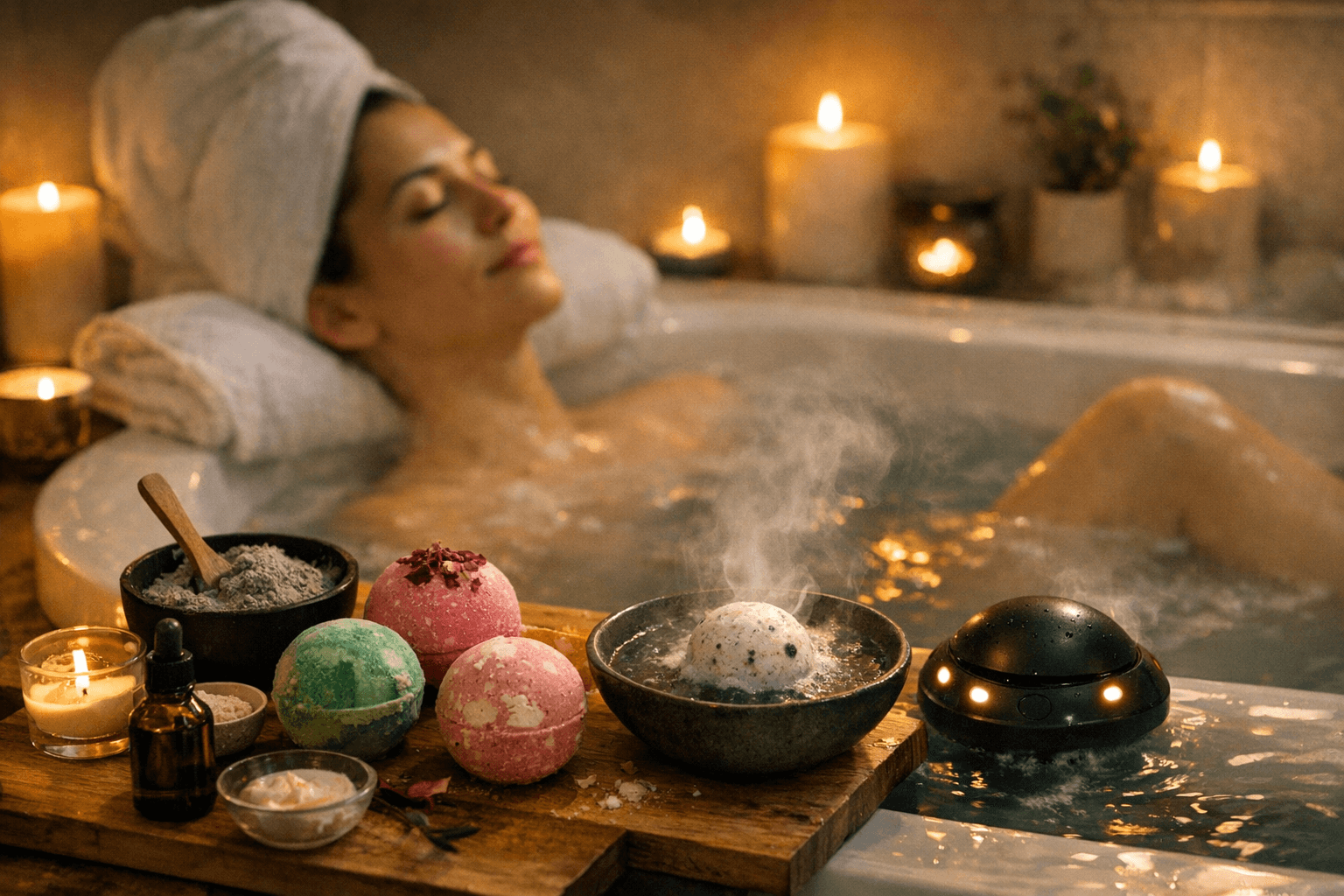
- Bath salts — $8–$20. A jar of bath salts instantly signals time set aside for a soak.
- Shower gel & body lotion — $8–$30 each. Coordinate scents for a tidy sensory experience.
- Loofah or sponge — $3–8. Small, useful, inexpensive filler.
- Cozy bathrobe — $30–$80. If you want a centerpiece, a plush robe is worth the splurge: it feels like a hug.
- Candles (again) and spa treatments — use them to anchor a “Spa Day” theme.
- Skincare & tools
- Facial cleansers, moisturizers, masks — $8–$35 each. Good for skincare-focused boxes.
- Jade roller / facial massager — $7–$100. Tools make a skincare box feel considered; rollers are cheap but feel luxurious.
- Mindfulness / tactile / grounding tools
- Playdough, fidget cubes, fidget spinners, stress balls — $3–$15. YoungMinds recommends tactile items: “Include something that you can touch. This serves as a good distraction for your hands. Playdough, fidget cubes or spinners, and stress balls are great for this.”
- Card sets and other mindfulness kits — $8–$25. Pack one themed card deck with calming prompts; it gives someone a simple practice to follow when they're overwhelmed.
- Rationale: tactile items “are satisfying to touch, and easy to put force into and relieve some stress. It can encourage your muscles to relax, which is what many methods to reduce anxiety involve.”
- Food & drink
- Herbal teas — $4–$12 per box; “cute mug” — $8–$20. “Add a box of herbal teas and a cute mug to your self-care basket and use them only in moments where you’re intentionally practicing some self-care.”
- Gourmet snacks (sweet or salty) — $4–$20. A small treat makes the box feel indulgent without being fussy.
- Physical relaxation tools
- Massage ball — $8–$20. Great for sore shoulders or travel aches.
- Yoga mat — $15–$60. If your recipient practices yoga, a new mat is meaningful and useful.
- Outdoor/adventure extras (for an adventure-themed box)
- Camping hammock — $20–$60.
- Waterproof phone case — $10–$25.
- Headlamp — $12–$40.
Winebasket explicitly calls these “An outdoor adventure gift basket” items for someone who loves exploring.
4. Pack the items in a basket, box, or bag
Winebasket instructs: “Pack the items in a basket, box, or bag.” Choose packaging that fits your theme—wicker for cozy/home spa, kraft box for mindful minimalism, or a durable bag for outdoorsy kits. Practical price examples: woven basket $10–$30, sturdy gift box $3–10, tissue and filler $2–8. Arrange items with the heaviest on the bottom and a focal item (robe, diffuser, hammock) on top so the recipient sees the highlight right away.
5. Add a personal note or card to the package to let the recipient know that you care
Never skip this: “Add a personal note or card to the package to let the recipient know that you care.” Handwritten notes cost $2–$6 but are priceless to the receiver. TheGoodLifeBoutique calls this “personal touches” — a small line about why you chose each item makes the gift intentionally curated rather than boxed.
6. Make a travel-friendly miniature self-soothe version
YoungMinds recommends a compact option: “I often take a miniature, more travel-friendly version when going on holiday also, which I would recommend if you find travelling stressful or anxiety-provoking.” Choose travel sizes: mini lotion and mask sachets ($1–6 each), a small stress ball ($3–6), and a sachet of tea. Pack them in a zip pouch so the recipient can toss it into carry-on luggage.
7. Encourage intentional use to remove decision fatigue
TheGoodLifeBoutique nails the point: “Creating a self-care basket can be a great way to remove any decision fatigue from your self-care moment and instead just focus on yourself.” Add a small “how to use” card: e.g., “Light the lavender candle, steep the chamomile, and inhale for five breaths.” That tiny nudge makes the box functional instead of decorative.
8. Final checklist before sealing the box
Run through Winebasket’s steps again as a checklist: 1) Determine needs, 2) Choose theme, 3) Select items, 4) Pack in a basket/box/bag, 5) Add a personal note. Confirm you’ve included sensory coverage if making a self-soothe kit: “something to smell, something to touch, something to look at and maybe even something to taste.” That line from YoungMinds is a practical rubric when you’re short on space.
Conclude with intent This isn’t about stuffing a box until it overflows; it’s about choosing a handful of things that speak to a person’s habits and mood. Whether you build a budget-friendly $25 box with a candle, tea, a stress ball, and a handwritten note, or a $150 luxe kit centered on a plush robe and diffuser, do it with the recipient in mind. A well-chosen self-care box removes friction and gives someone explicit permission to pause—and that’s the best gift you can give.
Know something we missed? Have a correction or additional information?
Submit a Tip