How to Plan and Play Minimal Techno Sets with Focused Flow
Focused flow wins: plan narrow arcs, pick tracks for restraint, and use small, deliberate changes to keep the dancefloor locked.

Minimal techno thrives on subtlety. If you're a newcomer or an intermediate DJ, this guide lays out how to plan, sequence, and deliver sets that prioritize focused flow, measured restraint, and the small but powerful changes that define the minimal aesthetic.
1. Define a clear set intention and flow arc
Decide the emotional and physical arc you want the dancefloor to follow before you load one track: meditative, driving, hypnotic, or a slow build toward release. For newcomers and intermediate DJs, thinking in terms of a single thread, a textural warp, a rhythmic motif, or a timbral slow-burn, keeps sequencing tight and prevents over-driving the set. Focused flow means limiting surprises to controlled moments; plan two or three pivot points where you will introduce a meaningful change rather than scattering attention across the night.
2. Curate with restraint: pick tracks that work together
Build crates of tracks whose differences are incremental: a clap with a different decay, a bassline with a shifted groove, or a pad with slight modulation. In minimal techno the aesthetic rewards restraint; pick records where "small but powerful changes" carry impact because the baseline context remains steady. Organize by texture and dominant element, percussion-led, bass-centric, or atmospherics, so you can layer and swap without breaking the set’s thread.
3. Sequence for gradual evolution, not sudden spikes
Sequencing is where focused flow becomes audible: move from sparse to denser arrangements in small steps so the crowd senses progression without jolts. Arrange tracks so each successor adds or subtracts one clear element, a hi-hat pattern, a reverb tail, a filtered layer, and avoid chaining multiple major changes at once. This approach turns micro-variations into momentum, keeping a dancefloor engaged while maintaining the minimal aesthetic.
4. Mix by subtraction and micro-adjustment
Mixing in minimal techno is often about removing rather than adding: carve frequencies, mute channels, automate tiny filter sweeps and do long blends that respect rhythmic space. Use EQ and gain to pivot attention between a kick and a groove, and let small fades or 4–8 bar swaps create tension and release. The discipline of restraint, fewer big FX drops, more gentle movement, reinforces the set’s focused flow and amplifies the impact of every chosen micro-change.
5. Use effects sparingly and purposefully
When you do use effects, make them decisive: a short delay to create rhythmic echoes, a narrow bandpass sweep to focus the midrange, or subtle saturation to thicken a loop. The minimal approach rewards one carefully timed effect more than an overworked chain; design each effect to alter one sonic parameter so the change reads clearly on the dancefloor. Map FX to specific pivot points you planned in step 1 so they underline, rather than drown, the set’s evolution.
6. Read the room and adapt without abandoning the plan
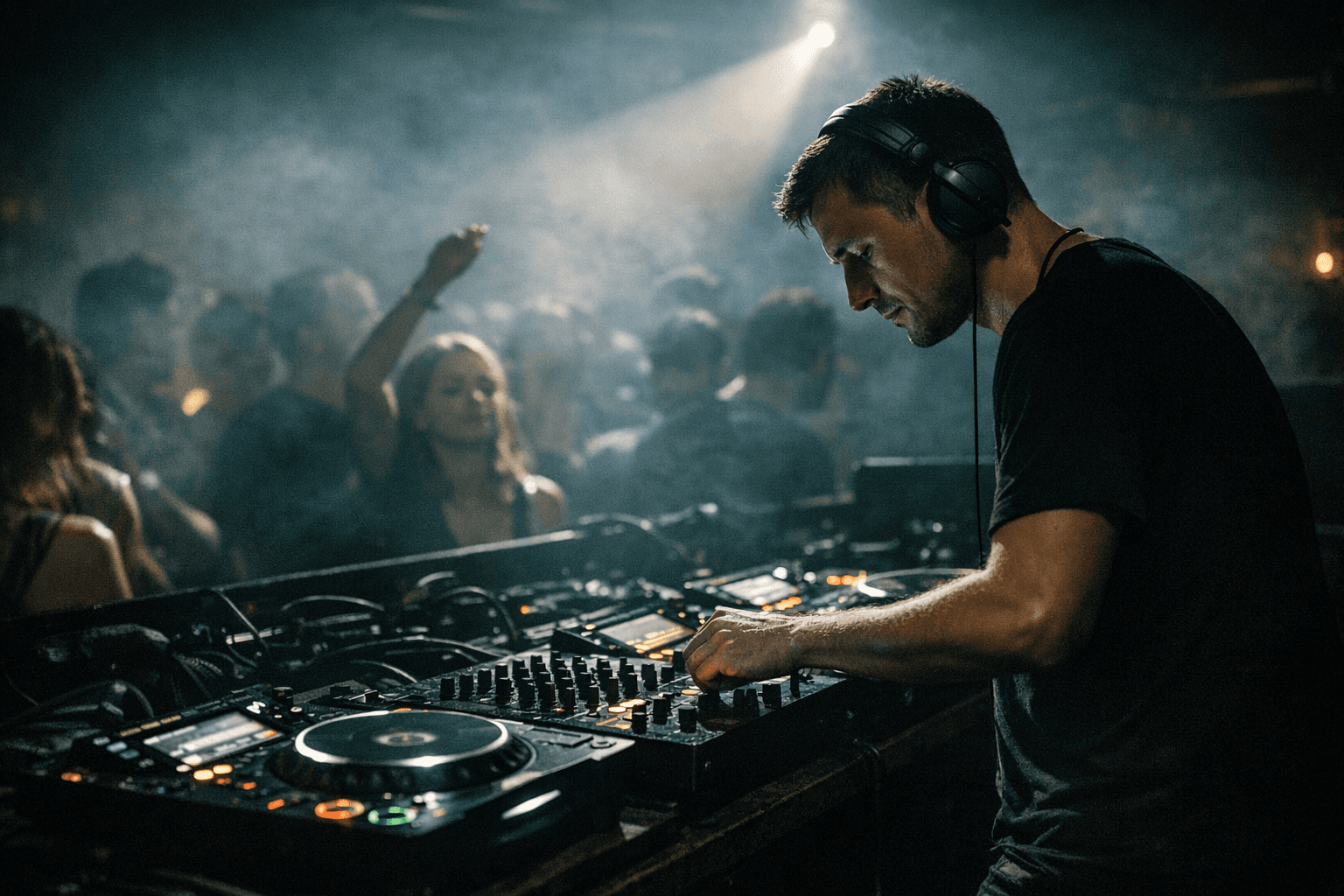
A focused set still needs to breathe with the crowd: watch movement, notice when people tighten or spread out, and match those moments with your pre-planned pivot points. If the dancefloor responds to textural warmth, extend those tracks and lean into that palette; if it wants more propulsion, bring forward records with clearer, driving grooves. Adaptation doesn’t mean wholesale reversal, keep your arc intact and make small, decisive changes that respect the minimal aesthetic while responding to real-time feedback.
7. Keep your setup reliable and signal flow simple
A tight, simple signal chain supports a restrained performance: prioritize stable routing, clear cueing, and basic FX sends that you know by feel. The minimal aesthetic thrives on musical choices, not technical showmanship, so avoid complex routing or deep FX chains that tempt you into over-processing. A dependable setup lets you focus on sequencing, micro-adjustments, and the subtle dynamics that make minimal techno dancefloor-ready.
8. Practice, record, and refine with intention
Rehearse full sets with the intended arc in mind and record them to evaluate whether your planned pivot points land the way you imagined. For newcomers and intermediate DJs, listening back reveals where you made too many changes, where restraint paid off, and which small edits had disproportionate effects. Use those recordings to refine crates, tighten transitions, and lock down the kind of focused flow that keeps people moving night after night.
- Tip: Limit yourself to only a few instruments or motifs per hour, this constraint encourages creative sequencing and elevates subtle changes into moments of consequence.
- Tip: Label tracks by dominant element (e.g., “percussion,” “bass motif,” “atmo”) so you can instantly find complementary pieces during a set.
- Tip: Schedule one rehearsal session per week around your planned arc and record it; the cumulative improvements are the quickest path from competent to authoritative.
Closing note: Minimal techno is a practice in precision. When you plan sets around a narrow, purposeful arc, select tracks for incremental difference, and execute changes deliberately, the dancefloor experiences continuity and momentum. For newcomers and intermediate DJs, that commitment to focused flow, rooted in restraint and small, powerful moves, turns a collection of tracks into a cohesive, dancefloor-ready performance.
Know something we missed? Have a correction or additional information?
Submit a Tip