How to Rehead and Maintain Your Drum Kit Step-by-Step
Keep your kit sounding great: a clear, step-by-step primer to rehead drums, tune toms, care for hardware and cymbals, and store your set for long life.
1. Who this guide is for: target and assumptions
This guide begins with the exact scope: "Who this guide is for: This evergreen primer is written for hobbyists and semi‑pro drummers who want a reliable, step‑by‑step approach to re‑heading and maintaining a drum kit. It assumes basic familiarity with hardware and standard tools (tuner, screwdriver, towel, and new heads). What you’ll accom" — that sentence from the source sets expectations: you already know your way around stands and a drum key, and this will walk you through the practical, repeatable steps of re‑heading and upkeep. Treat the truncated ending as a promise: the aim is practical competence with your heads, tuning, and daily maintenance.
2. Essential drum maintenance tips (big-picture)
"Essential Drum Maintenance Tips" is the header to remember: "Regular maintenance keeps your drum kit reliable, visually appealing, and sonically consistent." Build simple habits into your routine because, as the notes say, "Developing simple maintenance habits can prevent major issues over time." Think of maintenance as preventative tuning — small, regular checks save you from mid‑gig surprises and preserve tone and resale value.
3. Tools and consumables checklist
Make sure you have the fundamentals listed in the source: tuner, screwdriver, towel, and new heads — plus a drum key for tuning. Add dampening materials ("Use dampening if needed for control"), a light lubricant for hardware, and cymbal‑safe cleaners ("Clean them only with products designed specifically for cymbals, and always follow the manufacturer’s instructions"). Lay these out before you start: when you lift a hoop you want the right head, your key, and a clean workspace within reach.
4. Seat the drumhead properly
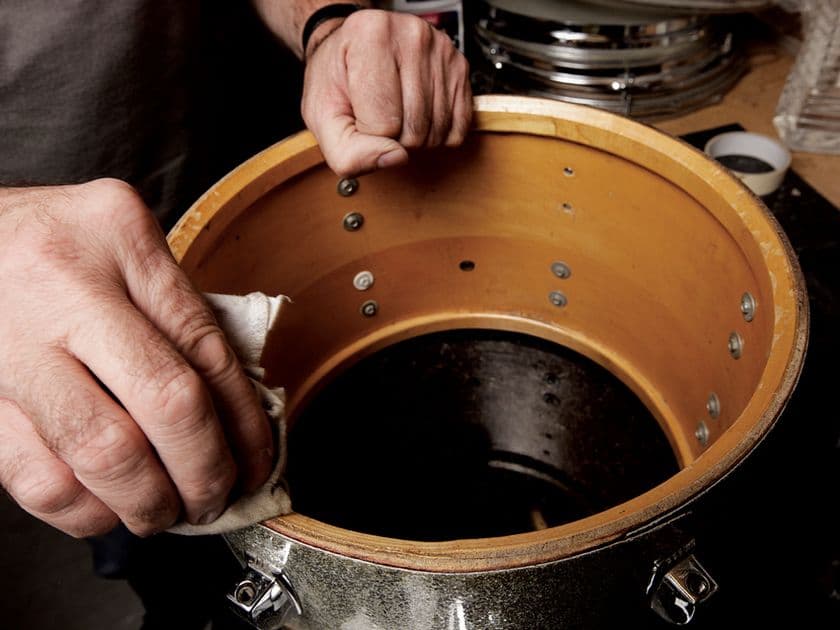
The source labels the step plainly: "2. Seat the Drumhead Properly." Follow the supplied directions: "Place the drumhead evenly on the shell and position the hoop on top." To help the head settle, "Lightly press the center of the head with your palm to help it seat evenly." This reduces uneven tension and, as the guidance states, "This step reduces uneven tension and improves tuning stability." Take your time here; an unseated head is the root of most tuning headaches.
5. Finger‑tighten the lugs
Next in the supplied sequence is "3. Finger-Tighten the Lugs." The explicit instruction: "Tighten each lug using your fingers until all rods feel equally snug. This creates a balanced starting point before using a drum key." Finger‑snug is not final tuning — it just creates an even baseline so the mechanical tuning that follows behaves predictably. If you skip finger‑tightening you’ll risk warping the head while turning the key.
6. Use a star or crisscross pattern
Follow the quoted method: "4. Use a Star or Crisscross Pattern." As the notes instruct, "Using a drum key, tighten opposite lugs gradually in a star pattern" and "Make small quarter-turn adjustments rather than large movements." The rationale is explicit: "This method distributes tension evenly across the head." One quarter turn per pass, working opposite lugs, brings the head to consistent tension far more reliably than circling the drum.
7. Match the pitch at each lug
The fragments include the heading "5. Match the Pitch at Each Lug" as the next step. Matching pitch at each lug is the practical follow‑through to even tension: use your tuner or a tuned reference and bring each lug to the same pitch so the head resonates evenly. Matching the lug pitches locks in the stability gained by seating and the star pattern, which is why this step sits where it does in the sequence.
8. Tom tuning: relationships and intervals
Under the "Tom Tuning" heading the notes advise: "Tune rack toms slightly higher than floor toms" and "Maintain musical intervals between toms." Apply that by listening for musical relationships between toms — the source emphasizes intervals rather than absolute pitches so your toms sing in context. For most kits that means a perceptible descent from rack to floor tom and tuning so fills and melodic tom parts feel intentional and connected.

9. Dampening: control when you need it
A short, explicit directive in the notes: "Use dampening if needed for control." Keep this as an on‑demand tool: add minimal dampening when a head or cymbal rings in a way that interferes with the part, and remove it when openness is required. Because the source gives no brand specifics, choose what works in your experience and apply sparingly — dampening is about control, not killing the instrument’s character.
10. Drumhead care and replacement cues
The research is clear on wear and cleaning: "Drumheads wear out gradually due to constant impact and tension." Watch for the signs: "Look for dents, stretching, or loss of tone as signs that replacement is needed." For routine hygiene, "Cleaning drumheads with a dry or slightly damp cloth removes stick residue and preserves responsiveness." Make visual inspections part of your practice session and wipe heads after heavy playing to limit grime and stick buildup.
11. Hardware maintenance and lubrication
Hardware is called out directly: "Hardware components such as tension rods, lugs, pedals, and stands should be inspected regularly." The explicit actions are: "Tighten loose screws, lubricate moving parts sparingly, and ensure pedals operate smoothly." The notes also stress maintenance impact: "Neglected hardware can cause tuning instability and performance distractions." Two sourced tones on lubrication appear in the fragments — one to "lubricate moving parts sparingly" and another warning that "Without constant lubrication, your drum kit will struggle to handle the friction and not play properly" — reconcile that by checking and applying lubrication regularly but sparingly, focusing on pivot points, cam surfaces, and tension rod threads.
12. Cymbal maintenance and mechanical care
The research reminds you: "Cymbals are delicate despite their appearance." Follow the given line: "Clean them only with products designed specifically for cymbals, and always follow the manufacturer’s instructions." Also heed the mechanical warning: "Avoid excessive tightening on stands, which can cause cracks over time." Keep felts and sleeves in good order and only finger‑tighten wing nuts during play to let the cymbal move while stopping contact damage.
13. Storage, transport and covers
Storage guidance is explicit: "Store drums in a dry, temperature-controlled environment" and "Use cases or covers during transport" while warning to "Avoid exposure to extreme heat or humidity." Drumcenternh’s phrasing reinforces the point: "When leaving your drum kit in one place for long periods, you don't want it to get dusty or greasy" and "Placing something over it when not playing can make a significant difference." Whether it’s a road case, padded bag, or even a sheet at home, protect your investment from smoke, moisture, and UV.
14. Brand note and resources (preserved lines)
The notes include promotional and branding fragments to preserve exactly as provided: "Download our app today and get early access to new products and exclusive deals." Also preserved: "Drum of Center, Protsmouth, Header Logo" and the duplicate guide title "How to Care for a Drum Set—The Ultimate Maintenance Guide." Include these lines in your resources checklist if you compile local vendor or retailer materials, but treat them as source text rather than technical advice.
15. Final maintenance reminder and forward view
Close with the maintenance truths the fragments emphasize: "Regular maintenance keeps your drum kit reliable, visually appealing, and sonically consistent." Remember that "Developing simple maintenance habits can prevent major issues over time." Put weekly checks and a head‑swap routine on your calendar — consistent attention preserves tone, prevents breakdowns, and keeps your kit ready for the next rehearsal or gig.
Know something we missed? Have a correction or additional information?
Submit a Tip