How Trump Decided to Strike Iran's Nuclear Sites Despite His VP's Warnings
Trump dined at Mar-a-Lago as B-2 bombers flew toward Iran; VP Vance, a Marine vet skeptical of the strikes, watched from the Situation Room.
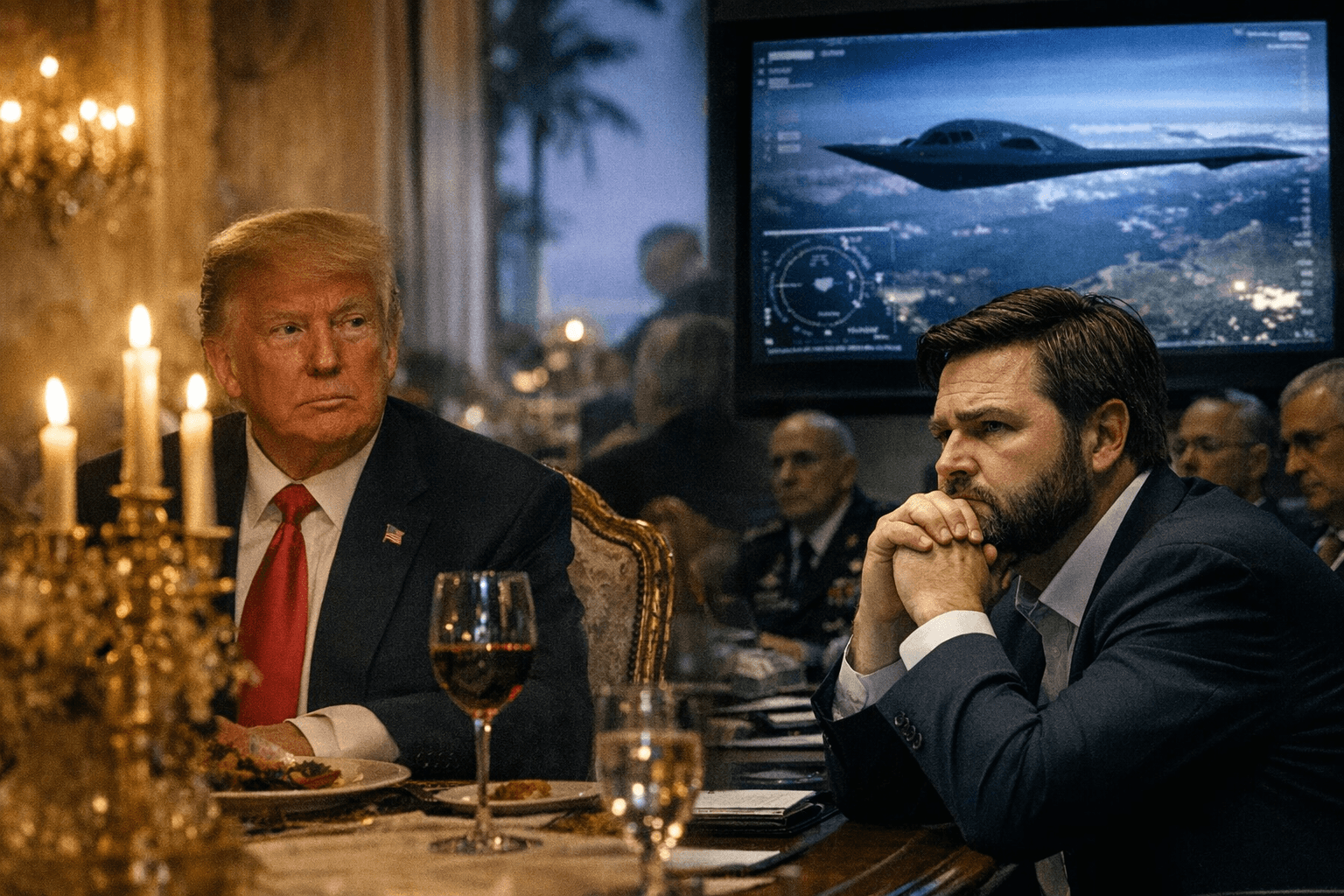
While B-2 stealth bombers carrying 30,000-pound bunker-busters crossed the midnight sky from their Missouri base toward Iran, President Trump sat at a patio table at Mar-a-Lago in Palm Beach, described by onlookers as "loose" and "easygoing." Joining him were Deputy Chief of Staff Stephen Miller, Secretary of State Marco Rubio, Special Envoy Steve Witkoff, and White House Counsel David Warrington. Conspicuously absent was Vice President J.D. Vance, who remained in the Situation Room in Washington under standard continuity-of-government protocol.
Vance, a 41-year-old Marine veteran who served in Iraq, had pushed hardest against the strikes of anyone in Trump's inner circle. He had previously said he was "misled" about the Iraq War, and his opposition to the June 21, 2025 operation reflected a genuine fear that limited bombing could snowball into a ground campaign. Vance publicly acknowledged Trump retained the ability to call off the strikes "until the very last minute," but the president elected to go ahead.
The path to that decision had begun months earlier. The second Trump administration reimposed maximum pressure on Iran from its first days, a campaign Treasury Secretary Scott Bessent called the "grand culmination" of the strategy after the Iranian currency collapsed in December 2025. On March 7, 2025, Trump wrote directly to Supreme Leader Ali Khamenei, offering nuclear negotiations while warning of military consequences if Iran refused. Iran's uranium enrichment had reached 60 percent, far beyond civilian nuclear energy thresholds. Witkoff later claimed Iran was "probably a week away from having industrial-grade bomb-making material."
A Defense Intelligence Agency assessment, kept unclassified even as strikes were ordered, concluded Iran could take until 2035 to develop a militarily viable intercontinental ballistic missile. Three unnamed American officials said Trump had exaggerated the immediacy of the threat. Congress was not consulted.
On the evening of June 21, Trump authorized strikes on Fordow, Natanz, and Isfahan. The B-2s, flying west initially as a deliberate misdirection, carried Massive Ordnance Penetrators, the largest conventional bombs in the U.S. arsenal, deployed in combat for the first time. Fordow, buried deep underground, was of particular concern to planners. A submarine launched more than two dozen Tomahawk cruise missiles at Isfahan simultaneously. Trump announced the operation on Truth Social, calling it a "very successful attack" and later declaring Iran's facilities "completely and totally obliterated."
They had not been. Gen. Dan Caine, Chairman of the Joint Chiefs of Staff, told Congress the military had focused on collapsing tunnel entrances at Isfahan rather than destroying the underlying material. Iran declared it would resume its nuclear program "without interruption," and independent assessments found core components could be back online within months.
Eight months later, Trump ordered a second, far larger campaign. At 20:38 UTC on February 28, 2026, he gave the command for Operation Epic Fury, while Israel launched its parallel offensive, Operation Roaring Lion. The opening strikes targeted the Leadership House compound. By March 2, video footage confirmed the IRGC Malek-Ashtar building in Tehran had been completely destroyed. One day before, Oman's Foreign Minister Badr Al-Busaidi had declared Iran agreed never to stockpile enriched uranium and to accept full IAEA verification, calling peace "within reach." That opening was bypassed.
Iran closed the Strait of Hormuz. Trump warned "a whole civilization will die tonight" unless Iran's leadership agreed to a deal and threatened to destroy the country's power plants and bridges. The U.S. military presence in the Middle East reached its largest level in more than two decades. American polling showed the public opposed the war. The RAND Corporation called it "a dilemma, not a debacle," a measured verdict for a conflict whose full consequences remained unresolved.
This article was produced by Prism’s automated news system from verified source data, official records, and press releases, then run through automated quality and moderation checks before publishing. The system is built and supervised by the people who set the standards it runs under. Read our full AI policy.
Did this article answer your question?


