How UK Jewellers Should Adapt to 2026's Values-Driven Engagement Buyers
UK jewellers must become partners in couples’ stories—pairing clear provenance, craft-led design and consultative sales like “propose with the diamond, then design together.”
1. Reposition your role: become a partner in the couple’s story
For many jewellers the sales model must shift from transaction to collaboration. “For me, the goal has shifted. We’ve moved beyond being just ‘suppliers.’ We’re trying to be the partners in their story,” writes Sunny Pal of Astella Jewellery. Make that language central to your shop: tell the story of makers, metals and stones, and offer workflows that let couples co-author the final ring.
2. Adopt the “propose now, design together” workflow
A concrete model buyers are already choosing is to buy the centre stone for a surprise proposal, then return as a couple to design or finish the setting. “They propose with the diamond, then return together to design the actual engagement ring. It’s the best of both worlds, the moment is a surprise, but the final ring is exactly what they both wanted.” Operationally, this requires secure stone custody, a clear provisional setting option, and clear timelines for design and remake.
3. Read the room: consultation is psychology as much as product
“Retail is mostly psychology, isn’t it? You have to watch for those moments where a consultation starts to feel heavy.” Train staff to spot the “silent partner” and the glazed look at technical grades. Use Sunny Pal’s two-lane tactic: if one partner is quiet, draw them in with a tactile prompt — “How does this engagement ring feel on your hand?” — and if GIA grades overwhelm, “stop talking product. We pivot back to romance. I’ll ask how they met or what the proposal plan is.” Remember: “People remember how you made them feel long after they've forgotten the clarity grade.”
4. Make provenance and sustainability explicit, not vague
Buyers in 2026 are “highly informed” and “values-led.” Be precise: display origin paperwork, explain whether a diamond is lab-grown or mined, list supplier certifications (GIA, IGI, Responsible Jewellery Council membership, Chain-of-Custody documentation) and declare any artisan or estate provenance you can substantiate. WhoWhatWear argues that antique and estate sourcing is pursued for “sustainability, sentimentality, and individuality,” so if you sell estate stones state the chain of custody and any refurbishment the stone has received.
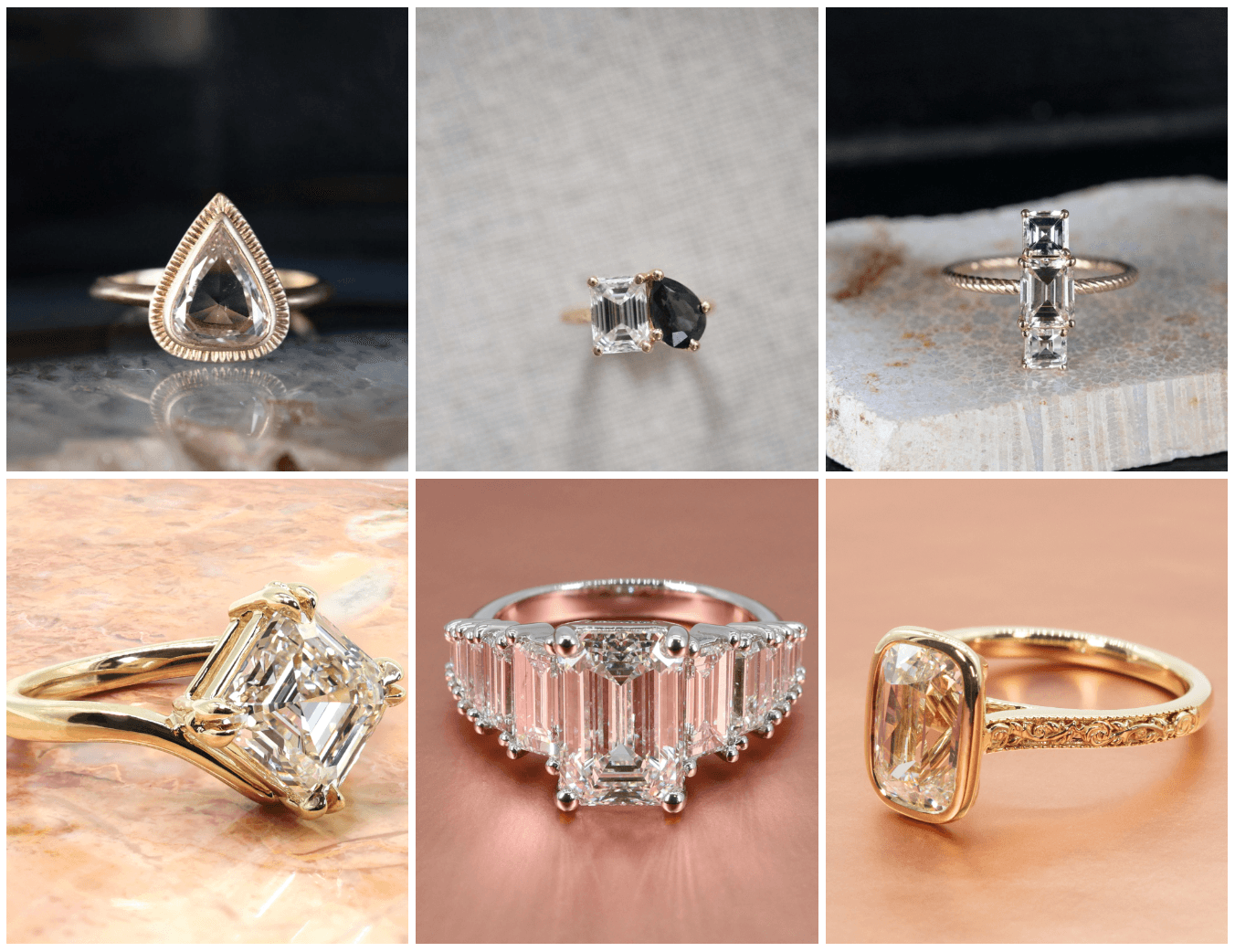
- Chunky, sculptural and cigar-style bands — think Dua Lipa’s bold cigar-style band and tension-like looks; product examples include Kinn’s Porter Cigar Band Ring Round Diamond and Marrow Fine’s The Harlow Cigar Band Engagement Ring.
- Bombé and domed silhouettes — a rounded profile described as “rounded shape catches the light beautifully.”
- Toi et Moi and asymmetric duos — Holden’s Emerald Toi Et Moi engagement ring, The Bezel Toi Et Moi and boutique custom Toi et Moi commissions such as Taylor Custom Rings’ pieces or a morganite + pink tourmaline 18K example.
- East‑west cuts and bezel re‑imagined — east‑west emerald and marquise orientations are resurging; WhoWhatWear cites a surge in east‑west bezel interest after celebrity engagements.
- Antique and heirloom cuts — Old Mine, Old European and elongated antique cushions are explicitly back, offering “candlelit sparkle” and irregular hand-cut proportions; The Clear Cut’s 1.71ct Old European and 3.68ct Old Mine pieces are examples customers now search for.
- Warm diamond palette — champagne, light yellow, honey and smoky brown diamonds are registering in demand.
5. Curate trends with named examples so shoppers can visualise
Stock and show the specific design families buyers are searching for rather than generic categories. Current, explicitly named trends include:
Naming these looks and showing specific pieces (Holden Embrace Solitaire Set, Shai Pear Solitaire with Twist Band, Frank Darling’s The Plutch XL and The Ray) helps staff match visual references to customers’ values.
6. Use jewellery craft and bespoke services as a values signal
Customers want makers who stand behind craft. Vogue’s reporting notes that buyers “are trying to align with designers whose work actually resonates with them,” and designers such as Sara Beltran of Dezso present distinct technical signatures — Beltran “never uses prong settings... long stones set horizontally, describing them as ‘modern and sexy.’” Promote maker signatures (Jessica McCormack’s silver‑topped gold mountings and old‑cut diamonds; her 2ct East‑West Emerald Cut Diamond Button Back Ring) and offer bespoke services: metal choices, hand-finishing options, and conservation of estate stones.
7. Lean into lab‑grown strategy for the “stretch effect,” but be transparent
WhoWhatWear labels the “Stretch Effect”: larger, elongated diamonds are more visible because “the adoption of lab-grown diamonds and price accessibility have made larger-than-life commonplace.” Carry clear lab-grown vs natural inventory and educate customers on optical differences, supply chain provenance, certification and long‑term value. Stock examples that demonstrate scale and price variety from Ring Concierge’s 6.59ct Oval Lab Diamond in Whisper Thin to a 10.01ct Cushion Natural Diamond for customers weighing both routes.
8. Make estate and antique sourcing a deliberate category
“Heirloom energy” is explicit: “Old is officially new again,” and many shoppers seek the irregular sparkle of antique cuts. Build a verifiable estate channel—record where stones came from, document any recutting or repolishing, and be able to show photos of prior mounts or provenance. Inventory examples to present include The Clear Cut’s 1.71ct Old European and 3.68ct Old Mine engagement rings.
9. Train teams to translate tech into story
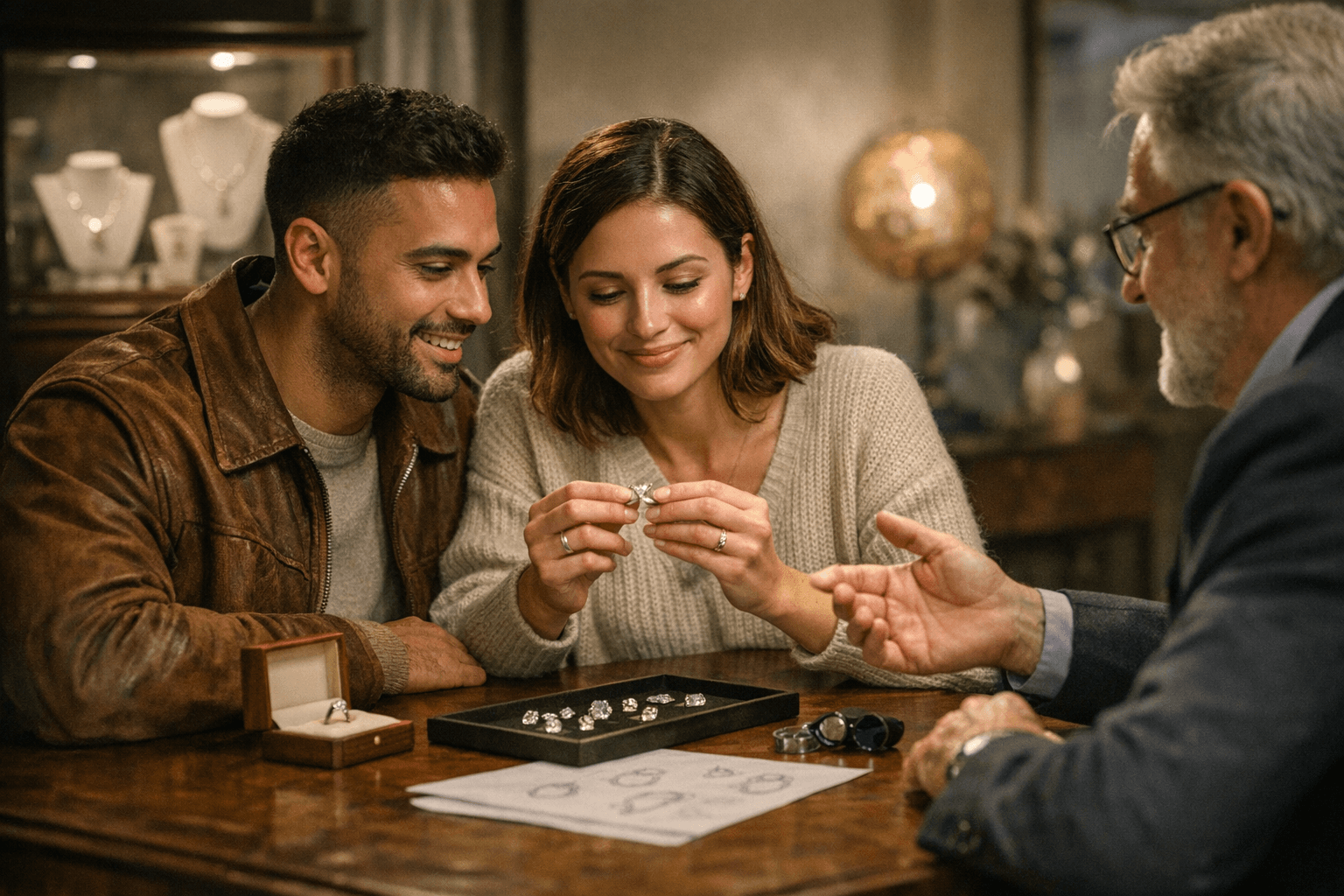
Technical grades matter to some buyers but alienate others. Use Sunny Pal’s approach: stop when “eyes glaze over at GIA grades” and pivot to narrative. Scripted questions (how they met, aesthetic references, daily wear habits) and tactile prompts (fit, profile, how a ring feels on the hand) will help staff convert curiosity into confidence without flattening the emotional experience.
10. Match merchandising to metal and setting fashions
Metals and settings are decisive signifiers: promote rose gold’s romantic warmth alongside minimalist solitaires (Hearts on Fire Vela Solitaire in white gold cited as a minimalist example), offer silver‑topped gold options (Jessica McCormack’s technique), and display bezel and east‑west settings as both modern and historically anchored. For customers drawn to bold statements, show cigar bands and bombé rings alongside delicate solitaires to explain how scale and profile change perceived intent.
11. Use celebrities and product examples as teaching tools—carefully
Celebrity moments drive searches; WhoWhatWear links 2025 engagements by Dua Lipa, Miley Cyrus and Zendaya to east‑west bezel interest, and Vogue highlights Jessica McCormack’s influence on public taste (Zendaya, Dakota Johnson). Use named examples in consults to illustrate trends, but pair them with provenance and maker context so the customer knows whether a celebrity look is vintage, bespoke or a modern reinterpretation.
12. Maintain a verification and transparency checklist before claims
Several metadata issues appear across coverage and should inform any public claims: confirm bylines (the Professional Jeweller material shows both Sunny Pal and a Harriet Whitaker byline), verify promotional claims such as Holden’s reported sitewide “10% off” before quoting it, confirm exact quote text against source pages and secure image permissions for product or celebrity photography. The supplied materials contain no hard market statistics—do not invent sales figures or percentages.
13. Offer aftercare, repair and conservation as part of the purchase
Heller Jewelers’ model is instructive: curated collections plus customization, expert services such as custom design and jewelry care, and showroom support are now baseline expectations. Explicitly present aftercare plans, lifetime sizing or refurbishment options for antique stones, and clear warranties to reinforce longevity over fast fashion.
14. Close with a clear editorial line on value
This moment rewards jewellers who marry craft, traceability and humane consultations: buyers want rings that carry character and a verified story. As Sunny Pal observes, “The landscape of our industry has shifted more in the last 24 months than in the previous decade,” and those who reframe their service to meet informed, values-led — and sometimes anxious — couples as partners will build long-term trust and relevance.
Final point: adapt operations to the “New Romance” by making provenance, personalized design workflows and emotionally intelligent sales the pillars of your engagement-ring offering; that practical integrity is what will convert curiosity into a meaningful purchase.
Know something we missed? Have a correction or additional information?
Submit a Tip