Huawei chip chief He Tingbo pushes new path beyond Moore's Law
He Tingbo’s Shanghai keynote showed Huawei betting on 381 chips built around Tau Scaling, as sanctions and Moore’s Law both push the company to reinvent its chip strategy.

He Tingbo has become the face of Huawei’s effort to build a chip strategy that can survive both U.S. sanctions and the slowdown of transistor shrinks. In Shanghai, she took the stage at the 2026 IEEE International Symposium on Circuits and Systems with a keynote on a new semiconductor path, putting a veteran Huawei engineer at the center of China’s wider drive for technological self-reliance.
He’s rise tracks Huawei’s transformation almost line by line. Huawei says she joined the company in 1996, was born in 1969, and holds degrees in semiconductor physics and communications engineering, plus a master’s degree from Beijing University of Posts and Telecommunications. When Huawei put her in charge of chip development in 2003, it backed her with a $400 million annual budget, a sign that the company was already treating semiconductors as a strategic battleground. Today, He is president of Huawei’s semiconductor business and director of its Scientist Committee, and Huawei’s governance materials place her among only two women on the company’s 17-member board.
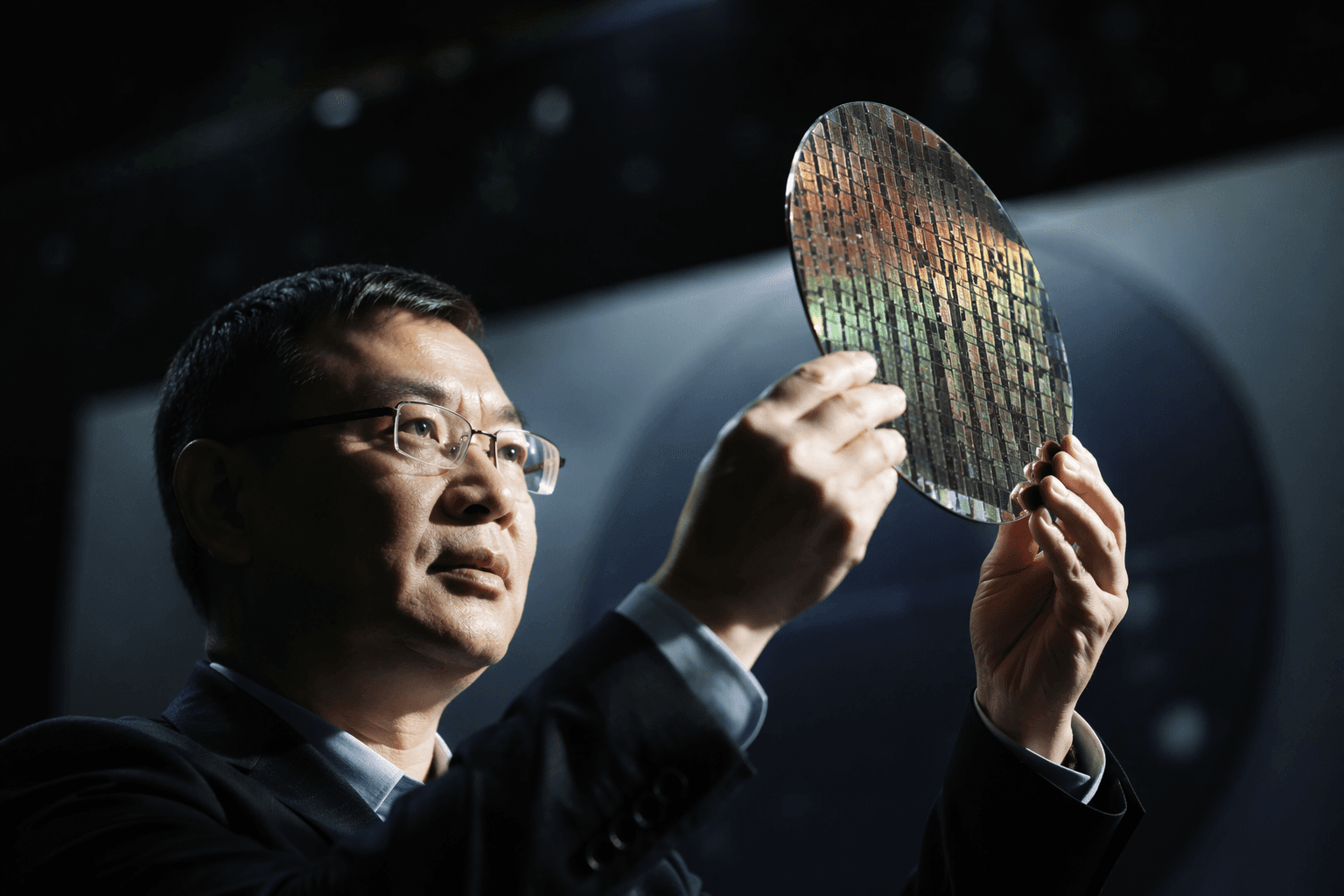
The timing of her keynote mattered as much as the message. Huawei’s ISCAS page said semiconductor scaling-down is approaching lithographic and atomic limits, weakening the historical force of Moore’s Law and Dennard’s Law. In response, Huawei has been pushing what it calls the Tau Scaling Law, a framework that shifts attention from simply shrinking components to speeding up transmission across devices, circuits, chips and computing systems. Huawei says it has spent six years working on the approach and has designed and mass-produced 381 chips based on it.
That technical pivot reflects a political one. The U.S. Commerce Department added Huawei and 68 affiliates to the Entity List effective May 16, 2019, saying the government had reasonable cause to believe the company had been involved in activities contrary to U.S. national-security or foreign-policy interests. The restrictions cut Huawei off from key foreign chip technologies and manufacturing, raising the pressure on smartphones, telecom gear and every other product line that depended on global supply chains. What had once looked like a long-term research agenda became an urgent survival strategy.
Huawei is now tying that strategy to a broader architecture called LogicFolding, with future Kirin chips scheduled for fall 2026 set to be the first to use it. The company also says a new Supervisory Board was elected in March 2026, underscoring that leadership remains in motion even as He’s profile rises. Her career now stands for both sides of Huawei’s story: the discipline of an engineer trying to overcome physical limits, and the ambition of a company that wants to prove China can still move forward when the old path closes.
Know something we missed? Have a correction or additional information?
Submit a Tip