Huawei Claims New AI Chip Outperforms Nvidia's H20 by Nearly 2.8 Times
Huawei's Atlas 350 accelerator card claims 1.56 petaflops of compute power, nearly tripling Nvidia's China-market chip on key inference tasks.
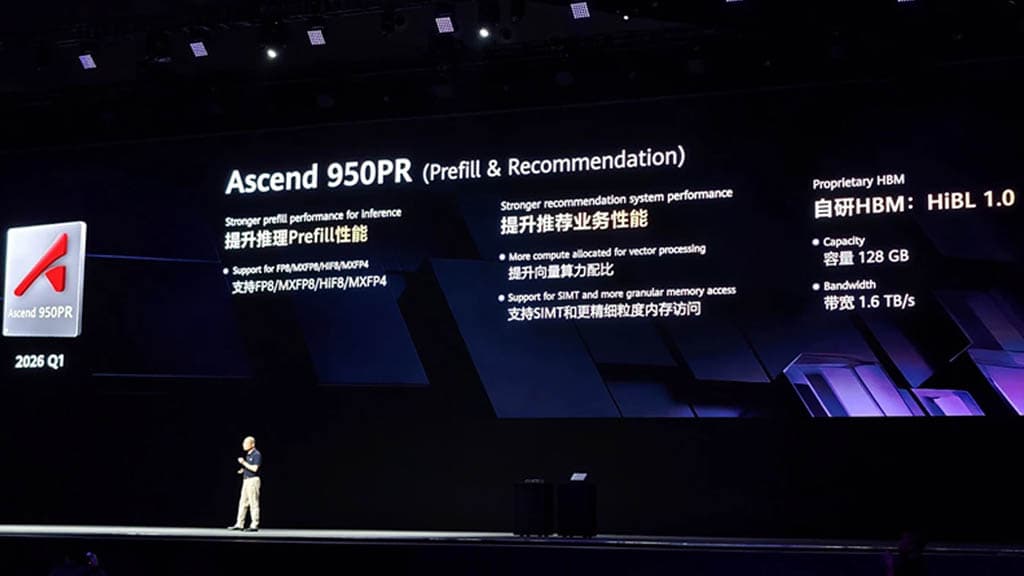
Huawei unveiled a new AI accelerator card at its China Partner Conference last week, claiming the device outperforms Nvidia's China-tailored H20 chip by nearly 2.8 times on certain inference workloads, a benchmark that, if verified, would mark a significant leap in China's domestically developed AI hardware.
The Atlas 350, powered by Huawei's Ascend 950PR processor, delivers 1.56 petaflops of computing power in the FP4 precision format, according to Zhang Dixuan, head of Huawei's Ascend computing business. FP4 is a low-precision floating-point format that enables faster data movement and lower memory usage, making it well-suited for high-throughput inference deployments rather than the numerically demanding work of model training. The card also carries up to 128 gigabytes of high-bandwidth memory, according to reporting by multiple outlets covering the announcement.
Ma Haixu, a vice-president at Huawei, said the Ascend 950PR was designed specifically to deliver enhanced computing power and storage efficiency for AI inferencing tasks, targeting workloads including search recommendation, multimodal generation, and large language model serving.
The performance comparison carries weight because the H20 is Nvidia's chip engineered to comply with U.S. export restrictions while still serving Chinese customers. Huawei's claim of a roughly 2.8-times advantage positions the Atlas 350 directly against the most capable Nvidia hardware legally available in China, a market where AI infrastructure investment is surging.
Yuan, president of Huawei's Data Storage Product Line, framed the announcement within a broader strategic vision. "While the first half of the AI era focused on computing power, the second half will be defined by data," Yuan said. "In 2026, Huawei will continue to upgrade its storage product lines and will closely work with major Chinese data infrastructure projects."
Huawei also announced plans for a FusionCybe A1000 cabinet designed to help small and medium-sized enterprises deploy AI quickly, extending the Atlas 350's reach beyond large cloud operators.
The launch fits a pattern Huawei has pursued since U.S. sanctions cut it off from advanced American chip technology. The company has leaned aggressively into self-developed semiconductors, and the Ascend line has emerged as the centerpiece of that effort. The Atlas 350 represents what Huawei positions as the mature deployment stage of the Ascend 950PR, which the company first introduced in September of last year.
The performance claims, however, come entirely from Huawei executives and have not been independently verified. No third-party benchmarks comparing the Atlas 350 against the H20 across representative workloads were available at the time of the announcement. The comparison figure itself varies slightly across outlets, reported as "2.8 times," "nearly 2.8 times," and "up to 2.8 times" depending on the source, reflecting the absence of a single standardized test methodology disclosed by Huawei.
That caveat matters. Vendor-claimed inference benchmarks frequently reflect best-case conditions on carefully selected workloads, and the gap between headline figures and real-world deployment performance can be substantial. Independent testing by customers, cloud providers, or research institutions will ultimately determine whether the Atlas 350 delivers on its numbers at scale.
What is already clear is the strategic signal: Huawei is moving from chip breakthrough to full hardware product, targeting the inference market at the precise moment Chinese enterprises are accelerating AI deployment.
This article was produced by Prism’s automated news system from verified source data, official records, and press releases, then run through automated quality and moderation checks before publishing. The system is built and supervised by the people who set the standards it runs under. Read our full AI policy.
Did this article answer your question?