Huawei touts chip breakthrough as it seeks 1.4-nm parity by 2031
Huawei says its LogicFolding design could bring 1.4-nm-equivalent chips by 2031, but analysts say density alone does not prove it can master cost, yield and scale.

Huawei used a semiconductor symposium in Shanghai to claim a fresh opening in China’s long race to blunt U.S. chip sanctions, saying a new design approach called LogicFolding would first appear in Kirin smartphone chips this fall and could carry its high-end parts to transistor density equivalent to 1.4-nanometer processes by 2031.
The pitch was framed as a manufacturing breakthrough, but independent analysts said the harder test is not whether Huawei can rearrange transistors on paper. The real question is whether the company can produce those chips at acceptable yield, power efficiency, thermal performance and cost, especially at commercial scale. Paul Triolo of DGA Group said a stacked or folded design may improve density, but does not prove Huawei has solved the full manufacturing problem that true 1.4-nm-class production requires. Neil Shah of Counterpoint Research said Huawei has been pushed toward such alternatives because it remains blocked from extreme ultraviolet lithography tools made by ASML in the Netherlands.
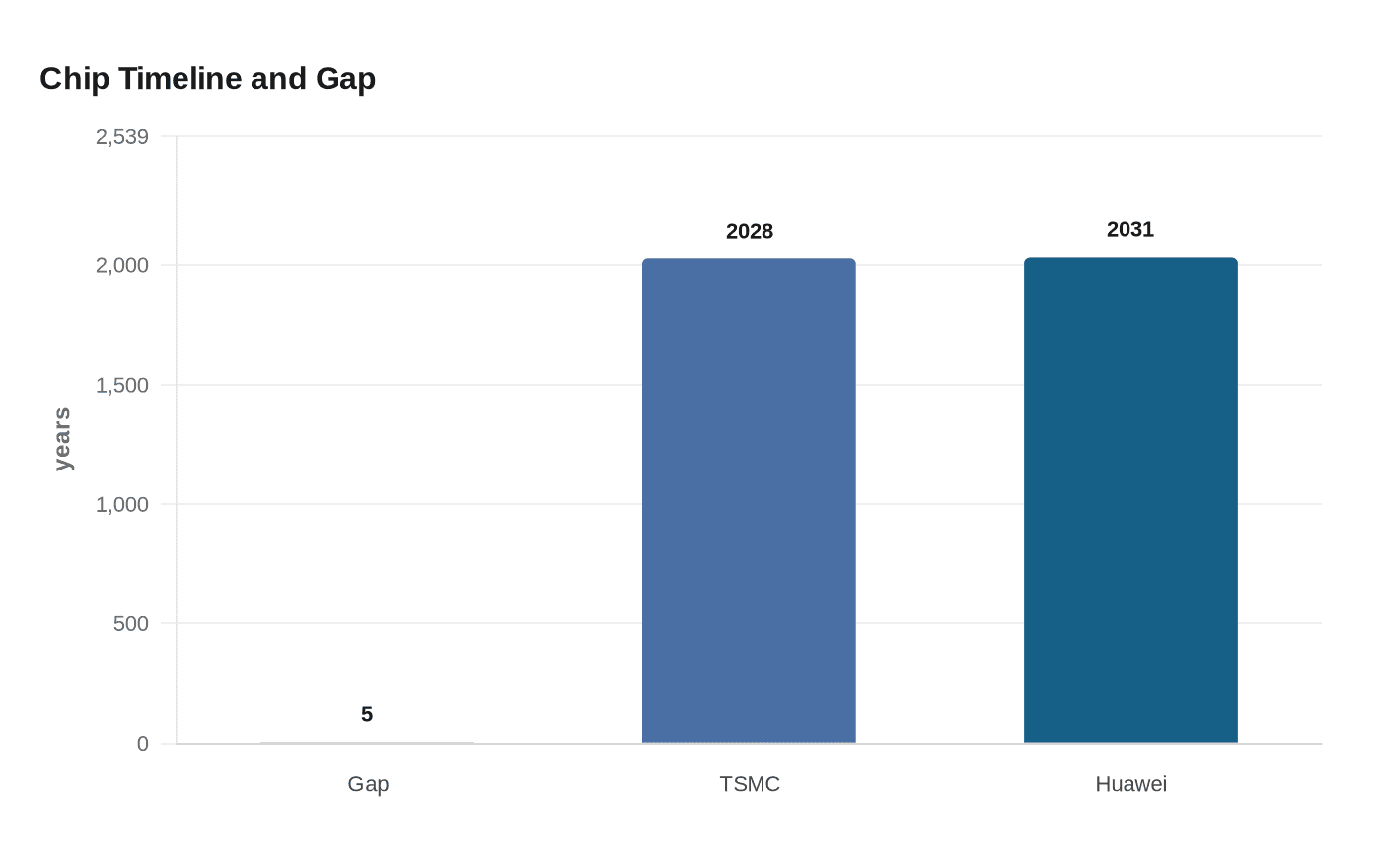
Huawei’s announcement also underscored how much the company’s chip strategy is shaped by the sanctions regime around it. The U.S. Commerce Department added Huawei to the Entity List in May 2019, sharply curbing the company’s access to U.S. components and software and helping drive China’s broader push for domestic chip self-sufficiency. Reuters-linked reporting has said Huawei and its manufacturing partner Semiconductor Manufacturing International Corp., or SMIC, are roughly five years behind Taiwan Semiconductor Manufacturing Co. in leading-edge production.
That gap still matters. TSMC is already in volume production of 2-nanometer chips and plans 1.4-nanometer mass production in 2028, three years before Huawei’s stated 2031 target. Huawei’s claimed timetable suggests it is still chasing parity rather than setting the pace.
The commercial stakes are clearest in smartphones, where Huawei’s 2023 Mate 60 launch helped the company regain market share from Apple in China. A LogicFolding rollout in Kirin chips could strengthen that recovery if it delivers better density and acceptable power use. But the same leap would have a different meaning for AI infrastructure or military systems, where sustained performance, reliability and manufacturing scale matter more than headline transistor density. The Council on Foreign Relations has argued that U.S. export controls and Huawei’s own roadmap point to a widening performance gap, with Huawei’s next-generation chip in 2026 potentially less powerful than its best chip today.
For Washington, the announcement is another reminder that sanctions can slow China’s access to frontier tools without halting the drive to work around them. For Beijing, it is a sign that the push for self-reliance is still advancing, even if the road to true parity remains measured in years, not quarters.
Know something we missed? Have a correction or additional information?
Submit a Tip