Hubble Captures 25 Years of Change Inside the Crab Nebula
Hubble compared 1999 and 2024 images of the Crab Nebula, clocking filaments racing outward at 3.4 million mph and revealing 3D shadows inside the millennium-old remnant.
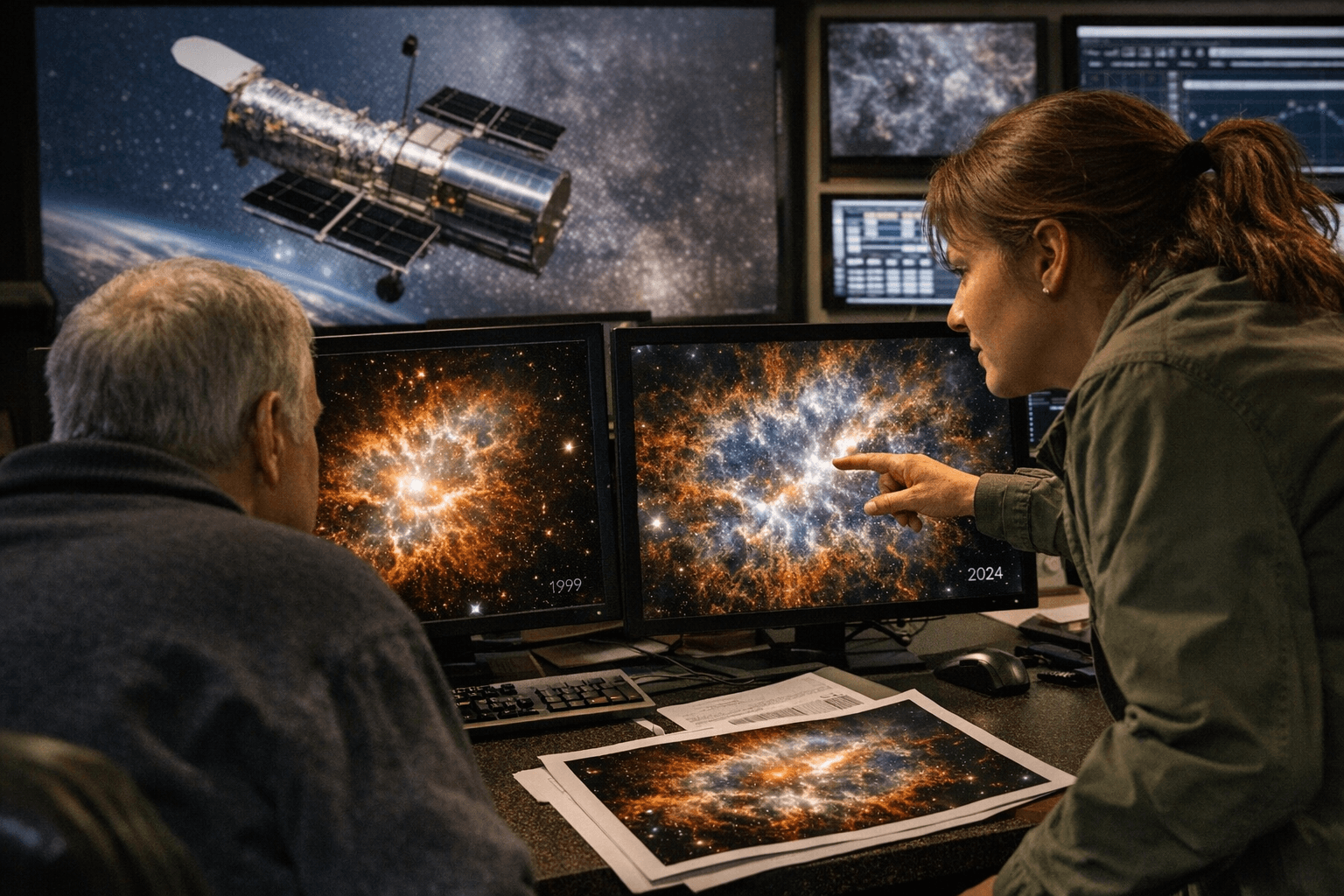
Hubble captured the Crab Nebula's intricate filamentary structure and the considerable outward movement of those filaments over 25 years, at a pace of 3.4 million miles per hour. The images, paired against a reprocessed 1999 portrait of the same remnant, show a thousand-year-old stellar corpse still violently unraveling — and doing so in ways that set it apart from almost every other supernova remnant astronomers study.
"We tend to think of the sky as being unchanging, immutable," said astronomer William Blair of Johns Hopkins University, who led the new observations. "However, with the longevity of the Hubble Space Telescope, even an object like the Crab Nebula is revealed to be in motion, still expanding from the explosion nearly a millennium ago."
The research, published in The Astrophysical Journal, uses Hubble's images to investigate how the Crab Nebula has expanded and changed over the 25 years between portraits. The paper is titled "The Crab Nebula Revisited Using HST/WFC3," and the lead author is William Blair. "Even though I've worked with Hubble quite a bit, I was still struck by the amount of detailed structure we can see and the increased resolution with the Wide Field Camera 3, as compared to 25 years ago," Blair said. Wide Field Camera 3 was installed in 2009, the last time Hubble instruments were updated by astronauts.
Blair noted that filaments around the periphery of the nebula appear to have moved more compared to those in the center, and that rather than stretching out over time, they appear to have simply moved outward. This is due to the nature of the Crab as a pulsar wind nebula powered by synchrotron radiation, which is created by the interaction between the pulsar's magnetic field and the nebula's material. In other well-known supernova remnants, the expansion is instead driven by shockwaves from the initial explosion, eroding surrounding shells of gas that the dying star previously cast off.
At the heart of that distinction is a single dense object: a rapidly spinning neutron star at the nebula's center known as the Crab Pulsar. Its magnetic field, not the violence of the original explosion, drives the Crab's continuing outward push.
The new images also yielded something unexpected in three dimensions. The higher-resolution Hubble observations provided additional insights into the 3D structure of the Crab Nebula, which can be difficult to determine from a 2D image. Shadows of some of the filaments can be seen cast onto the haze of synchrotron radiation in the nebula's interior. Counterintuitively, some of the brighter filaments in the latest Hubble images show no shadows, indicating they must be located on the far side of the nebula. Those shadow patterns give astronomers depth cues that flat imaging alone cannot provide.
For better comparison with the new image, Hubble's 1999 image of the Crab was re-processed. The variation of colors in both Hubble images shows a combination of changes in local temperature and density of the gas as well as its chemical composition. Image processing for the study was carried out by Joseph DePasquale of the Space Telescope Science Institute.
The Crab Nebula is the aftermath of SN 1054, located 6,500 light-years from Earth in the constellation Taurus. In 1054, Chinese astronomers were startled by the appearance of a new star, so bright it was the brightest object in the night sky, second only to the Moon, and was visible in broad daylight for 23 days. The supernova was also recorded by Japanese, Arabic, and Native American stargazers. The nebula's name traces to a later century: the Crab Nebula, also known as Messier 1, NGC 1952, and Taurus A, derived its label from a drawing made by Irish astronomer Lord Rosse in 1844, whose sketch of the object's tangled filaments resembled a crustacean.
According to Blair, the real value of Hubble's Crab Nebula observations is still to come. The Hubble data can be paired with recent data from other telescopes observing the Crab in different wavelengths of light. NASA's James Webb Space Telescope released its infrared-light observations of the Crab Nebula in 2024. Combining optical data from Hubble's Wide Field Camera 3 with Webb's infrared view is expected to sharpen understanding of a remnant that, nearly a millennium after the explosion that created it, has no intention of holding still.
This article was produced by Prism’s automated news system from verified source data, official records, and press releases, then run through automated quality and moderation checks before publishing. The system is built and supervised by the people who set the standards it runs under. Read our full AI policy.
Did this article answer your question?


