Hundreds Mourn Three Lebanese Killed in Israeli Strike at Funeral
Lebanon's president says all three killed were journalists; Israel says one was a Hezbollah operative in disguise. Their funeral drew hundreds.
Lebanon's president and the Israeli military could not agree on who was being buried when hundreds gathered to mourn three Lebanese media workers killed in a strike on their vehicle. Lebanon's president condemned the killings and maintained all three were journalists. Israel said at least one was a member of Hezbollah's military wing operating under journalist cover. The answer determines whether the strike constitutes a targeted military operation or a violation of international humanitarian law, which specifically protects media workers in conflict zones.
Ali Shoeib, a well-known correspondent for Al Manar TV, was killed alongside Fatima Ftouni and cameraman Mohamed Ftouni, both of the pan-Arab satellite channel Al Mayadeen, when Israeli forces struck their media vehicle, according to their employers. Al Manar TV is affiliated with Hezbollah. Both stations publicly identified their staff as among the dead. The Israeli military did not respond to requests for comment about the strike on the journalists' vehicle.
The killings fit a pattern that Lebanon's health ministry has been tracking across the country's emergency response sector. At least 42 paramedics have been killed by Israeli strikes since March 2, the ministry reported as of March 25. Four days before the journalists' funeral, colleagues wept in identical uniforms over the caskets of Ali Jaber and Joud Sleiman in Nabatieh, two paramedics struck while riding a motorcycle clearly marked as an ambulance with flashing lights on a rescue mission. "A paramedic who doesn't even have a knife, going to save someone else - they strike him and kill him. This has happened in more than one strike, more than one place," said Hassan Jaber, Ali's father and a local official. Joud's father, Mohammed Sleiman, Nabatieh's chief paramedic, accused Israel of deliberate targeting: Israel "insists on damaging, on killing, on oppressing, on terrorising - and we insist on staying."
Lebanese health officials have reported more than 1,100 people killed since the escalation began, with civilians increasingly caught in the crossfire. In the largely Shia town of Saksakiyeh, hundreds gathered for the burial of Jawad Younes, an 11-year-old, and his uncle Ragheb Younes, 41, killed when their family compound was struck. One coffin was draped in Hezbollah's yellow flag. Malak Meslmani, Jawad's mother, sat beside her son's body as she spoke to reporters: "My son is gentle and pure. He loved the idea of martyrdom, and when he grew up, he wanted to be with the resistance. He wanted to resist the enemy Israel who killed him." The Israeli military did not respond to a request for comment on the intended target of that strike.
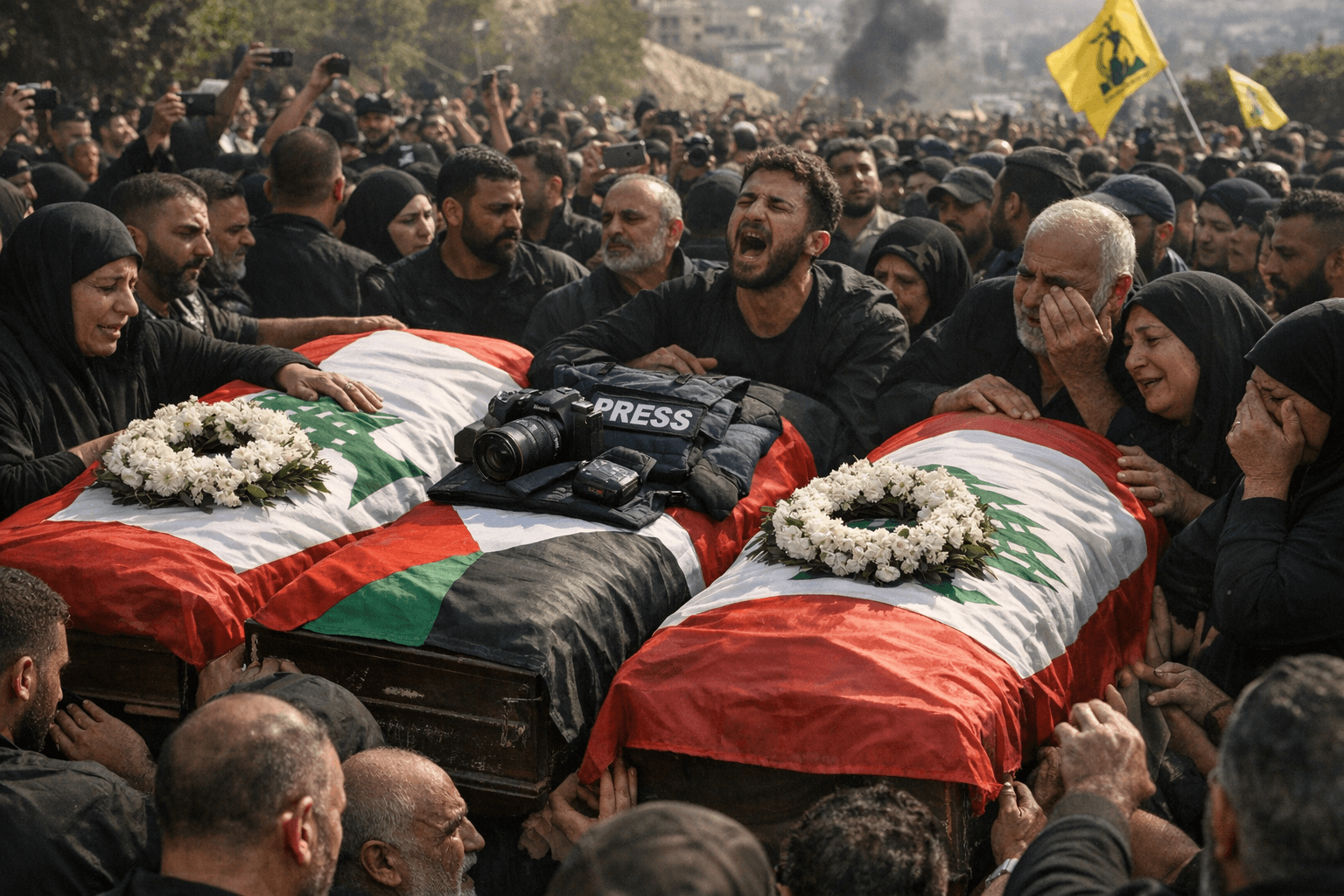
Southern Lebanon's funerals have become sites where grief sharpens into explicit political demands. At the Beirut funeral for Hamas deputy head Saleh Al Arouri, assassinated in an Israeli strike in the Lebanese capital in January 2024, mourner Mahmoud Diab, 56, gave voice to the sentiment that has since echoed at burial grounds across the south: "We are waiting for a retaliation, but everything will come in its time. We can't respond immediately. When the time comes, an important blow will be delivered."
Those calls for retaliation carry new diplomatic stakes after the journalists' deaths. With Lebanon's president publicly condemning the killings and framing the victims as press workers, the incident adds institutional pressure to an already volatile confrontation. Israel's counterclaim, offered without independent corroboration, leaves the legal and political status of the three dead unresolved precisely at the moment when border communities across southern Lebanon are absorbing the latest round of strikes and evacuation orders that have already emptied much of Nabatieh.
This article was produced by Prism’s automated news system from verified source data, official records, and press releases, then run through automated quality and moderation checks before publishing. The system is built and supervised by the people who set the standards it runs under. Read our full AI policy.
Did this article answer your question?