ICE Agent Airport Deployment Fails to Ease Ongoing Travel Disruptions
An NTSB investigator stood in a Houston TSA line for three hours while trying to reach LaGuardia's fatal crash scene, exposing the real cost of airport chaos that ICE deployment has not fixed.
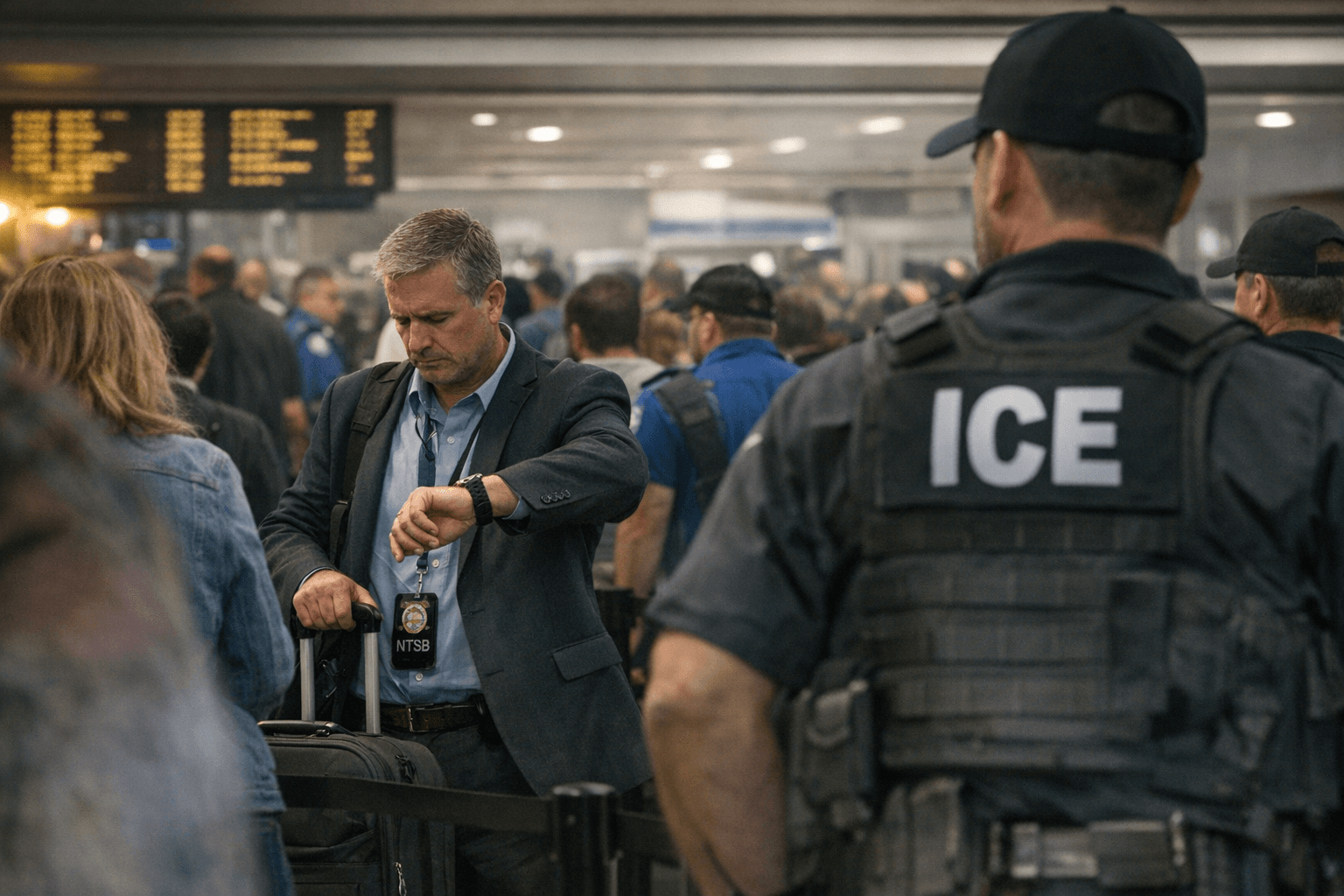
An air traffic control specialist working for the National Transportation Safety Board spent three hours trapped in a security line at Houston's George Bush Intercontinental Airport on Tuesday, unable to reach New York's LaGuardia Airport to investigate Sunday night's deadly runway collision until her agency called Houston officials and begged to get her through. Travelers at George Bush Intercontinental Airport still languished in four-hour lines Tuesday, the second consecutive day of severe disruption at the country's fourth-busiest air hub, despite the presence of federal immigration agents deployed specifically to ease the crisis.
NTSB chair Jennifer Homendy confirmed the cascade at a Tuesday news conference. "Our air traffic control specialist, who was in line with TSA for three hours until we called in Houston to beg to see if we can get her through so we can get here," she said. "So, it's been a really big challenge to get the entire team here, and they're still arriving as I speak." Lines at LaGuardia Airport in New York also stretched well over an hour, as the airport shouldered a backlog of passengers after shutting down for hours Sunday night following a deadly collision between an Air Canada plane and a fire truck.
The Houston delays came despite the airport being one of 14 airports that received ICE personnel on Monday. ICE agents deployed to George Bush Intercontinental Airport were passing out bottles of water to travelers while they waited in TSA lines as long as four hours. According to an advisory posted on the Houston Airport System's website, the wait time as of 11 a.m. local time on Tuesday was estimated to exceed four hours. On Monday, conditions were even more stark: lines reached 270 minutes in Terminal E and just over four hours in Terminal A, with only two of the airport's terminals running open security checkpoints as of 2 p.m. local time. TSA CLEAR was unavailable and PreCheck services were suspended after 10:30 a.m.
On Monday, ICE deployed hundreds of agents to 14 airports as the Trump administration sought to ease disruptions. President Trump had announced the plan over the weekend, and White House border czar Tom Homan told ABC News that agents would be directed by the TSA administrator on how they would best be used to "plug holes in security." Trump added that if ICE assistance proved insufficient, he would deploy the National Guard to airports. Both Homan and Trump stated the agents would still enforce immigration laws if they encountered violations while deployed.
TSA workers expressed concern about losing their jobs after ICE agents were deployed. The ICE agents are not trained to do security screenings and don't know the airports they are assigned to, union officials said. Hydrick Thomas, president of AFGE TSA Council 100, said flatly: "There's no way ICE can guarantee safety for the passengers." Officials maintained that ICE officers would help with administrative and support tasks, such as managing queues and assisting airport operations, and would not carry out security screenings or replace TSA officers.
The results were uneven. After seeing three-hour waits on Monday, passengers at Hartsfield-Jackson Atlanta International Airport made it through Tuesday in less than 45 minutes. At Dulles International Airport in Virginia, seven ICE agents were observed patrolling on Tuesday even though Dulles was not on the administration's initial list of 14 deployment locations. The airport's website showed normal wait times.
The root problem is a staffing crisis now in its sixth week. The DHS said that on Sunday, nearly 12 percent of TSA officers, more than 3,450 workers, did not report for duty, the highest absence rate since the shutdown began in February. Funding for the Department of Homeland Security lapsed on February 14. Because TSA officers are considered essential workers, they are expected to continue working during the shutdown even without pay, but that has led to high rates of staffers calling out, with some officers taking second jobs to pay their bills. More than 450 TSA officers have quit and more than 3,000, amounting to about 11 percent of the agency's workforce, have called out of work as of Monday, according to DHS.
ICE is not affected in the same way as TSA because it already received separate funding through a major spending law passed last year, known as Trump's "One Big Beautiful Bill Act," which gave ICE and CBP billions of dollars that do not expire for several years, meaning the agency can continue operating and paying staff even while DHS funding is blocked. Homan told reporters the deployment would expand: there "will be more" airports seeing ICE presence as long as travel disruptions persist. With Congress still deadlocked over DHS funding and spring break travel at peak volume, that warning looks less like a threat than a forecast.
This article was produced by Prism’s automated news system from verified source data, official records, and press releases, then run through automated quality and moderation checks before publishing. The system is built and supervised by the people who set the standards it runs under. Read our full AI policy.
Did this article answer your question?