ICE Agents Could Stay at Airports After TSA Workers Return From Shutdown
ICE deployed to 13 airports as over 400 TSA officers quit; Homan says their presence may outlast the government shutdown itself.

The pilot and flight attendants on a Memphis-to-Atlanta morning flight reached a shared verdict about the immigration agents now stationed at Hartsfield-Jackson below: "They're not trained to have the patience we have in this business."
That remark cuts to the central question of the ICE airport deployment that has spread across more than a dozen major U.S. travel hubs since mid-March: will the agents leave once the TSA staffing crisis ends, or has a new enforcement presence taken root at American security checkpoints?
White House border czar Tom Homan signaled the answer may not be straightforward. The decision to maintain ICE's airport presence, Homan said, would depend "in part" on whether TSA agents "come back to work," a formulation that leaves room for continued deployment even after the partial government shutdown is resolved. Homan also told reporters that Americans should prepare to see ICE at additional airports beyond those already confirmed.
The partial government shutdown began February 13, 2026, after a political stalemate over immigration policy left the Department of Homeland Security only partially funded, stripping TSA of critical manpower. The White House reported that more than 400 TSA officers had quit since the shutdown began. At Atlanta's Hartsfield-Jackson alone, more than 40 percent of TSA officers called out on a single Sunday, forcing passengers into lines exceeding three hours. Atlanta police canceled days off for some officers and assigned others to 12-hour shifts to manage the overflow.
In response, the administration deployed up to 150 ICE officers across the country in a single day, with confirmed presence at 13 airports including Atlanta's Hartsfield-Jackson, Chicago's O'Hare International, and New York's JFK. ICE officers also appeared in Houston. A senior ICE official said at least 50 ICE personnel per shift would be stationed at each airport. Unlike TSA agents working through the shutdown without pay, ICE personnel are on the federal payroll.
DHS described the deployment as an effort to "help bolster TSA efforts to keep our skies safe and minimize air travel disruptions." Homan told CNN's Dana Bash that ICE would handle tasks outside TSA's specialized domain: "We're simply there to help TSA do their job in areas that don't need their specialized expertise, such as screening through the X-ray machine. Not trained in that? We won't do that."
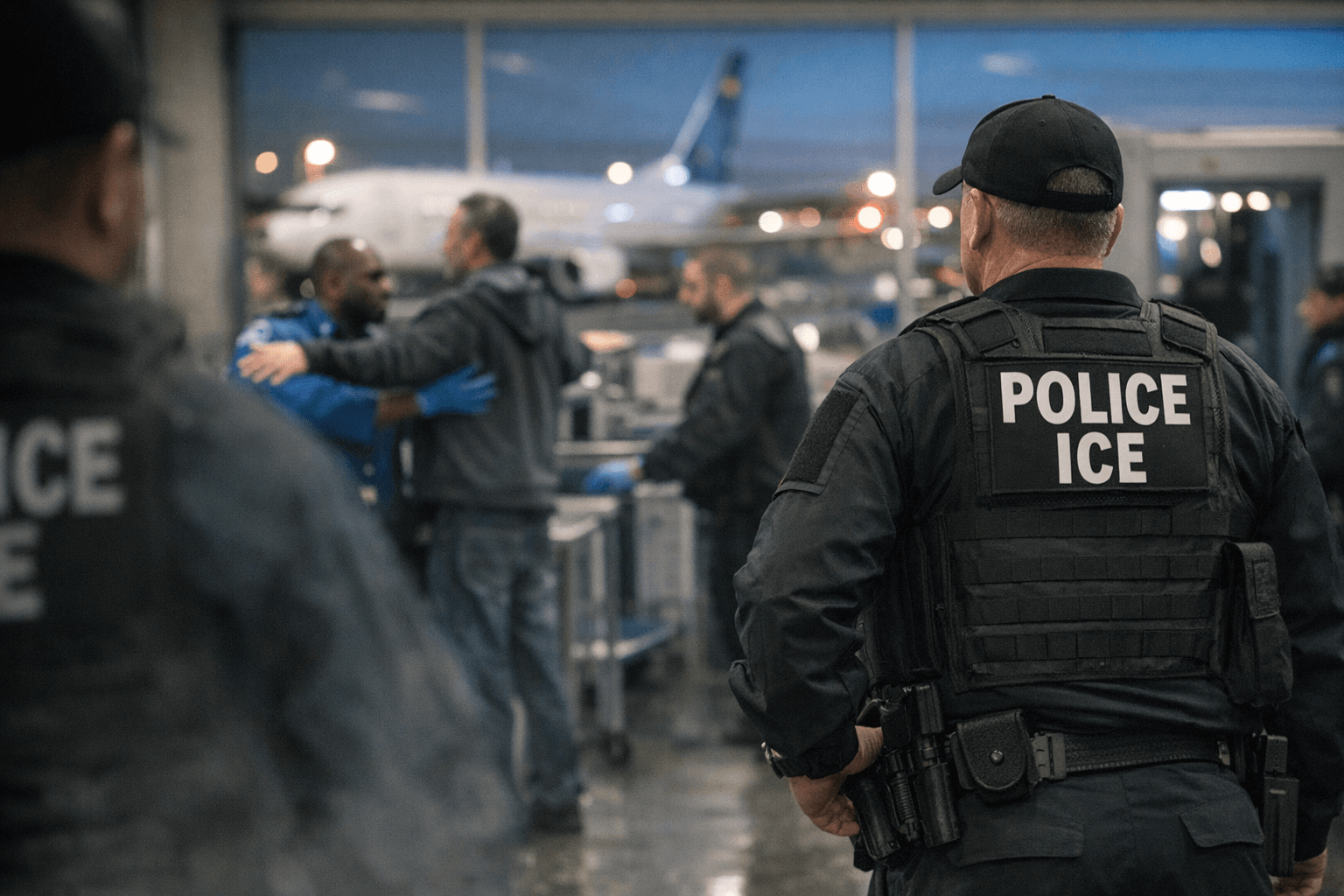
Yet what ICE was actually doing at those checkpoints became contested. A senior ICE official said agents would not perform screening duties; another confirmed they are not trained on magnetometers or X-ray machines. But Lauren Bis, DHS's acting assistant secretary for public affairs, confirmed on March 25 that after receiving "standard TSA training curriculum," ICE officers were guarding entrances and exits, assisting with logistics, doing crowd control, and "verifying identification using TSA equipment and standard operating procedures." At multiple airports, officers were observed walking through check-in areas and standing near exits, their faces mostly unmasked.
The legal basis for that expanded role is unsettled. Under Title 49 of the U.S. Code, passenger and baggage screening is technically required to be carried out by federal employees overseen by the TSA. Formalizing ICE's checkpoint role would likely require an act of Congress, and without that change, TSA remains the legally accountable agency regardless of who is posted nearby.
Everett Kelley, national president of the American Federation of Government Employees, the union representing TSA officers, was unsparing. "ICE agents are not trained or certified in aviation security," Kelley said. "TSA officers spend months learning to detect explosives, weapons, and threats specifically designed to evade detection at checkpoints. You cannot improvise that. Putting untrained personnel at security checkpoints does not fill a gap. It creates one."
No timeline for ending the ICE deployment has been announced. The question of which federal authority authorized agents to use TSA equipment at checkpoints, and what congressional or legal oversight applies to that authorization, has not been answered publicly.
This article was produced by Prism’s automated news system from verified source data, official records, and press releases, then run through automated quality and moderation checks before publishing. The system is built and supervised by the people who set the standards it runs under. Read our full AI policy.
Did this article answer your question?


