India and European Union near historic free-trade pact after decades-long talks
Multiple government sources say India and the EU moved close to finalizing a comprehensive free-trade agreement, a shift that could reshape trade and investment flows.
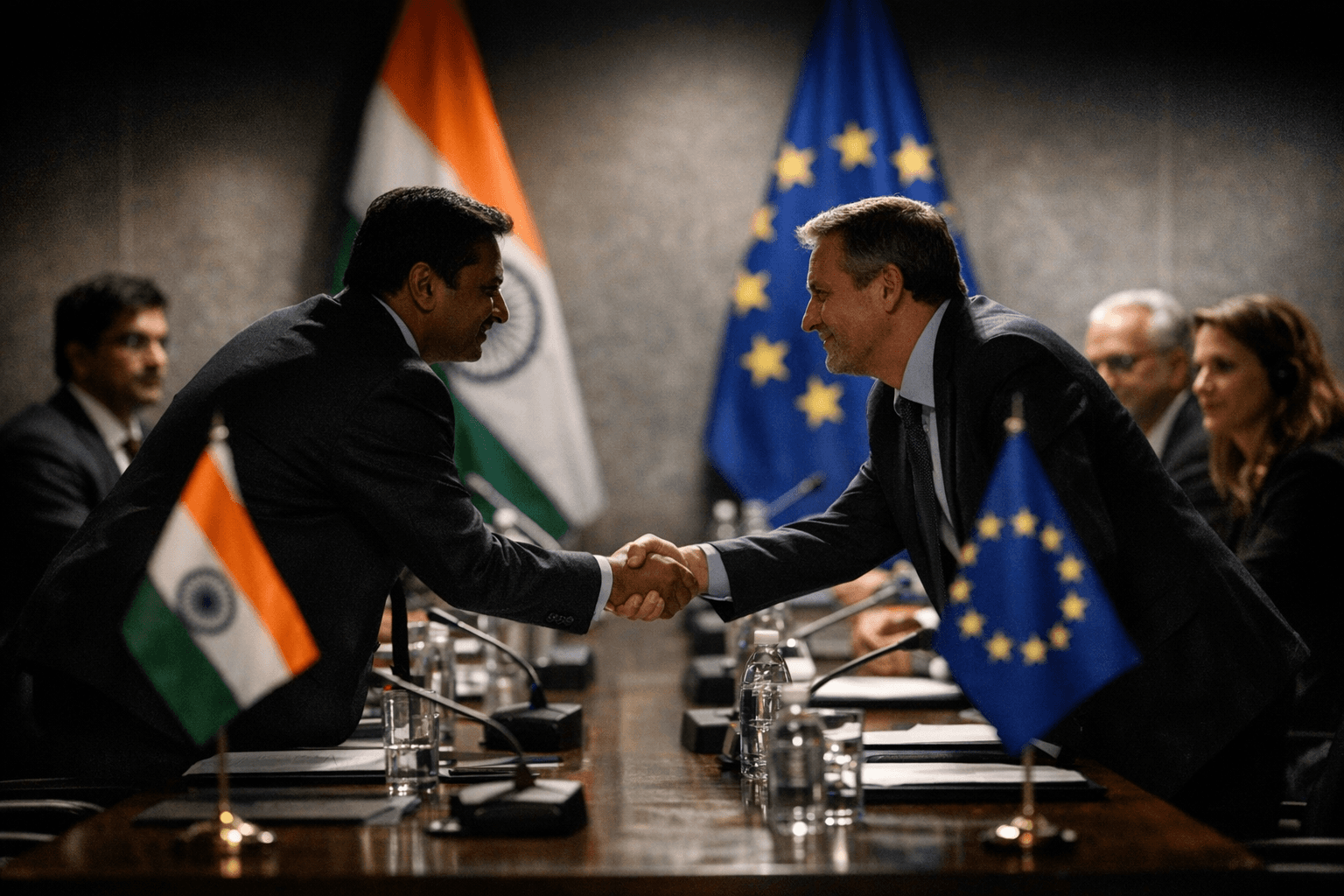
India and the European Union moved close to finalizing a long-running free-trade agreement, multiple government sources said, with officials expecting a formal announcement around the India-EU summit in New Delhi following talks on January 24, 2026. The potential accord would mark a major step in tying Asia's third-largest economy more closely to the EU single market and could alter investment and supply-chain patterns across sectors.
Negotiators have worked intermittently for nearly two decades to bridge differences on tariffs, services liberalization, public procurement and regulatory equivalence. The coming package is understood to include phased tariff cuts on industrial goods, new market access for skilled services and an investment protection framework intended to reassure European firms while addressing Indian sensitivities on tariff revenue and local industry support. Sensitive agricultural products and certain labor mobility provisions are likely to have been carved out for separate arrangements or transition periods.
Bilateral trade in goods and services has grown substantially in recent years, reaching roughly $150 billion annually, making the EU one of India’s largest trading partners. Economists estimate that a comprehensive pact could lift two-way trade by double digits within five years as tariffs fall and non-tariff barriers are reduced. For India, exporters of pharmaceuticals, information technology services, textiles and automotive components stand to gain improved access to high-income EU markets. For European firms, the agreement would ease access to India’s large domestic market and its expanding consumer base, and could accelerate investment into manufacturing and renewable energy projects.
Market implications are likely to be sector-specific. Capital is expected to move toward companies positioned to exploit tariff cuts and rules-of-origin advantages, while financial markets could reprice risk premia for cross-border investments. Foreign direct investment flows into India, which have averaged tens of billions of dollars annually, could rise if the deal includes clearer dispute-settlement and investor-protection clauses. Currency markets may see modest repositioning, with the rupee potentially appreciating on improved investment prospects over the medium term.
The agreement will not be immediate policy change. After political leaders sign a political agreement, legal teams typically produce detailed texts that require scrutiny and ratification. In the EU this means approval by the European Parliament and, depending on the text, possibly by member state legislatures. In India the centre will need to manage parliamentary scrutiny and domestic stakeholders ranging from industry associations to agricultural lobbies. Those domestic politics are a key reason why the deal has been long delayed and why implementation timelines could stretch into 2027 or later.
Strategically, the deal signals deeper economic alignment between India and the EU at a moment when both are diversifying supply chains away from overconcentration and seeking more resilient trade partners. Over the long term, a concluded pact could strengthen high-value manufacturing corridors, stimulate technology partnerships and anchor regulatory cooperation on issues from data flows to green standards. The immediate next step is technical legal work; the political announcement, if confirmed, will kick off a period of detailed drafting and ratification that will determine the speed and scale of the pact’s economic payoff.
This article was produced by Prism’s automated news system from verified source data, official records, and press releases, then run through automated quality and moderation checks before publishing. The system is built and supervised by the people who set the standards it runs under. Read our full AI policy.
Did this article answer your question?

