India Announces Assembly Election Dates Across Four States, One Territory
India's Election Commission mobilized 2.5 million officials to manage votes for 174 million eligible voters across four states and one territory, with all five counting on May 4.
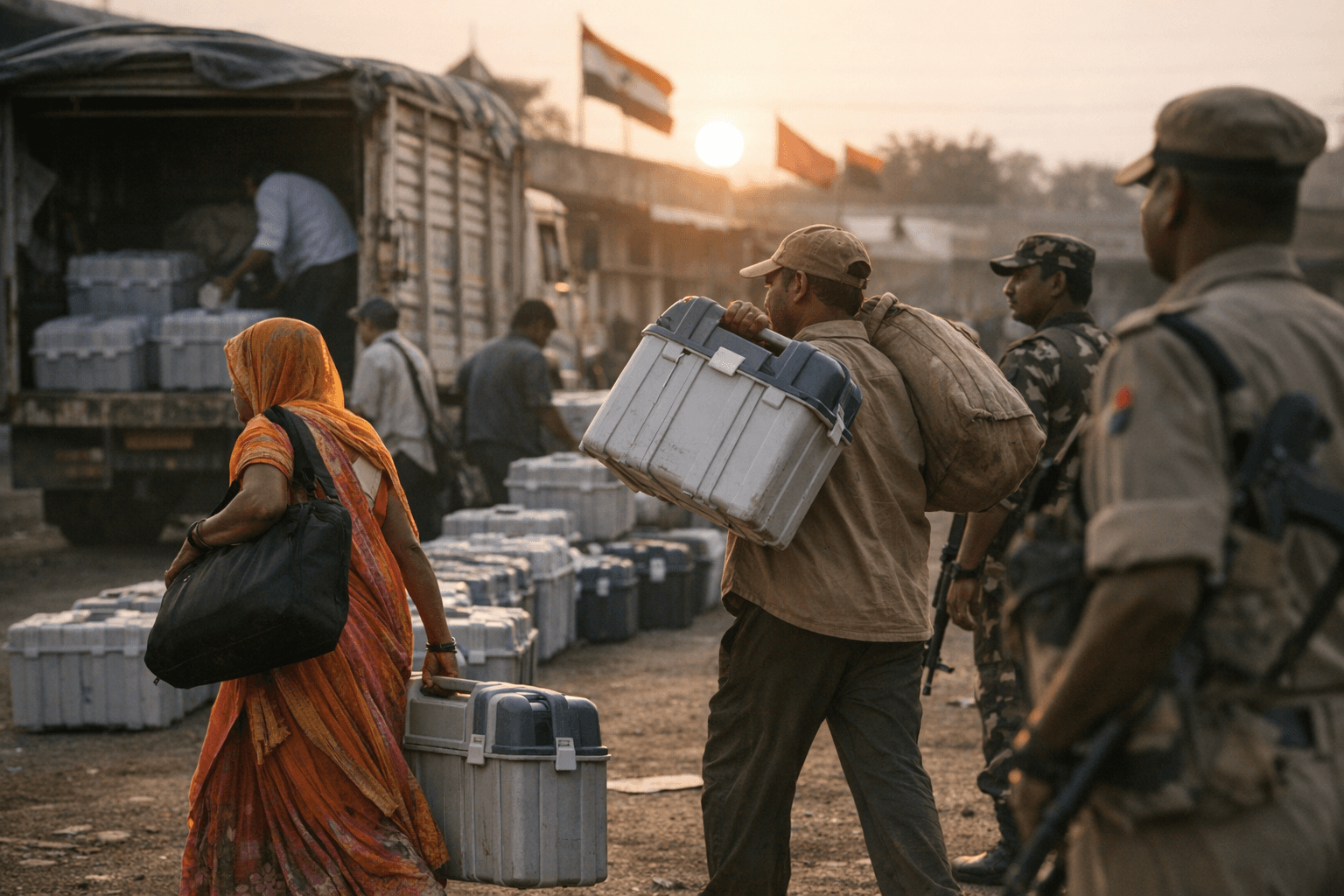
India's Election Commission set polling dates for 174 million eligible voters across 824 constituencies in four states and one union territory, mobilizing 2.5 million election officials and 219,000 polling stations for an exercise Chief Election Commissioner Gyanesh Kumar described as equivalent to managing democratic participation across multiple medium-sized countries simultaneously.
The schedule staggers voting across three windows. Assam, Kerala and Puducherry vote in a single phase on April 9. Tamil Nadu follows on April 23. West Bengal holds two rounds: April 23 and April 29. All five assemblies count on May 4.
That phased structure reflects deliberate operational logic. Spreading polling across multiple dates allows election officials to shift security forces and personnel between states, a standard Indian practice that stands in marked contrast to the American model of single-day national voting. At 219,000 stations, the sequencing is one of the largest democratic mobilizations in the world.
The voter-roll revision preceding the announcement will draw scrutiny. The commission's Special Intensive Revision produced a net reduction of nearly 1.898 million registered voters across West Bengal, Tamil Nadu, Kerala and Puducherry. Officials described the exercise as a cleanup of duplicates and outdated records. In West Bengal, where roll disputes have historically served as credibility flashpoints for opposition parties, a large-scale net removal of names will invite close examination by party monitors and election observers before April 9.
Campaigning was in full swing on April 1 when the schedule was confirmed. Congress leader Priyanka Gandhi Vadra, in Assam, argued the country was absorbing the West Asia crisis's economic fallout faster than peer economies because of what she called "faulty" central government policies. Prime Minister Narendra Modi, also in Assam, made the BJP's case on welfare delivery and fulfilled commitments, telling supporters the party sought a third consecutive term in the state and renewing pledges on housing and tribal cultural protections.

The five regions present sharply distinct political conditions: Tamil Nadu's entrenched regional-party system, West Bengal's intense binary rivalry, Kerala's layered alliance politics among a high-literacy electorate, and Assam's mix of identity and development priorities. May 4's simultaneous count will serve as an early barometer of whether national pressures like inflation and foreign-policy shocks are pulling state-level races, or whether local governance records hold as the primary driver. For the Indian-American diaspora with deep roots across these regions, and for U.S. policymakers watching India's alignment on trade and China strategy, the results will carry weight well beyond the five state capitals.
This article was produced by Prism’s automated news system from verified source data, official records, and press releases, then run through automated quality and moderation checks before publishing. The system is built and supervised by the people who set the standards it runs under. Read our full AI policy.
Did this article answer your question?

