India's 2027 Census Will Reshape Power, Policy, and Caste Representation
India's first caste count since 1931 will trigger a chain reaction: redrawn parliamentary maps, unlocked women's seats, and overhauled welfare quotas that could shift power between north and south.
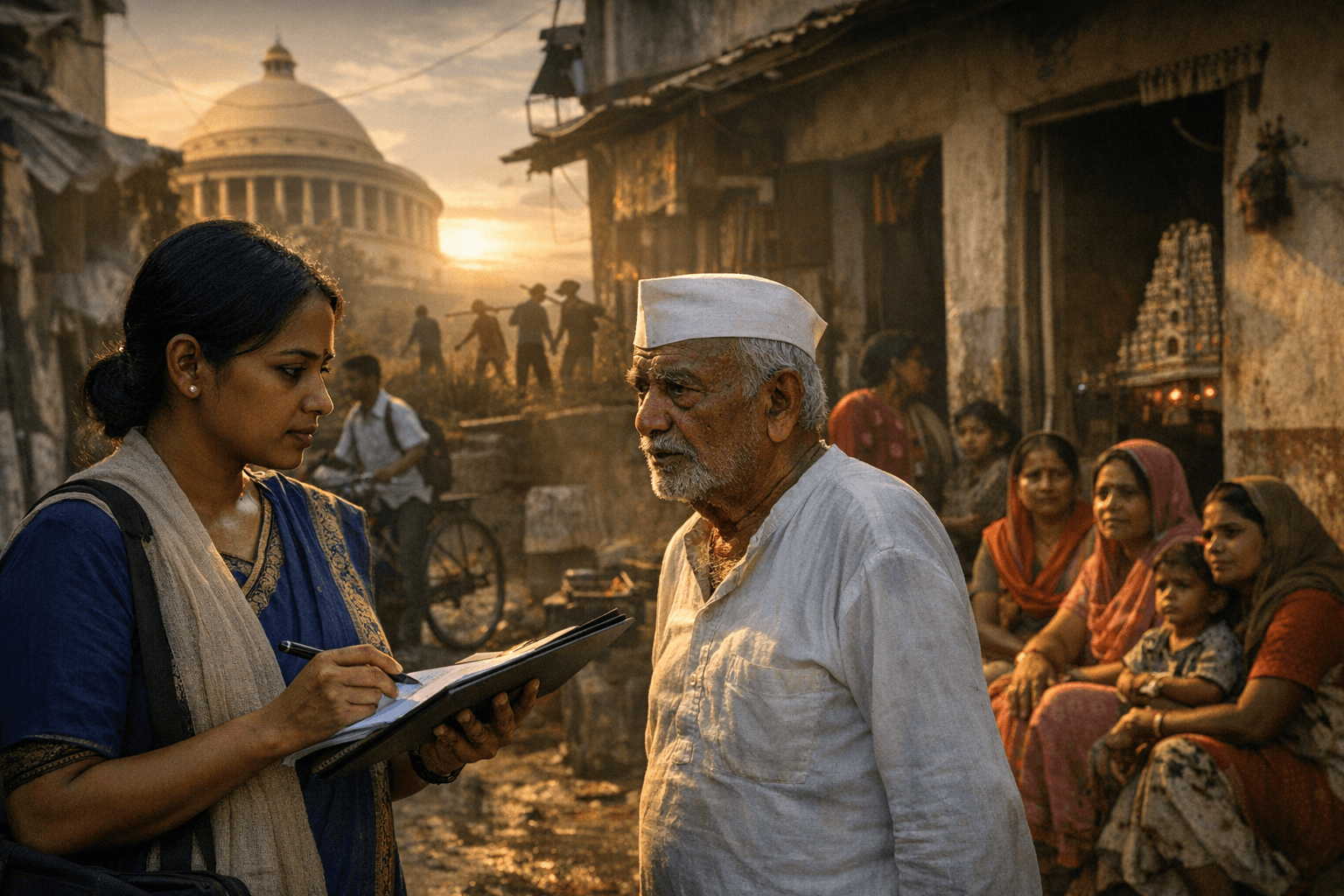
Sixteen years of governance running on stale data ends the moment the first enumerator knocks on a door. India's 16th census, delayed from its original 2021 schedule by the COVID-19 pandemic, the first interruption in a counting cycle that stretches back to 1872, formally began its house-listing phase on April 1, 2026. The population enumeration follows in February 2027. What emerges from that count will not simply update a demographic ledger. It will set off a chain reaction: redrawn parliamentary maps, newly unlocked seats for women, overhauled welfare quotas, and a north-south power struggle that has been quietly building for decades.
A Census Built for the Digital Age
For the first time in India's history, the count will be conducted entirely through digital tools. Registrar General and Census Commissioner Mritunjay Kumar Narayan confirmed that over 3 million enumerators, supervisors, and officials will collect data via mobile applications rather than paper forms. Citizens will also be able to self-enumerate through a web portal, a participatory feature that marks a significant shift in how the state gathers information about itself.
The operation unfolds in two phases. The first, running from April through September 2026, asks each household 31 questions covering building materials, access to drinking water, sanitation, household assets, and cooking fuel. The second phase, in February 2027, conducts the actual headcount using a 33-question questionnaire with a reference date of March 1, 2027. Snow-bound Himalayan regions, including Ladakh and parts of Himachal Pradesh, Jammu and Kashmir, and Uttarakhand, begin enumeration earlier, from September 2026.
The digital pivot promises faster data processing and release, but it introduces serious equity concerns. According to the National Family Health Survey (2021-22), only 57% of rural households had internet access, compared to 80% in urban areas. Counting migrants and slum populations, communities already prone to undercounting in paper-based exercises, requires enumerators to physically reach households without connectivity. The government has committed to end-to-end encryption and strict access controls under the Census Act, 1948, framing census data as statistical rather than surveillance material. Whether that assurance holds as sensitive caste and socioeconomic data moves into digital storage will depend on implementation, not just intent.
The Caste Question Returns After 94 Years
No single decision embedded in Census 2027 carries more political voltage than the inclusion of caste enumeration. The Cabinet Committee on Political Affairs approved the measure in April 2025. When the count is complete, it will mark the first comprehensive nationwide caste enumeration since 1931, nearly a century after the last one. Scheduled Castes and Scheduled Tribes have always been counted, but data on Other Backward Classes, the vast and politically decisive middle tier of India's caste architecture, has never been collected at national scale since independence.
The consequences of that absence are measurable. India's current 27% OBC reservation quota rests on figures from the 1931 census. According to submissions made by the central government to the Justice G. Rohini Commission, just 10 OBC castes were cornering a dominant share of reservation benefits, while 37% of OBC castes received nothing at all. State-level surveys in Bihar, Karnataka, and Telangana have already revealed substantial OBC and Extremely Backward Class populations, generating momentum for a national reckoning.
The 2027 caste data is expected to be a raw catalogue of castes rather than a pre-sorted categorisation into umbrella groups. That distinction matters: it will give policymakers, courts, and communities the granular information needed to challenge or restructure the 27% quota, to identify which sub-groups within OBCs have been effectively excluded, and potentially to mount legal challenges to the Supreme Court's longstanding 50% cap on caste-based reservations. The Supreme Court's recent endorsement of sub-classification within Scheduled Caste and Scheduled Tribe reservations, allowing more targeted allocation within these categories, adds another layer of complexity that fresh data will directly feed.
Delimitation: The Frozen Clock Starts Ticking
The most structurally consequential outcome of Census 2027 is the delimitation exercise it triggers. Under Articles 81 and 82 of the Constitution, parliamentary constituencies must be redrawn after every census. That process has been effectively paused since the 1971 census. The 42nd Amendment, passed during the Emergency, froze seat allocation to protect states that had invested in family planning and education; the Vajpayee government extended that freeze through 2026 via the 84th Amendment. India's 543 Lok Sabha seats, the number that has defined its Parliament, have not changed since 1976.
Census 2027 marks the constitutional deadline for lifting that freeze, and the numbers underneath it reveal why the exercise is so politically charged. An MP from Uttar Pradesh currently represents approximately 3 million constituents. An MP from Tamil Nadu represents roughly 1.8 million. That disparity exists because northern states grew faster while southern states successfully implemented population control. A straightforward reallocation of the existing 543 seats based on updated population data would hand northern states like Uttar Pradesh and Bihar an estimated 31 additional seats while southern states like Tamil Nadu and Kerala could lose as many as 26. Tamil Nadu's chief minister is among the state leaders who have publicly framed this as penalizing success.
One proposed solution is to expand the Lok Sabha from 543 to 816 seats, a 50% increase that would allow proportional state weightage to remain roughly constant. That would require amending Article 81, which currently caps the house at 550, demanding a two-thirds parliamentary majority. Even with political will, census data may not be fully processed and released before 2028, making a completed delimitation before 2031 or 2032 highly unlikely.
Women's Representation Locked Behind the Same Gate
The 106th Constitutional Amendment, passed in September 2023 with 454 votes in favour in the Lok Sabha, reserves one-third of parliamentary and state assembly seats for women. It was the culmination of a legislative effort that had been stalled for 27 years. There is one catch: implementation is contingent on delimitation being completed.
In an 816-seat Lok Sabha, one-third translates to approximately 273 reserved seats. The political logic embedded in the expansion proposal is deliberate: reserved seats would be drawn from newly created constituencies rather than existing ones, so no sitting MP would be displaced. That design reduces resistance, but it also means women's reservation in Parliament is unlikely to be implemented before the 2034 general elections, given the chain of steps still required.
What Gets Measured, What Gets Missed
The 16-year gap since 2011 has left India's planning architecture running on assumptions. Urban agglomerations have sprawled, slum populations have swelled, and internal migration has reshaped the demographic geography of major cities in ways that no current dataset captures accurately. Government schemes, from the Mahatma Gandhi National Rural Employment Guarantee Act to the National Food Security Act, have been allocating resources on population figures that no longer reflect the country's actual distribution.
The 2027 census will expose that misalignment. It will reveal the true extent of urbanization, map migration corridors, and provide a baseline for intersectional analysis that overlays caste identity with literacy, income, occupation, and housing conditions. That combination, demographic weight crossed with socioeconomic status, is what transforms a headcount into a policy instrument.
The headcount beginning now is, in that sense, a negotiation conducted at national scale: over who counts, how they count, and what the numbers will ultimately cost. The results will arrive in stages through 2028 and beyond, and the political tremors they trigger may define India's legislative and social landscape well past the next decade.
This article was produced by Prism’s automated news system from verified source data, official records, and press releases, then run through automated quality and moderation checks before publishing. The system is built and supervised by the people who set the standards it runs under. Read our full AI policy.
Did this article answer your question?